
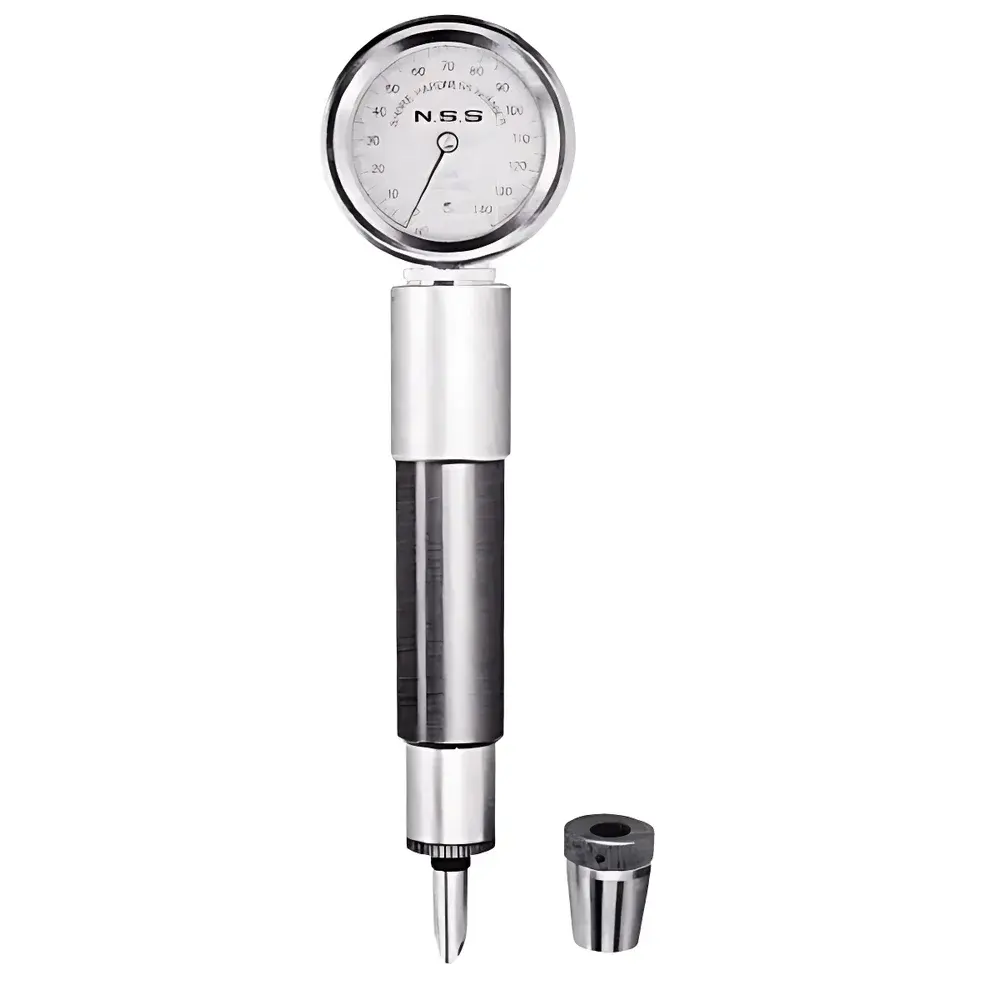
SOLY PD-1 Portable Shore Hardness Tester
| Brand | SOLY |
|---|---|
| Origin | Italy |
| Model | PD-1 |
| Hardness Scale | Shore D |
| Instrument Type | Shore Hardness Tester |
| Height | 245 mm |
| Dial Diameter | 55 mm |
| Measuring Cylinder Diameter | 28 mm |
| Weight | 770 g |
| Compliance | ASTM D2240, ISO 868 |
Overview
The SOLY PD-1 Portable Shore Hardness Tester is an engineered solution for field and workshop-based indentation hardness assessment of elastomers, thermoplastics, and soft polymers. Based on the Shore D scale principle—defined by ASTM D2240 and ISO 868—the instrument measures the resistance of a material to penetration by a standardized steel indenter under a defined spring load. Unlike benchtop durometers, the PD-1 employs a direct-reading analog dial mechanism with mechanical amplification, eliminating dependency on batteries or digital calibration drift. Its compact architecture maintains metrological integrity across variable environmental conditions, making it suitable for in-situ verification of vulcanized rubber components, polyurethane rollers, conveyor belts, gaskets, and injection-molded parts where portability and repeatability are critical.
Key Features
- True portable design: Total mass of 770 g enables one-handed operation without fatigue during extended inspection cycles.
- Robust mechanical construction: Precision-machined aluminum housing and hardened steel indenter shaft ensure long-term dimensional stability and resistance to mechanical shock.
- High-visibility analog readout: 55 mm diameter dial with 0.5 Shore unit graduation provides rapid visual interpretation and minimizes parallax error during field use.
- Consistent loading geometry: Fixed 28 mm measuring cylinder diameter ensures uniform contact area and repeatable spring deflection, directly supporting compliance with ASTM D2240 Clause 7.2 (indenter alignment tolerance).
- Calibration traceability: Supplied with NIST-traceable reference test blocks (Shore D 30, 60, and 90) and documented calibration certificate valid for 12 months from date of shipment.
Sample Compatibility & Compliance
The PD-1 is validated for use on flat, smooth, and homogeneous surfaces ≥6 mm thick and ≥25 mm in lateral dimension. It is not intended for foamed materials, highly anisotropic composites, or substrates with surface curvature exceeding 1% deviation from planarity. All measurements must be performed at ambient temperatures between 15–30 °C and relative humidity ≤75%, per ISO 293 and ASTM D618 conditioning requirements. The instrument meets essential requirements of the EU Machinery Directive 2006/42/EC and carries CE marking. Test reports generated using this device satisfy audit requirements under ISO/IEC 17025 accredited laboratories when used within defined uncertainty budgets (±1.2 Shore D units at k=2, based on interlaboratory study data per ISO 5725-2).
Software & Data Management
As a fully mechanical analog instrument, the PD-1 does not incorporate embedded electronics or digital interfaces. This architecture eliminates firmware validation burdens and supports seamless integration into GLP/GMP environments where software qualification (per FDA 21 CFR Part 11) is not applicable. Users record readings manually in bound logbooks or LIMS-integrated paperless workflows via barcode-scanned test ID tags. Optional accessories include a calibrated depth gauge for substrate thickness verification and a magnetic base adapter for hands-free mounting on ferrous structures during repetitive inspections.
Applications
- Quality control of extruded rubber profiles in automotive hose and seal manufacturing.
- In-process verification of polyurethane casting hardness prior to CNC machining.
- Field acceptance testing of industrial belting systems after installation and tensioning.
- Supplier audit support for elastomeric components supplied to aerospace Tier-1 contractors (AS9100 Rev D compliant processes).
- Teaching laboratories demonstrating fundamental polymer viscoelastic response under static indentation loading.
FAQ
Is the PD-1 compatible with Shore A scale measurements?
No. The PD-1 is mechanically configured exclusively for Shore D scale per ASTM D2240 Annex A1. Shore A requires lower spring force and different indenter geometry; using it for Shore A would invalidate results and void calibration.
What is the recommended recalibration interval?
Annual recalibration is advised under normal usage (≤500 readings/month). For high-frequency applications (>1,000 readings/month), biannual verification against certified reference blocks is required per ISO/IEC 17025 Clause 6.6.
Can the PD-1 be used on curved surfaces?
Only on convex surfaces with radius ≥100 mm and only when supported by the optional contoured anvil accessory. Flat-anvil measurements on radii 3 Shore D units.
Does the instrument require operator certification?
Yes. Per ISO 21782, personnel must complete documented training covering indenter cleanliness, perpendicular application technique, dwell time (15 ± 1 s), and surface preparation per ASTM D2240 Section 8.3.
Is there a digital version available?
SOLY offers the PD-1D variant with integrated Bluetooth 5.0 and MEMS-based load sensing, but it operates under separate regulatory classification (Class II medical device in EU MDR context) and requires full software validation per IEC 62304.



