
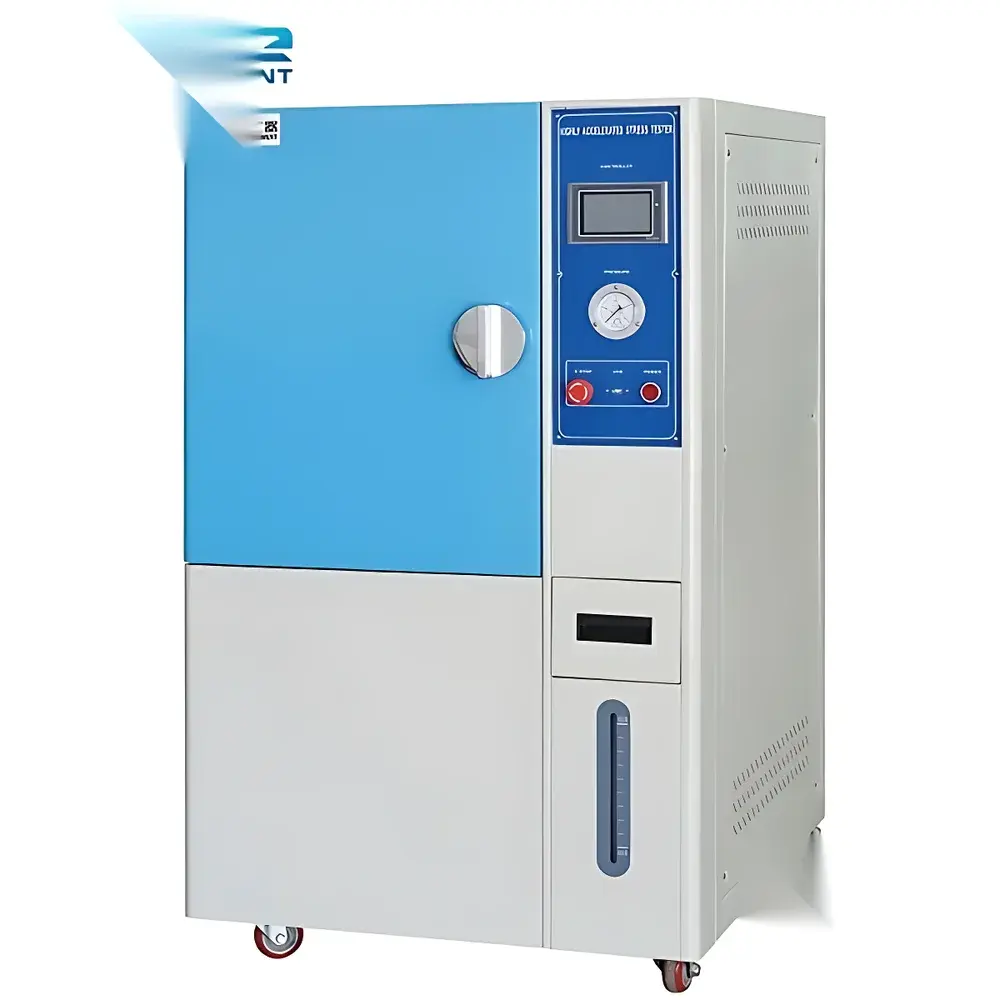
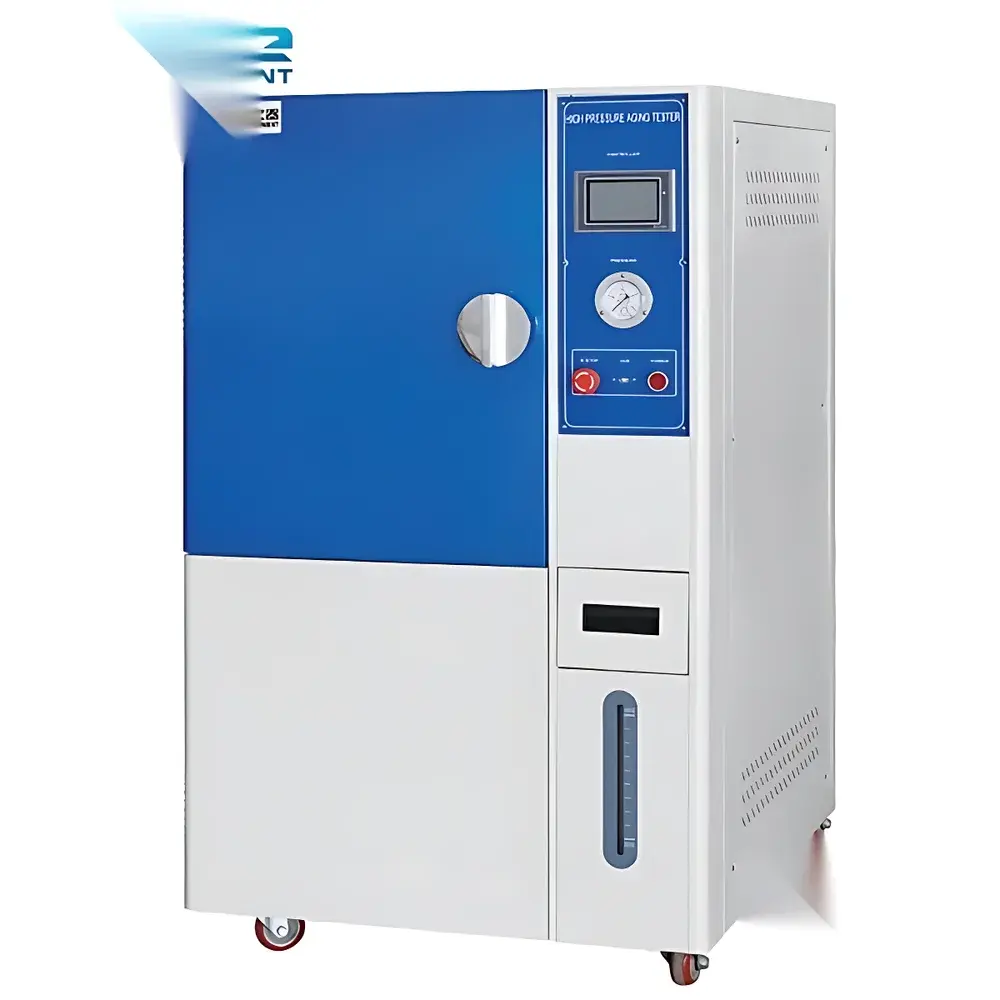
Saturated Steam Life Test Chamber
No specifications available.
Overview
The Saturated Steam Life Test Chamber is an environmental stress screening (ESS) system engineered for accelerated reliability testing of electronic components, printed circuit assemblies (PCAs), and hermetic packaging under controlled saturated steam conditions. It operates on the fundamental principle of exposing test specimens to precisely regulated temperature, pressure, and 100% relative humidity (RH) environments—mimicking high-temperature, high-humidity aging mechanisms such as moisture diffusion, intermetallic growth, and corrosion-induced failure modes. Unlike legacy systems relying on indirect vapor-pressure interpolation or psychrometric estimation, this chamber employs direct, real-time sensing of temperature (via calibrated Pt100 RTDs), absolute pressure (using traceable piezoresistive transducers), and saturation state (confirmed via dew-point equivalence at 100% RH)—ensuring metrological traceability and eliminating calculation-based uncertainty in critical life-cycle modeling.
Key Features
- Triple-tier configurable chamber volumes: Φ25 × 35 cm, Φ30 × 45 cm, Φ40 × 55 cm, and Φ50 × 60 cm internal dimensions—enabling scalability from component-level qualification to board-level HALT/HASS protocols.
- Operating range: 105–132°C, 105–142.9°C, and 105–155°C; corresponding gauge pressure ranges: +0.2–2.0 kg/cm², +0.2–3.0 kg/cm², and +0.2–3.5 kg/cm²—fully compliant with JEDEC JESD22-A108, MIL-STD-883 Method 1008, and IEC 60068-2-66 test profiles.
- True saturated steam control: Maintains 100% RH at all operating temperatures without supplemental humidification—eliminating condensate pooling and ensuring uniform vapor-phase exposure across the test load.
- HAST-6890 intelligent controller with dual-language (English/Chinese) UI, USB 2.0 host port, and RS-232C serial interface for real-time data logging, curve export (CSV), and remote monitoring integration.
- High-fidelity resolution: ±0.1°C temperature, ±0.1% RH (at saturation), ±0.1 kg/cm² pressure—validated per ISO/IEC 17025-accredited calibration procedures.
- Thermal and humidity uniformity: ±0.5°C / ±5% RH across working volume—verified using NIST-traceable multi-point sensor mapping per ASTM E2297.
- Optional biasing capability: Up to 55 individually isolated DC/AC channels (125 V, 1 A max), supporting functional testing during steam exposure per JEDEC JESD22-A110.
Sample Compatibility & Compliance
The chamber accommodates bare dies, wire-bonded packages (QFP, BGA, SOIC), multilayer PCBs, MEMS sensors, and optoelectronic modules. Structural design adheres to mechanical robustness requirements for vibration-sensitive devices: modal analysis confirms compliance with the “2× fundamental frequency” rule for dynamic stiffness; cantilevered fixtures are minimized; cast/welded enclosure architecture reduces bolted-joint dependency per MIL-HDBK-340 guidance. All electronic subassemblies—including power supplies, pressure regulators, and sensor signal conditioners—are subjected to 100% burn-in and vibration screening (5–500 Hz, 10 g RMS) prior to integration. The system supports GLP/GMP audit trails when paired with validated data acquisition software meeting FDA 21 CFR Part 11 requirements for electronic records and signatures.
Software & Data Management
The HAST-6890 controller firmware supports time-stamped event logging (start/stop, setpoint changes, alarms), real-time trend visualization, and CSV export of full-resolution sensor streams (temperature, pressure, elapsed time). Data files include embedded metadata: operator ID, test specification reference (e.g., “JESD22-A108 Rev F”), chamber serial number, and calibration expiry date. Optional Ethernet-enabled gateway modules enable OPC UA or Modbus TCP integration into centralized MES/QMS platforms—facilitating automated report generation, SPC charting, and nonconformance flagging per ISO 9001 Clause 8.7.
Applications
- Accelerated moisture resistance validation of conformal coatings and underfill materials.
- Qualification of automotive-grade semiconductors per AEC-Q100 stress test conditions.
- Failure mechanism analysis (FMA) of solder joint intermetallic brittleness under steam-assisted thermal cycling.
- Reliability assessment of medical device PCBs exposed to sterilization-relevant steam environments (ISO 13485 Annex C).
- Process window qualification for wafer-level packaging and fan-out wafer-level packaging (FOWLP) technologies.
FAQ
What standards does this chamber support for HAST testing?
It fully complies with JEDEC JESD22-A110 (Highly Accelerated Temperature and Humidity Stress Test), JESD22-A108 (Temperature-Humidity-Bias Life Test), and IEC 60068-2-66 (Test Db: Damp Heat, cyclic, 100% RH).
Is pressure calibration traceable to national standards?
Yes—pressure transducers are calibrated annually against NIST-traceable deadweight testers with documented uncertainty budgets ≤0.05% FS.
Can the chamber operate without external compressed air?
No—external dry air (≥6 bar, ISO 8573-1 Class 2:2:2) is required for pneumatic door sealing and pressure ramping; integrated air booster is not included.
How is condensation prevented on test specimens during cooldown?
A programmable post-test purge sequence introduces heated, desiccated air while gradually reducing chamber pressure—maintaining dew point depression >15°C below specimen surface temperature throughout depressurization.
Does the system support automated pass/fail decision logic?
Not natively—the controller logs raw data only; pass/fail evaluation requires external statistical analysis per IPC-9701 or customer-specific reliability models.



