
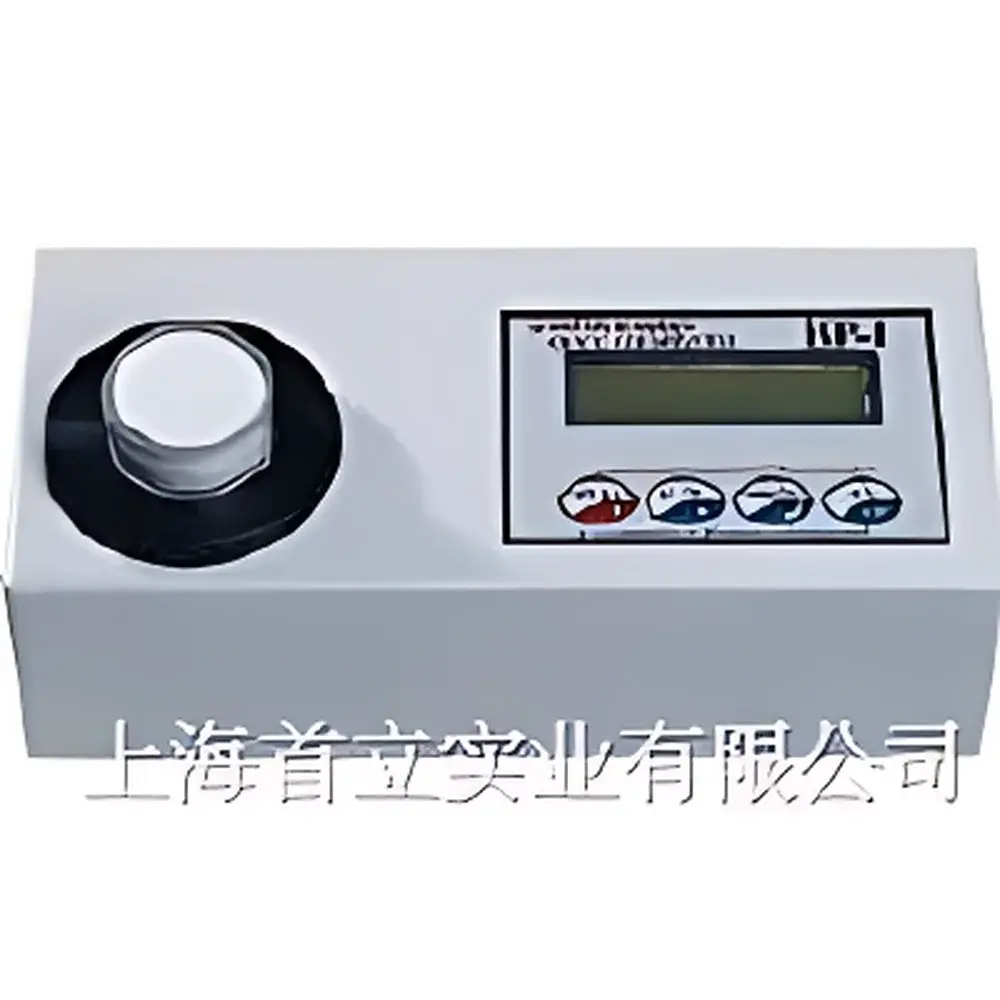
BP-1 Advanced Portable Colorimeter
| Origin | Japan |
|---|---|
| Manufacturer Type | Authorized Distributor |
| Origin Category | Imported |
| Model | BP-1 |
| Pricing | Upon Request |
Overview
The BP-1 Advanced Portable Colorimeter is a compact, handheld optical measurement instrument engineered for rapid, field-deployable color assessment in industrial quality control environments. Based on the CIE 1931 2° standard observer and CIE 1964 10° supplementary observer under illuminants C (daylight) and D65 (standard daylight), the device implements a 0°/45° geometry per JIS Z 8722—ensuring compliance with Japanese Industrial Standards for reflectance-based color evaluation. It operates via tristimulus colorimetry, converting spectral reflectance data into standardized color spaces including Yxy, CIELAB (L*a*b*), and CIELCh. Designed specifically for high-repetition batch monitoring—particularly in fermented food production—the BP-1 delivers traceable, repeatable measurements without warm-up delay, enabling immediate operation upon power-on. Its lightweight architecture (0.8 kg without batteries) and battery-powered design support extended use in production lines, QC labs, and raw material receiving areas where portability and operational continuity are critical.
Key Features
- Zero-warm-up operation: Activates instantly using four AA alkaline (1.5 V) or Ni-Cd (1.2 V) cells; no stabilization delay required.
- Single-button reference setting: Enables rapid establishment of pass/fail thresholds for ΔE*, ΔL*a*b*, or ΔYxy against user-defined standards.
- Integrated environmental compensation: Onboard temperature sensor monitors ambient thermal drift and triggers visual alerts when operating conditions exceed calibration stability limits.
- Intelligent power management: Automatic sleep mode engages after 3 minutes of inactivity; full recovery occurs within 0.5 seconds upon button press.
- Multi-space reporting: Simultaneously displays Yxy, L*a*b*, and Lab values per measurement, with real-time delta calculation relative to stored references.
- Statistical functionality: Built-in averaging across up to 20 consecutive readings; stores mean, SD, and min/max for each parameter set.
Sample Compatibility & Compliance
The BP-1 accommodates solid, semi-solid, and powdered samples via interchangeable accessories—including glass Petri dishes, quartz sample plates, and standard 10 mm aperture test disks—ensuring consistent 10 mm measurement area coverage. Its 0°/45° optical path minimizes specular reflection interference, making it suitable for textured or matte surfaces common in soy paste (miso), spice blends, cocoa powders, and pharmaceutical excipients. The instrument conforms to JIS Z 8722 for geometric and photometric validation, and its chromaticity repeatability (ΔE* ≤ 0.1 after 20 measurements on certified white tile) meets internal QA protocols aligned with ISO 11664-4 (CIELAB) and ASTM E308-22 (computation of color differences). While not FDA 21 CFR Part 11–certified out-of-box, audit-ready data export supports GLP/GMP documentation workflows when paired with optional Windows-compatible software.
Software & Data Management
Optional Windows-compatible data acquisition and analysis software enables bidirectional communication via RS-232C interface. The application supports CSV export, statistical summary generation (mean, SD, CPK), trend charting over time, and customizable report templates compliant with internal SOPs. All measurement records include timestamp, operator ID (manually entered), reference ID, and environmental metadata (temperature reading at time of capture). Audit trail functionality logs configuration changes, calibration events, and data deletion actions—providing foundational traceability for regulated environments. Printer integration allows direct hardcopy output of single measurements or batch summaries, supporting paper-based QC sign-offs where digital systems are not yet deployed.
Applications
- Batch-to-batch color consistency verification in fermented soy products (e.g., miso, soy sauce, doenjang).
- Raw material qualification of food-grade pigments, starches, and dairy powders.
- In-process monitoring during drying, roasting, or blending stages where thermal browning or oxidation affects hue.
- Supplier acceptance testing for cosmetic powders, ceramic glazes, and polymer granules.
- Stability studies tracking color shift under accelerated aging (e.g., light exposure, humidity cycling).
FAQ
What color spaces does the BP-1 support for direct readout?
The instrument displays Yxy, CIELAB (L*a*b*), and Lab values simultaneously per measurement, with selectable delta modes (ΔE*, ΔL*a*b*, ΔYxy) referenced to user-stored standards.
Is the BP-1 compliant with international color measurement standards?
Yes—it adheres to JIS Z 8722 for geometry and photometry, and its color space calculations follow CIE 1931 (2°) and CIE 1964 (10°) observer functions under illuminants C and D65, consistent with ISO 11664 series fundamentals.
Can measurement data be exported for regulatory review?
When used with the optional Windows software and RS-232C cable, all raw and processed data—including timestamps, operator inputs, and environmental metadata—can be exported as CSV or PDF for audit submission.
Does the device require annual recalibration?
While no mandatory factory recalibration interval is specified, users are advised to verify performance quarterly using NIST-traceable white and gray reference tiles; deviation beyond ±0.15 ΔE* warrants service intervention.
What is the typical battery life under continuous use?
Four AA alkaline cells provide approximately 12 hours of active measurement time (at 1 reading/30 sec), extending to >40 hours in standby due to automatic power-down logic.




