
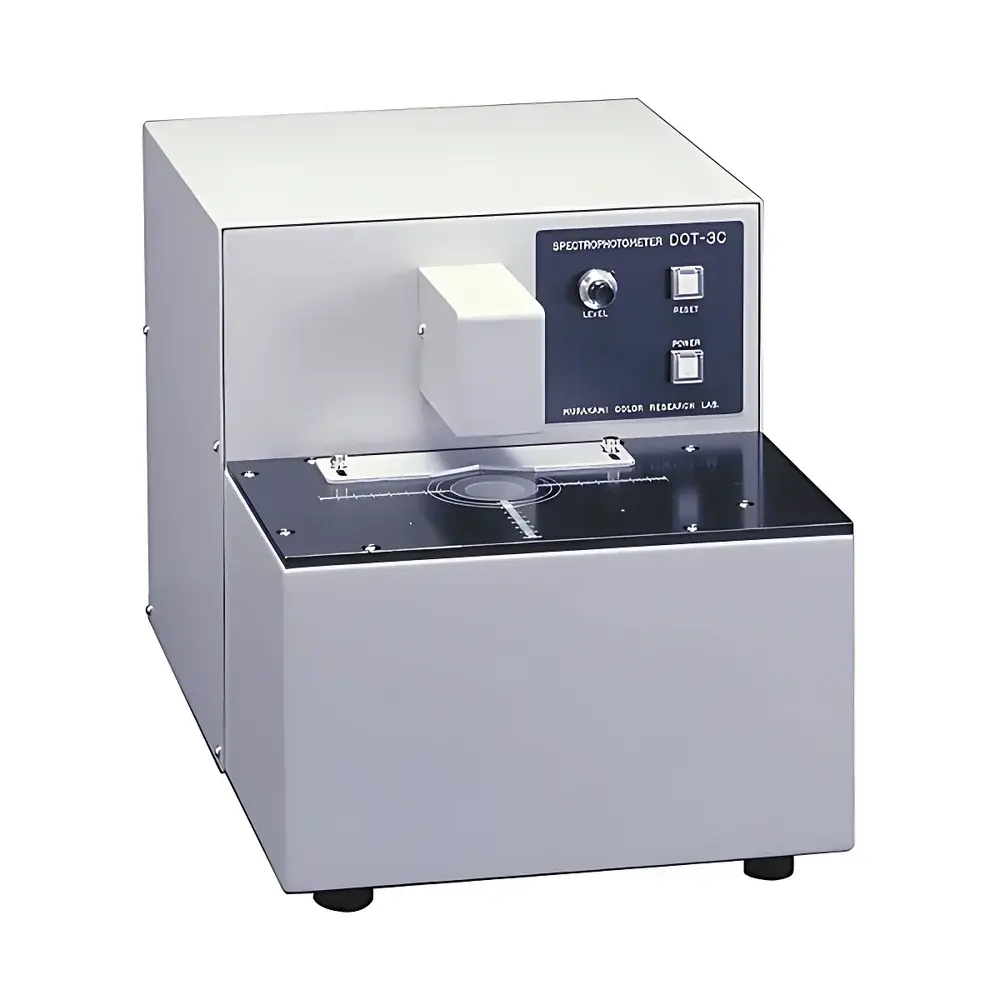
Murakami DOT-3C Integrating Sphere Spectrophotometer for Transmittance and Color Measurement
| Origin | Japan |
|---|---|
| Manufacturer Type | Authorized Distributor |
| Origin Category | Imported Instrument |
| Model | DOT-3C |
| Price Range | USD 42,000 – 70,000 |
| Light Source | Tungsten-Halogen Lamp |
| Spectral Range | 380–720 nm (standard), 390–730 nm (optional) |
| Wavelength Interval | Fixed at 10 nm |
| Calibration & Sensitivity Adjustment | Manual SPAN Knob |
| Sample Height Limit | ≤30 mm |
Overview
The Murakami DOT-3C is a high-precision integrating sphere spectrophotometer engineered for quantitative measurement of spectral transmittance and colorimetric properties of transparent, translucent, and highly scattering optical materials. Operating on the principle of double-beam spectrophotometry with an upward-illuminated 150 mm diameter integrating sphere, the DOT-3C delivers exceptional photometric stability and repeatability over extended operational periods. Its optical design mitigates errors from sample surface irregularities—such as lens curvature, molded resin textures, or ground glass diffusion—by capturing total transmitted radiant flux regardless of angular scattering distribution. The instrument employs a tungsten-halogen lamp as its stable broadband source, coupled with a fixed-grating monochromator delivering discrete 10 nm wavelength intervals across the visible spectrum (380–720 nm). This configuration ensures compliance with CIE 15:2018 spectral irradiance requirements for colorimetric evaluation and aligns with ISO 13655:2017 (Spectral measurement of reflective and transmissive materials) for metrological traceability in optical quality control.
Key Features
- Upward-facing open-stage sample platform eliminates door operation, reducing cycle time and enabling rapid sequential measurement of multiple lenses or curved optics without mechanical repositioning.
- Dual-beam architecture with real-time reference beam monitoring ensures long-term photometric stability (<0.002 ΔT/h drift under controlled ambient conditions), critical for GLP-compliant production line verification.
- Optional 10× sensitivity enhancement module enables accurate quantification of low-transmittance states—particularly essential for crossed-polarizer configurations used in retardation and extinction ratio analysis of polarizing films and liquid crystal components.
- Compatible with samples up to 30 mm in thickness; accommodates ophthalmic lenses (including progressive and aspheric designs), automotive headlamp covers, and laminated safety glass without disassembly or edge masking.
- Optimized for high-diffusion materials: validated performance on ground glass, opal acrylic, frosted polycarbonate, and milk glass—samples where conventional collimated-path instruments exhibit significant measurement variance due to stray light rejection limitations.
Sample Compatibility & Compliance
The DOT-3C supports flat, convex, concave, and toric substrates without auxiliary fixtures. Its top-illumination geometry inherently compensates for surface normal misalignment, making it suitable for unmounted spectacle lenses per ISO 8980-3:2020 (Ophthalmic optics — Uncut finished spectacle lenses — Part 3: Transmittance). It meets ASTM E308-22 requirements for conversion of spectral data to CIE tristimulus values (CIE 1931 2° standard observer), and supports calculation of dominant wavelength, excitation purity, and color difference metrics (ΔE*ab, ΔE00). For regulated environments, raw spectral data output adheres to FDA 21 CFR Part 11 audit trail requirements when integrated with compliant LIMS or QC software platforms.
Software & Data Management
The instrument interfaces via USB 2.0 to Murakami’s proprietary SpectraView Pro software (Windows 10/11 compatible), which provides real-time spectral plotting, batch reporting, statistical process control (SPC) charting, and automated pass/fail evaluation against user-defined transmittance or color tolerance windows. All measurements are timestamped, operator-ID tagged, and stored in encrypted .spc binary format with embedded calibration metadata. Export options include CSV (for Excel-based SPC), XML (for LIMS ingestion), and CIE-compliant .cie files. Software validation documentation (IQ/OQ/PQ protocols) is available upon request for GMP-regulated optical component manufacturing.
Applications
- Ophthalmic lens certification: transmittance mapping of UV-blocking, blue-light filtering, and photochromic lenses per ANSI Z80.3-2023.
- Automotive glazing: spectral characterization of HUD-compliant windshield interlayers and adaptive dimming rearview mirrors.
- Polarization film QC: precise transmittance and polarization extinction ratio (PER) measurement of PVA-based polarizers and quarter-wave retardation films.
- Medical optics: verification of spectral cutoff profiles in endoscopic light guides and diagnostic filter sets.
- Display materials: evaluation of anti-glare, anti-reflective, and privacy film transmission uniformity across visible and near-UV bands.
FAQ
Does the DOT-3C support reflectance measurement?
No—this model is configured exclusively for transmittance and colorimetry. Murakami offers the DOT-5C variant for combined transmittance/reflectance analysis using a motorized baffle system.
Can the instrument measure samples with strong fluorescence?
It does not include excitation source filtering or fluorescence correction algorithms; fluorescent specimens require spectral deconvolution using third-party software or dedicated fluorospectrophotometers.
Is NIST-traceable calibration provided with shipment?
Yes—a certificate of calibration with uncertainty budget (k=2) for spectral irradiance and photometric linearity is included, traceable to NIST SRM 2035 and 2036 via JIS Z 8722-2012 accredited laboratory procedures.
What maintenance is required for long-term accuracy?
Annual recalibration is recommended; lamp replacement every 1,500 hours; integrating sphere coating inspection every 2 years per Murakami Technical Bulletin TB-DOT-07.
Is remote operation supported for factory automation integration?
Yes—SCPI command set and TCP/IP socket interface enable integration with PLC-controlled test cells and MES systems via Modbus TCP or custom API middleware.



