
OK Thermal Shock Test Chamber OK-TS-49.012
| Brand | OK Instruments |
|---|---|
| Origin | Guangdong, China |
| Manufacturer Type | Direct Manufacturer |
| Model | OK-TS-49.012 |
| High-Temperature Range | +150 °C |
| Low-Temperature Range | −60 °C |
| Thermal Shock Range | −60 °C to +150 °C |
| Temperature Stability | ±2 °C |
| Heating Rate | 10 °C/s (typical transient response) |
| Cooling Rate | 10 °C/s (typical transient response) |
| Refrigeration System | Dual-stage cascade refrigeration with imported German semi-hermetic compressors |
| Cooling Method | Water-cooled (external cooling tower required: 10 m³/h flow rate) |
Overview
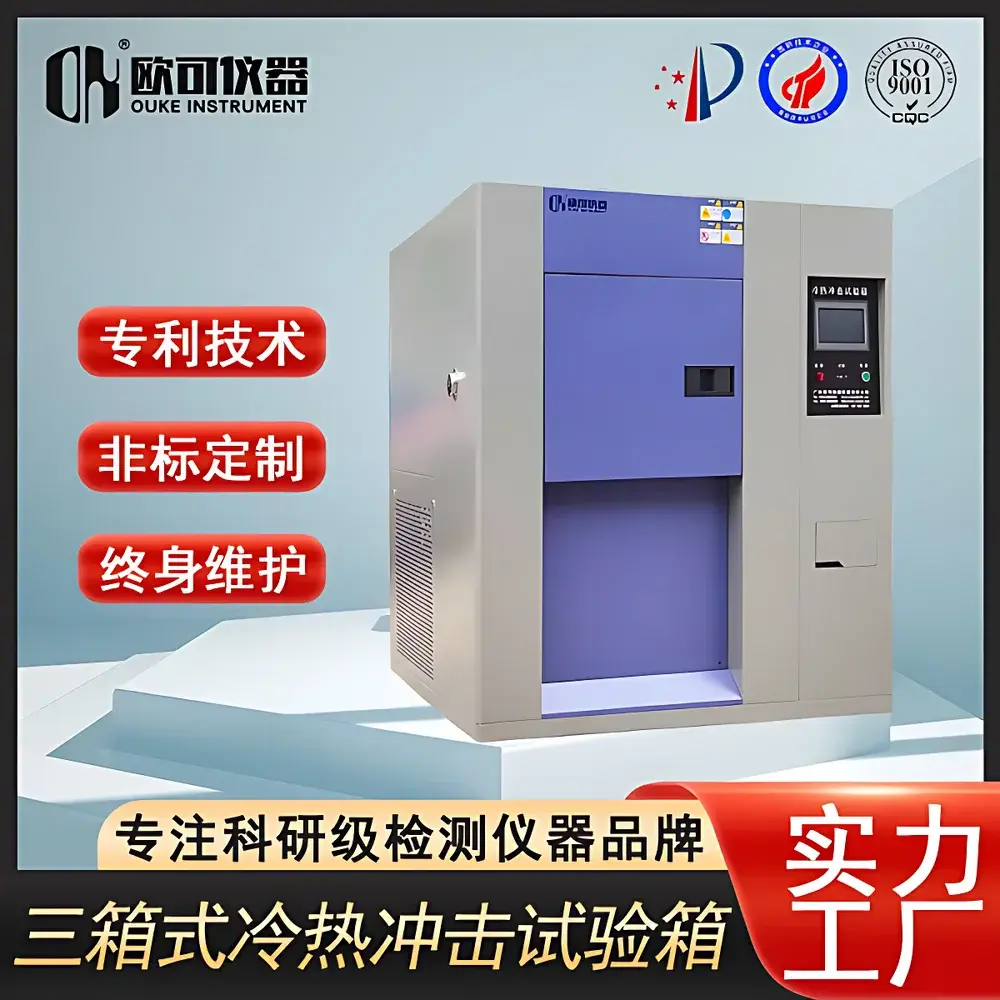
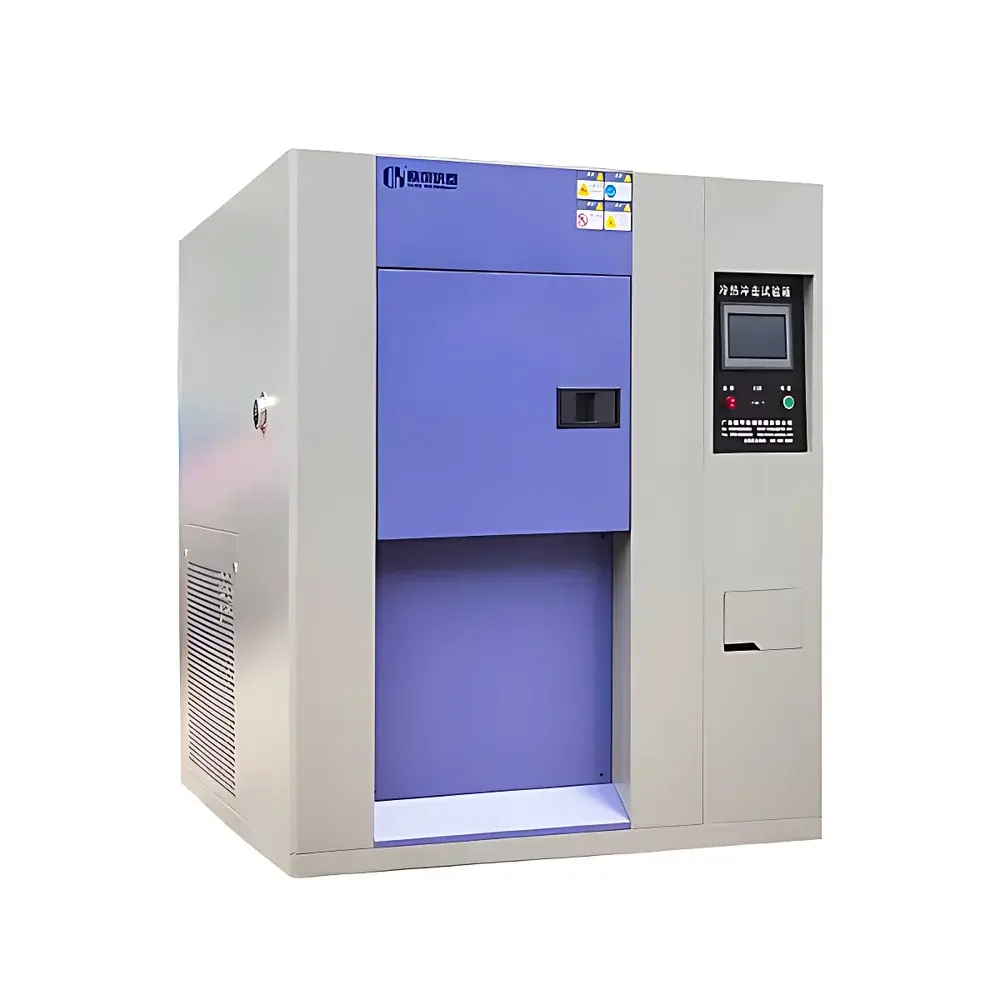
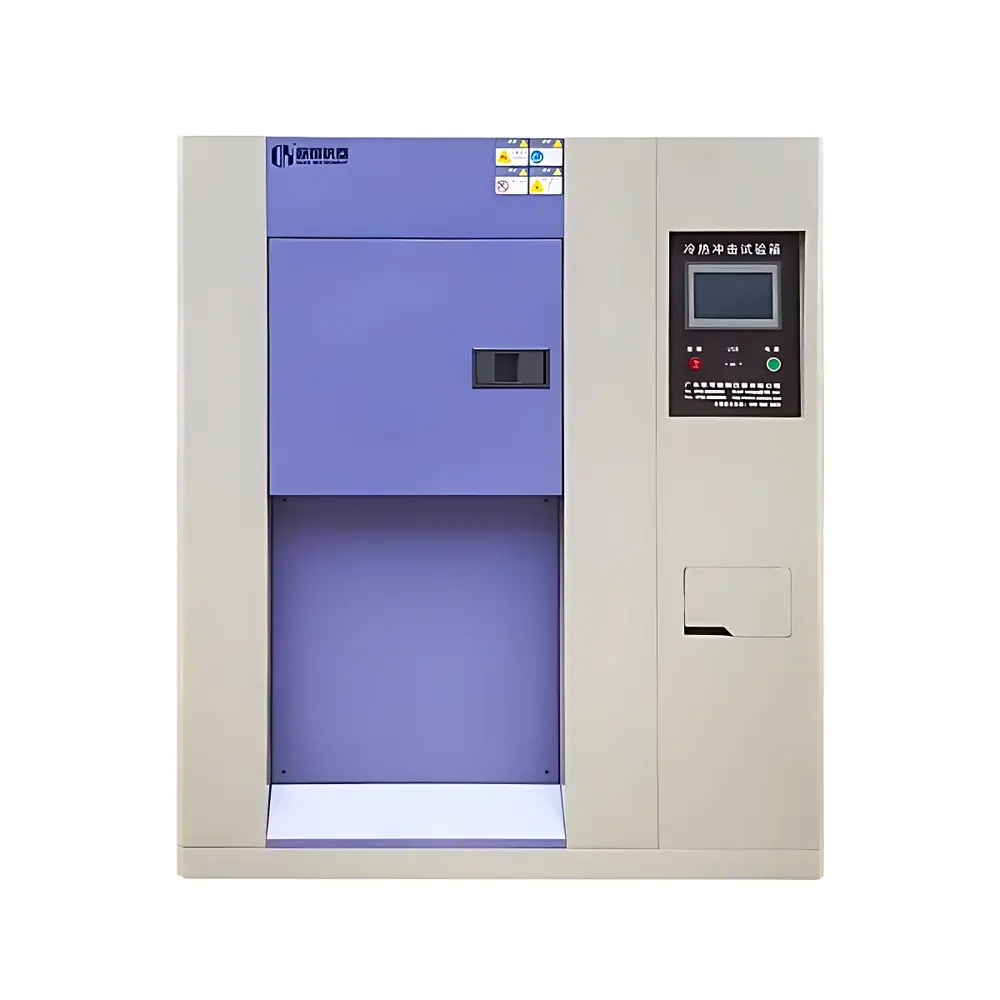
The OK Thermal Shock Test Chamber OK-TS-49.012 is an engineered environmental stress screening (ESS) system designed for rapid, high-fidelity thermal cycling and shock testing of electronic components, automotive modules, aerospace hardware, polymer composites, and metallic assemblies. It operates on the principle of controlled, high-speed thermal transition between extreme temperature extremes—achieving transitions from −60 °C to +150 °C (and vice versa) within seconds via either two-chamber or three-chamber architectures. Unlike conventional temperature chambers, this system isolates thermal mass in dedicated hot and cold reservoirs (or adds a separate test chamber), enabling repeatable, low-inertia thermal transients essential for detecting latent defects such as interfacial delamination, solder joint fatigue, sealant cracking, and coefficient-of-thermal-expansion (CTE) mismatch failures. Its design conforms to the fundamental physics of thermal shock: inducing transient thermal gradients that generate time-dependent stress fields exceeding material yield limits—thereby accelerating failure modes not observable under steady-state conditions.
Key Features
- Dual-configuration flexibility: Supports both two-chamber (hot/cold lift-basket) and three-chamber (hot reservoir / cold reservoir / test chamber) operational modes—enabling user-selectable trade-offs between throughput, thermal uniformity, and cross-contamination control.
- High-speed thermal actuation: Achieves nominal temperature transitions at up to 10 °C per second, validated per IEC 60068-2-14 (Test N: Change of Temperature) and MIL-STD-810H Method 503.6.
- Cascade refrigeration architecture: Integrates two independent refrigeration circuits—high-stage (R404A) and low-stage (R23)—with an evaporative condenser interface, ensuring stable sub-zero performance down to −60 °C without liquid nitrogen dependency.
- Water-cooled condensing system: Requires external cooling tower (10 m³/h capacity) for sustained high-load operation; eliminates air-cooling limitations in ambient temperatures above 35 °C.
- Precision temperature control: Equipped with PID-controlled heating/cooling modulation, platinum RTD sensors (Class A, ±0.15 °C accuracy), and chamber uniformity maintained within ±2 °C across the working volume.
- Robust mechanical construction: Stainless steel inner chamber, insulated with high-density polyurethane foam (≥150 mm thickness), and reinforced door sealing compliant with ISO 16750-4 for automotive ECU validation.
Sample Compatibility & Compliance
The OK-TS-49.012 accommodates samples up to 49 L internal volume (standard configuration), with customizable basket dimensions and load-bearing capacity (up to 30 kg static). It supports DUTs ranging from PCBAs and MEMS sensors to battery packs and optical housings. The chamber meets full compliance with international and defense-grade standards including: IEC 60068-2-14 (Temperature Change), MIL-STD-810H Method 503.6 (Thermal Shock), GJB 150.5A-2009 (China Military Standard for Temperature Shock), GB/T 2423.22–2012 (Environmental Testing – Temperature Change), and QC/T 17–2019 (Automotive Component Environmental Testing). Optional data logging and audit trails support GLP/GMP-aligned validation protocols per FDA 21 CFR Part 11 when integrated with OK’s certified software suite.
Software & Data Management
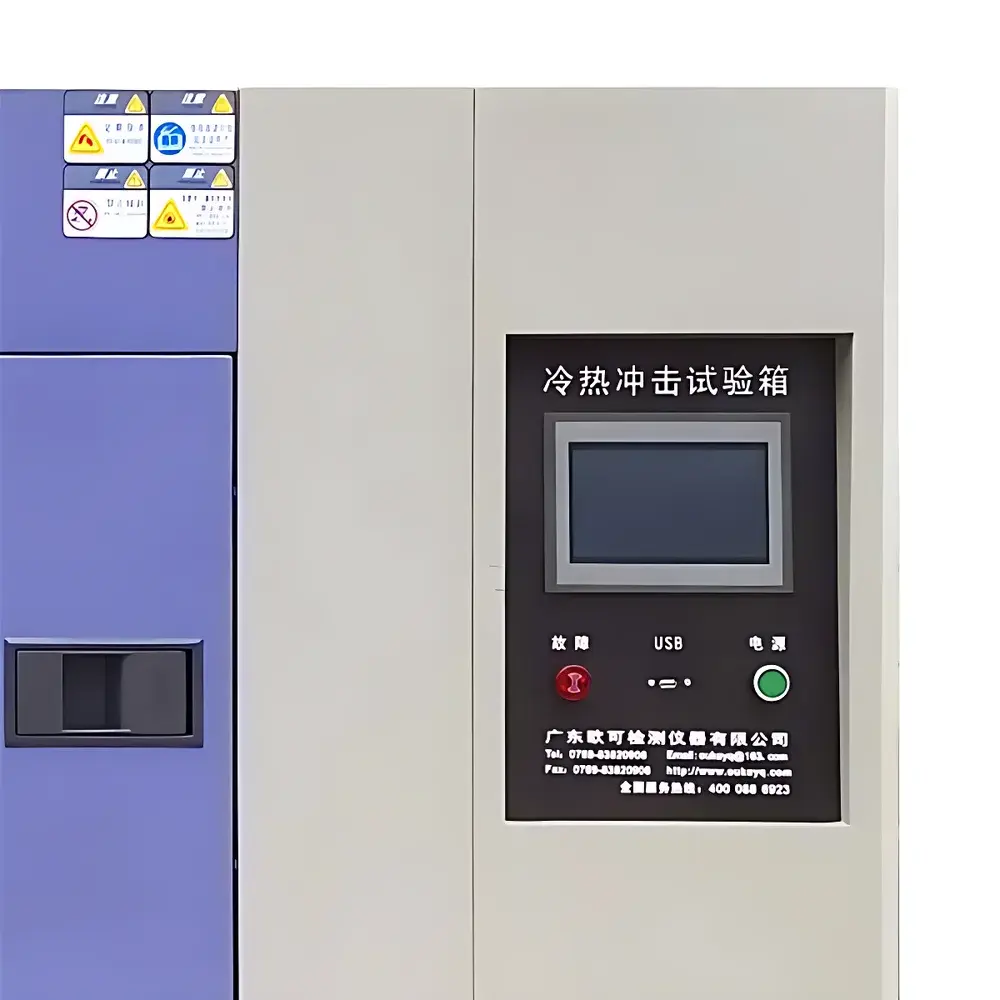
Bundled with OK-TCM v3.2 (Thermal Control Manager), the system provides real-time monitoring, programmable multi-step profiles (including dwell, ramp, and shock cycles), and synchronized thermocouple/RTD data acquisition at 1 Hz resolution. All test logs—including chamber setpoints, actual temperatures, compressor status, and alarm history—are timestamped, digitally signed, and exportable in CSV or PDF format. The software supports user role-based access control (RBAC), electronic signature workflows, and automatic report generation aligned with ISO/IEC 17025 documentation requirements. Optional integration with LabVantage or Siemens Opcenter enables traceability into enterprise quality management systems (QMS).
Applications
- Qualification testing of avionics and flight-critical electronics per DO-160 Section 4.5 (Temperature Shock).
- Reliability screening of EV battery modules during cell-to-pack (CTP) thermal interface validation.
- Failure analysis of encapsulated optoelectronic devices subjected to repeated CTE-induced stress.
- Process qualification of conformal coating adhesion under accelerated thermal cycling.
- Material compatibility assessment for space-grade polymers exposed to lunar diurnal extremes (−173 °C to +127 °C equivalent shock modeling).
- Production line burn-in and HASS (Highly Accelerated Stress Screening) implementation for semiconductor packaging.
FAQ
What is the difference between thermal cycling and thermal shock testing?
Thermal cycling applies gradual, repetitive temperature ramps over minutes or hours, simulating long-term environmental exposure. Thermal shock uses near-instantaneous transitions (typically < 15 s) between extreme setpoints to induce high-magnitude transient stresses—making it more aggressive and defect-sensitive.
Does the OK-TS-49.012 require liquid nitrogen or dry ice?
No. It relies solely on a self-contained dual-stage cascade refrigeration system with industrial-grade compressors—eliminating consumables, logistical dependencies, and safety hazards associated with cryogenic media.
Can the chamber be validated for IQ/OQ/PQ protocols?
Yes. Full validation documentation packages—including sensor calibration certificates (NIST-traceable), temperature mapping reports (per ASTM E2297), and software verification protocols—are available upon request.
Is remote monitoring supported?
Yes. Ethernet-enabled controller with Modbus TCP and OPC UA interfaces allows integration into SCADA, MES, or cloud-based predictive maintenance platforms.
What maintenance intervals are recommended?
Compressor oil and filter replacement every 3,000 operating hours; annual refrigerant leak check and cooling tower water treatment verification; quarterly calibration of all critical RTDs and pressure transducers.



