
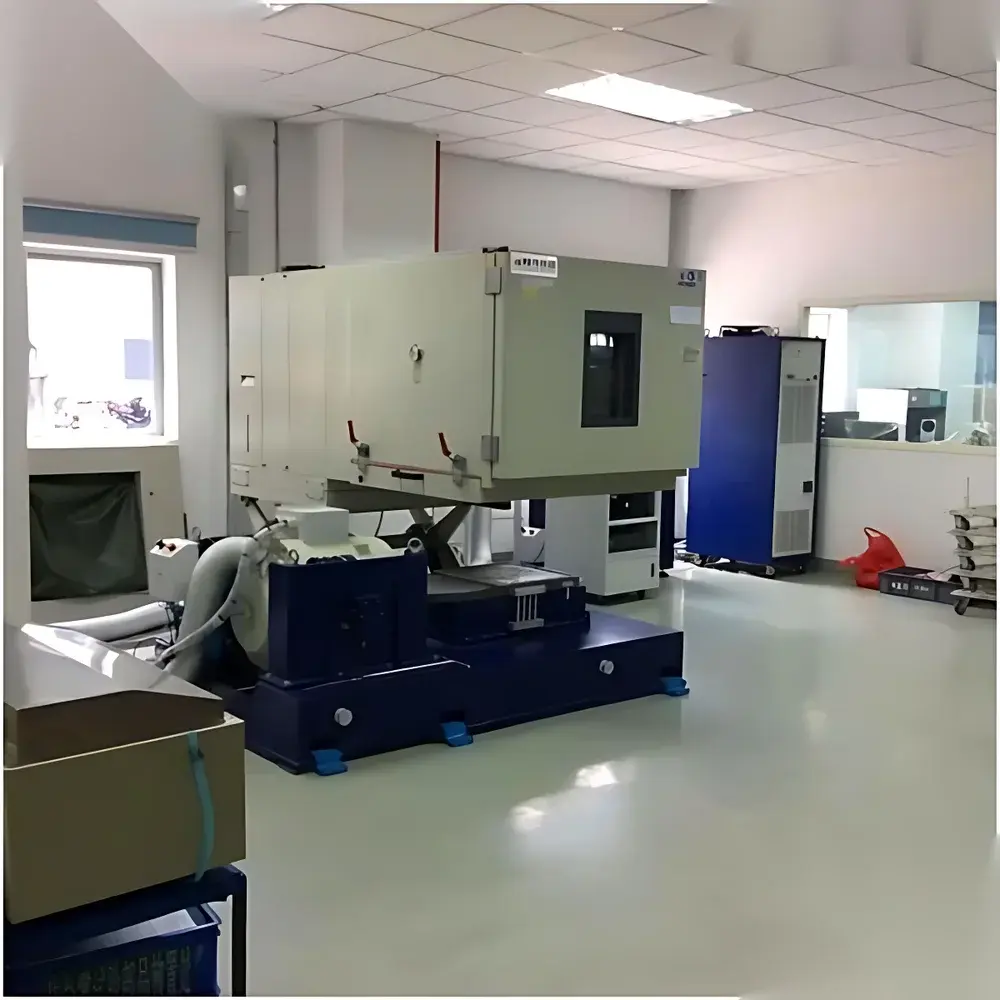
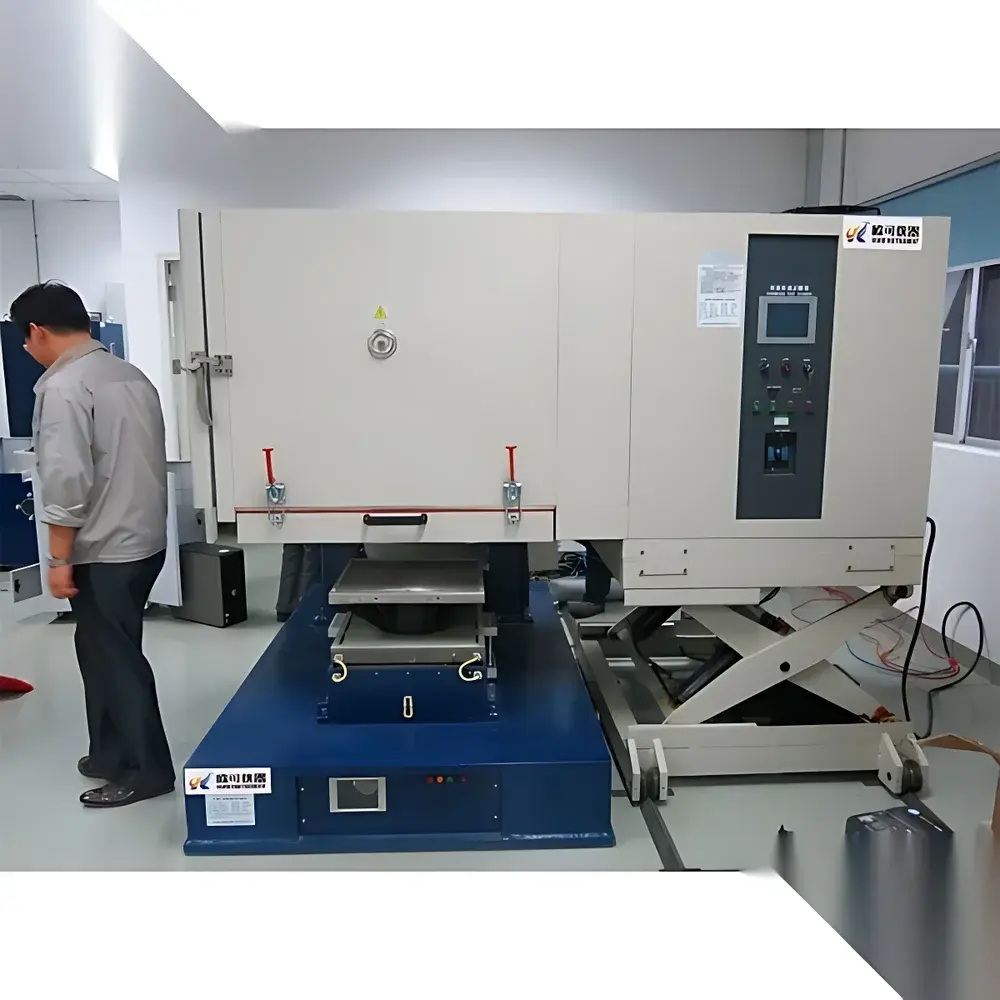
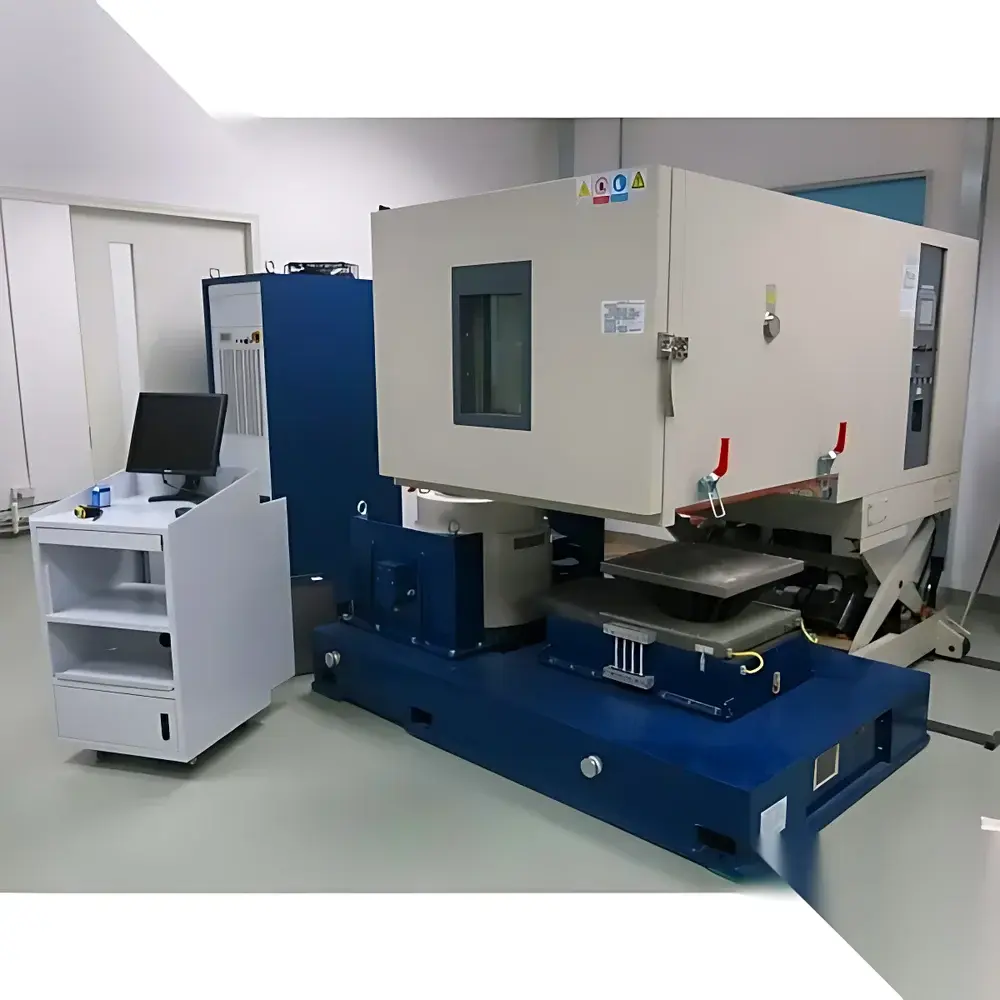
ASLI OK-ZTH-408 Combined Rapid Temperature Change and Vibration Test System
| Brand | ASLI |
|---|---|
| Model | OK-ZTH-408 |
| Temperature Range | -55°C to +150°C |
| Temperature Ramp Rate | 15°C/min |
| Vibration Frequency Range | 1–5000 Hz (with PC-controlled option) |
| Vibration Mode | Vertical, Horizontal, or Combined (Vertical + Horizontal) |
| Max. Load Capacity | 50 kg |
| Effective Table Size | 1.0 m × 1.0 m |
| Peak-to-Peak Amplitude | 25.4 mm |
| Speed Display Resolution | 0.1 RPM |
| Drive Motor Power | 1 HP |
| Power Supply | 220 V, 50 Hz |
| Weight | ~300 kg |
| Compliance | GB/T 2423, IEC 60068-2-6 (FC), JJG 189–1997, GB/T 13309–1991, EN, ANSI, UL, ASTM, ISTA Transport Standards |
Overview
The ASLI OK-ZTH-408 Combined Rapid Temperature Change and Vibration Test System is an integrated environmental stress screening platform engineered for concurrent thermal cycling and mechanical vibration exposure. It operates on the principle of synergistic stress application—simultaneously subjecting test specimens to controlled, high-rate temperature transitions (up to 15°C/min across a -55°C to +150°C range) and programmable sinusoidal or random vibration profiles (1–5000 Hz). This dual-stress methodology replicates real-world operational and transportation conditions where thermal expansion/contraction interacts dynamically with mechanical shock and fatigue—critical for validating reliability in aerospace components, UAV systems, automotive ECUs, military electronics, and industrial control modules. Unlike sequential testing approaches, the OK-ZTH-408 enables true multi-stress correlation, revealing latent defects such as solder joint microfractures, connector loosening, or material delamination that only manifest under combined thermal-mechanical load.
Key Features
- High-fidelity rapid temperature transition capability: Achieves ±0.5°C chamber uniformity and ±2.0°C temperature accuracy over the full -55°C to +150°C operating range, with ramp rates configurable from 1°C/min up to 15°C/min.
- Modular vibration excitation system: Supports vertical (CZ), horizontal (SP), and bi-axial (CZ+SP) configurations; selectable frequency bandwidths include 1–600 Hz standard and extended 1–5000 Hz variants with optional closed-loop digital controller and real-time spectrum analysis.
- Robust electrodynamic shaker integration: 50 kg payload capacity on a 1.0 m × 1.0 m rigid aluminum table; peak-to-peak displacement of 25.4 mm at low frequencies; DC motor drive with 0.1 RPM speed resolution and programmable dwell/timing (0 seconds to 99 hours).
- Thermally isolated vibration interface: Patented thermal break design minimizes heat conduction from chamber walls to shaker armature, preserving both temperature stability and mechanical fidelity during simultaneous operation.
- Compliance-ready architecture: Pre-configured test profiles aligned with IEC 60068-2-6 (vibration), IEC 60068-2-14 (rapid temperature change), MIL-STD-810H Method 502.7, and ISTA 3A/3E transport simulation protocols.
Sample Compatibility & Compliance
The OK-ZTH-408 accommodates a broad spectrum of physical form factors—from compact PCB assemblies and sensor modules to full UAV airframes and automotive infotainment units—within its 1.0 m × 1.0 m active table area. Its modular mounting interface supports custom fixtures, thermal mass compensation plates, and non-metallic isolation mounts to prevent parasitic resonance. The system meets international regulatory and industry-standard requirements including GB/T 2423 (China National Standard), IEC 60068-2 series (Environmental Testing), JJG 189–1997 (Calibration of Vibration Test Systems), and ASTM D4169 (Performance Testing of Shipping Containers). For regulated industries, it supports audit-ready documentation packages compatible with GLP and GMP environments, including calibration traceability to NIST standards and electronic log generation per FDA 21 CFR Part 11 requirements when paired with optional PC-based control software.
Software & Data Management
The system integrates with ASLI’s proprietary TestMaster™ control suite (optional PC version), providing synchronized waveform generation, real-time parameter monitoring, and automated pass/fail evaluation against user-defined thresholds. Software features include harmonic distortion analysis, PSD (Power Spectral Density) profiling, temperature-vibration cross-correlation charts, and exportable CSV/Excel reports compliant with ISO/IEC 17025 data integrity guidelines. All test sessions generate immutable audit trails—including operator ID, timestamp, environmental setpoints, vibration spectra, and system health diagnostics—enabling full traceability for internal QA reviews or external certification audits.
Applications
- Aerospace & UAV qualification: Validation of flight-critical avionics under thermal shock and broadband vibration representative of launch, ascent, and atmospheric re-entry.
- Automotive electronics: End-of-line stress screening for ADAS sensors, battery management systems (BMS), and infotainment head units per AEC-Q200 and ISO 16750-4.
- Industrial IoT devices: Accelerated life testing of edge controllers exposed to warehouse temperature swings and forklift-induced floor vibrations.
- Military-grade hardware: Environmental ruggedness verification per MIL-STD-810H methods including Method 502.7 (Temperature Shock) and Method 514.7 (Vibration).
- Consumer electronics: Drop-and-transport simulation for handheld devices using combined thermal preconditioning and ISTA 3-series vibration profiles.
FAQ
What is the maximum payload weight the OK-ZTH-408 can support during simultaneous temperature and vibration testing?
The system maintains full specification compliance at up to 50 kg on its 1.0 m × 1.0 m table, with dynamic force limits adjusted per frequency band to ensure structural integrity and thermal stability.
Does the system support random vibration profiles in addition to sine sweeps?
Yes—the 1–5000 Hz PC-controlled configuration includes real-time random vibration synthesis with user-definable PSD profiles, kurtosis control, and fatigue damage spectrum (FDS) analysis.
Can test data be exported in formats compatible with third-party analysis tools like MATLAB or Python?
All raw time-history and spectral data are exportable as ASCII-encoded CSV files with metadata headers, enabling direct ingestion into MATLAB, Python (NumPy/Pandas), or commercial CAE platforms for post-test root cause analysis.
Is on-site installation, commissioning, and operator training included?
ASLI provides factory-certified field service engineers for site survey, mechanical/electrical integration, IQ/OQ protocol execution, and hands-on operator training covering safety procedures, profile programming, and maintenance routines.



