
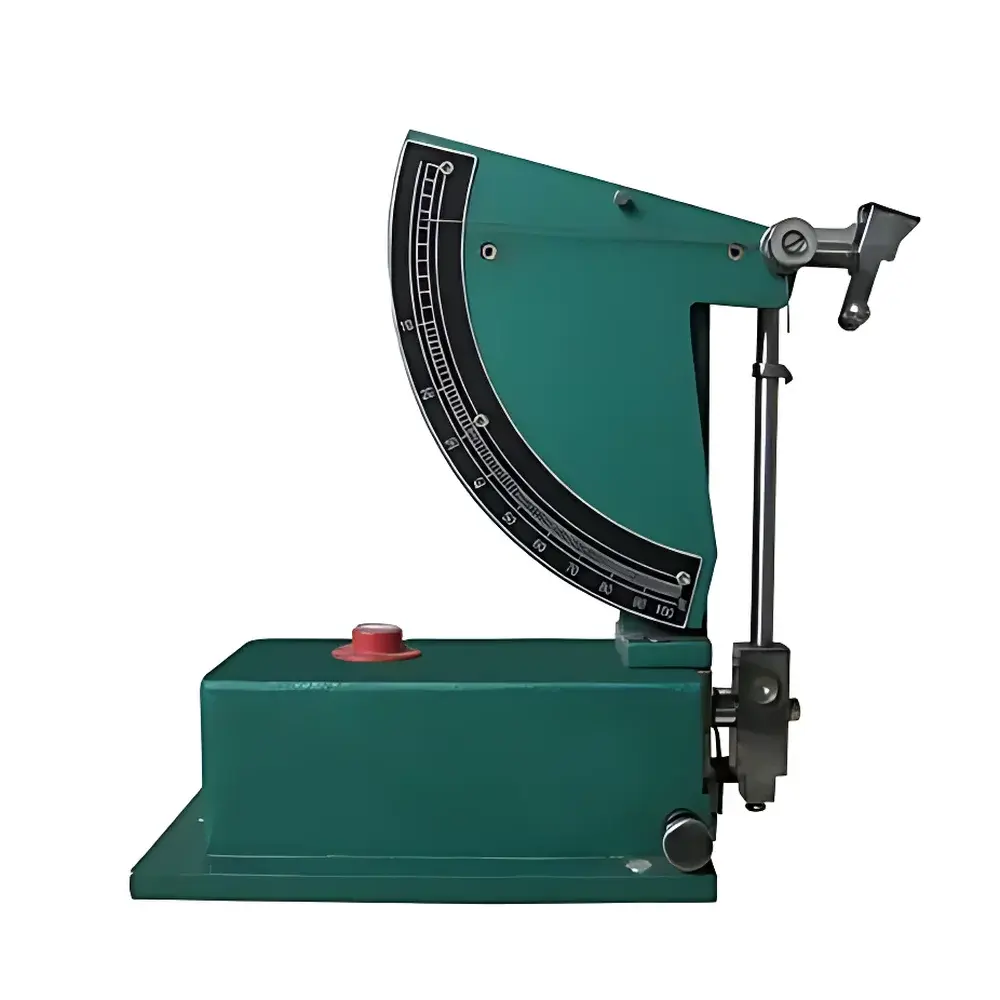
TianYuan TY-4088 Pendulum-Type Impact Resilience Tester for Vulcanized Rubber
| Brand | TianYuan |
|---|---|
| Origin | Jiangsu, China |
| Manufacturer Type | Direct Manufacturer |
| Country of Origin | China |
| Model | TY-4088 |
| Quotation | Upon Request |
| Impact Energy | 0.5 J |
| Compliant Standards | GB/T 1681, ISO 4662 |
| Indenter Diameter | Φ15 mm |
| Specimen Dimensions | Φ29 mm × 12.5 mm |
| Impact Mass | 0.35–0.1 kg |
| Impact Velocity | 1.4 ± 0.6 m/s |
| Apparent Strain Energy Density | 351 ± 112 kJ/m³ |
| Resilience Reading Accuracy | ±0.5% |
Overview
The TianYuan TY-4088 Pendulum-Type Impact Resilience Tester is a precision mechanical instrument engineered for the quantitative determination of resilience (rebound elasticity) in vulcanized rubber and thermoplastic elastomers. It operates on the fundamental principle of energy conservation in an impact-rebound system: a calibrated pendulum with a hemispherical indenter strikes a standardized cylindrical specimen at a defined velocity; the rebound height—measured optically or via digital encoder—is directly proportional to the ratio of recovered kinetic energy to incident kinetic energy. This dimensionless value, expressed as a percentage, reflects the material’s ability to dissipate minimal energy during rapid elastic deformation—critical for applications demanding dynamic performance, such as tire treads, vibration isolators, and dynamic sealing elements. The device conforms strictly to the physical test methodology outlined in GB/T 1681 and ISO 4662, ensuring metrological traceability and inter-laboratory comparability under controlled environmental conditions (23 ± 2 °C, 50 ± 5 % RH).
Key Features
- Fixed-energy 0.5 J pendulum system with adjustable mass distribution to maintain consistent impact energy across the specified range (0.35–0.1 kg), enabling precise calibration against NIST-traceable reference standards.
- Hemispherical steel indenter (Φ15 mm, Rockwell C hardness ≥60) mounted orthogonally to the pendulum axis, minimizing lateral torsion and ensuring uniform stress distribution upon contact.
- Optical or high-resolution rotary encoder-based rebound angle detection with real-time digital readout, delivering resolution better than 0.1° and repeatability ≤±0.3% RSD (n=10, standard reference rubber).
- Rigid cast-iron base frame with vibration-damping feet, isolating measurement from ambient floor-borne disturbances and maintaining alignment stability over extended operational cycles.
- Compliance-ready mechanical design: no embedded firmware or network connectivity—fully auditable via mechanical calibration certificates, certified weights, and geometric verification protocols per ISO/IEC 17025 requirements.
Sample Compatibility & Compliance
The TY-4088 accepts cylindrical specimens conforming to ISO 4662 and GB/T 1681 specifications: diameter 29.0 ± 0.2 mm, thickness 12.5 ± 0.2 mm, with parallel, flat, and smooth surfaces (Ra ≤ 0.8 µm). It is validated for materials within the Shore A / IRHD hardness range of 30–85, covering natural rubber (NR), styrene-butadiene rubber (SBR), ethylene propylene diene monomer (EPDM), nitrile rubber (NBR), and thermoplastic polyurethane (TPU). All test procedures support full compliance with ISO/IEC 17025 documentation requirements—including raw data logs, operator identification, environmental monitoring records, and calibration history. While the instrument itself does not require electrical certification for intrinsic safety, its mechanical operation aligns with laboratory safety standards (e.g., ANSI Z535.4) through guarded pendulum arc and fail-safe locking mechanisms.
Software & Data Management
The TY-4088 operates as a stand-alone mechanical tester without integrated software. Data acquisition is performed manually or via optional external USB-connected angular encoders interfaced with validated third-party data logging platforms (e.g., LabVIEW™ or MATLAB® scripts compliant with 21 CFR Part 11 audit trail requirements). Raw outputs include rebound angle (degrees), calculated resilience (%), specimen ID, test date/time, operator initials, and ambient temperature/humidity. When deployed in GLP/GMP environments, laboratories may implement paper-based or electronic lab notebook (ELN) workflows that capture full metadata—ensuring full traceability for regulatory submissions, internal audits, or ISO 9001 surveillance assessments.
Applications
- Quality control of rubber compounds in tire manufacturing—correlating resilience with rolling resistance and heat build-up behavior.
- Formulation screening during R&D of high-resilience elastomers for dynamic seals, bushings, and anti-vibration mounts.
- Batch-to-batch consistency verification in production of conveyor belts, rollers, and shock-absorbing pads.
- Accelerated aging studies: tracking resilience decay after thermal, ozone, or UV exposure per ASTM D573, ASTM D1149, and ISO 1431.
- Technical specification validation for automotive OEM material release criteria (e.g., Ford WSS-M99P1111-A, GMW15634).
FAQ
What hardness range is supported by the TY-4088?
The instrument is validated for vulcanized rubbers with hardness values between 30 and 85 IRHD (International Rubber Hardness Degrees), as defined in ISO 48 and GB/T 531.1.
Is calibration traceable to national standards?
Yes—calibration utilizes certified masses, optical angle references, and geometry-verified specimen fixtures traceable to CNAS-accredited calibration laboratories (certificate included with delivery).
Can the TY-4088 be used for thermoplastic elastomers (TPEs)?
Yes, provided specimens meet dimensional tolerances and hardness falls within the validated range; however, pre-conditioning at service temperature is recommended due to TPE’s viscoelastic sensitivity.
Does the tester comply with FDA or pharmaceutical testing requirements?
While not designed for direct use in pharmaceutical compendial testing (e.g., USP ), its mechanical integrity and documentation structure support GMP-aligned QC labs where rubber component resilience is a critical quality attribute (CQA).
What maintenance is required for long-term accuracy?
Biannual verification of pendulum bearing friction, indenter surface finish (via profilometry), and base levelness using Class 0 spirit level; annual recalibration by authorized service center recommended.



