
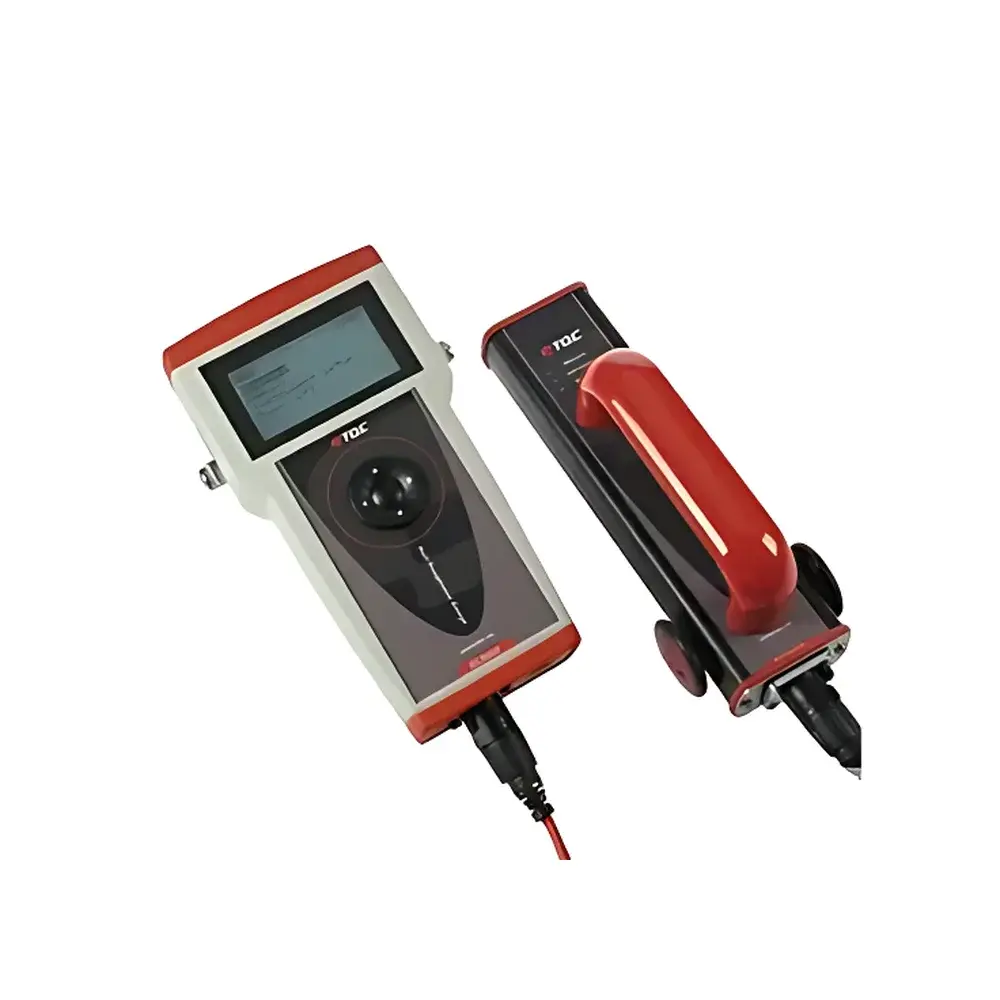
TQC DC9000 Hull Roughness Gauge
| Origin | Netherlands |
|---|---|
| Manufacturer Type | Authorized Distributor |
| Origin Category | Imported |
| Model | DC9000 |
| Pricing | Upon Request |
| Accuracy | ±5 µm or <2% |
| Scanning Speed | 50 mm/s (with integrated speed-indicating LED) |
| Data Storage | Up to 4 full hull scans (total >10,000 individual measurement points) |
| Interface | USB-to-serial PC interface |
| Power Supply | 4 × AA batteries |
| Compliance | ISO 8502-4, ASTM D3276-05, BS 7079-B4, NACE RP0197 |
Overview
The TQC DC9000 Hull Roughness Gauge is a portable, field-deployable instrument engineered for quantitative assessment of marine hull surface topography in accordance with internationally recognized coating and corrosion inspection standards. It operates on the principle of contact profilometry—utilizing a precision-machined diamond-tipped stylus that traverses the hull surface at a controlled linear velocity of 50 mm/s. The sensor captures vertical displacement data at high spatial resolution, enabling calculation of the Average Hull Roughness (AHR), a critical hydrodynamic performance metric defined as the arithmetic mean of all roughness peaks and valleys across a standardized measurement length. AHR directly correlates with increased skin friction drag; even modest increases (e.g., +30–50 µm beyond baseline) can elevate fuel consumption by 2–5% per nautical mile. The DC9000 is deployed during dry-docking cycles—both pre-cleaning (to establish baseline condition) and post-coating application (to verify surface preparation quality and anti-fouling film integrity)—supporting evidence-based decisions in vessel maintenance planning, coating system qualification, and regulatory compliance reporting.
Key Features
- Single-hand operable interface with intuitive 4-direction navigation buttons, optimized for use in confined or elevated workspaces aboard vessels.
- Ruggedized, IP67-rated waterproof housing designed for maritime environments—including exposure to salt spray, deck washdowns, and mechanical impact during transit.
- Integrated status LED array providing real-time visual feedback on power level, scanning progress, memory capacity, and calibration state—eliminating need to view display during operation.
- Onboard non-volatile memory capable of storing up to four complete hull surveys, each comprising over 2,500 individual AHR measurements (cumulative storage >10,000 data points).
- USB-to-serial interface compliant with standard RS-232 protocols, enabling direct data export to Windows-based analysis software for statistical reporting, trend mapping, and integration into fleet management databases.
- Battery-powered operation using four standard AA cells, delivering >12 hours of continuous scanning under typical duty cycles—no external power source required during dockside or offshore inspections.
Sample Compatibility & Compliance
The DC9000 is validated for use on ferrous and non-ferrous hull substrates—including steel, aluminum, and fiber-reinforced polymer (FRP) composites—coated with epoxy, silicone, foul-release, and self-polishing copolymer (SPC) antifouling systems. Its measurement methodology adheres strictly to the geometric definitions and sampling protocols specified in ISO 8502-4 (Preparation of steel substrates before application of paints and related products — Tests for the assessment of surface cleanliness — Part 4: Assessment of dust on steel surfaces), ASTM D3276-05 (Standard Guide for Visual Evaluation of Painted Surfaces), BS 7079-B4 (Preparation of steel substrates before application of paints and related products — Code of practice for surface preparation of steel), and NACE RP0197 (Measurement of Surface Profile of Abrasive Blast Cleaned Steel). All firmware and calibration routines are traceable to NPL (National Physical Laboratory) reference standards, ensuring metrological consistency across global inspection teams.
Software & Data Management
Data acquired via the DC9000 is exported as ASCII-delimited text files compatible with industry-standard platforms including Microsoft Excel, MATLAB, and proprietary fleet analytics suites. The accompanying TQC HullScan™ desktop application (v3.2+) supports automated AHR calculation per ISO-defined evaluation lengths (typically 20 mm), generation of roughness distribution histograms, comparative overlay of pre- and post-docking datasets, and export of PDF inspection reports compliant with IMO MEPC.263(68) guidelines for Energy Efficiency Design Index (EEDI) monitoring. Audit trails—including operator ID, timestamp, GPS coordinates (when paired with optional Bluetooth GNSS module), and calibration certificate expiry—are embedded in each dataset to satisfy GLP/GMP documentation requirements and support FDA 21 CFR Part 11-compliant electronic record retention where applicable.
Applications
- Quantitative verification of abrasive blast profile prior to antifouling application per SSPC-SP 10/NACE No. 2.
- Post-application assessment of coating uniformity and mechanical damage (e.g., impact scars, roller marks, overspray zones).
- Trend analysis of hull roughness degradation over successive dry-dock intervals to optimize recoating frequency and budget allocation.
- Third-party verification for charter party agreements specifying maximum allowable AHR thresholds (e.g., ≤25 µm for newbuilds, ≤40 µm for mid-life vessels).
- Supporting evidence for EEXI (Energy Efficiency Existing Ship Index) and CII (Carbon Intensity Indicator) compliance reporting under IMO MARPOL Annex VI.
FAQ
What is the physical meaning of AHR, and how does it differ from Ra or Rz?
AHR (Average Hull Roughness) is a ship-specific parameter derived from longitudinal profilometry scans along the hull’s waterline zone; it reflects hydrodynamically relevant macro-roughness features (e.g., coating defects, biofouling colonies, pitting) rather than micro-scale surface texture metrics like Ra (arithmetic average) or Rz (maximum peak-to-valley height) used in machined part inspection.
Can the DC9000 measure underwater or in wet conditions?
No—the instrument requires direct mechanical contact with a dry, stable surface; measurements must be performed during dry-docking or in above-water zones after thorough drying. Submerged or damp surfaces invalidate stylus tracking and compromise accuracy.
Is calibration required before each use?
Field calibration using the supplied certified reference shim (10 µm and 50 µm traceable to PTB) is recommended prior to critical surveys; full recalibration at an accredited service center is advised every 12 months or after 500 operational hours.
Does the device support multi-language UI?
The onboard interface displays only status LEDs and numeric AHR values; all configuration, reporting, and interpretation occur in the English-language TQC HullScan™ software.
How is measurement repeatability ensured across different operators?
The DC9000 enforces constant scan speed via internal servo control and includes tactile feedback triggers to guide consistent probe placement; operator training per ISO 2063-1 and documented SOP adherence are prerequisites for inter-operator reproducibility.



