
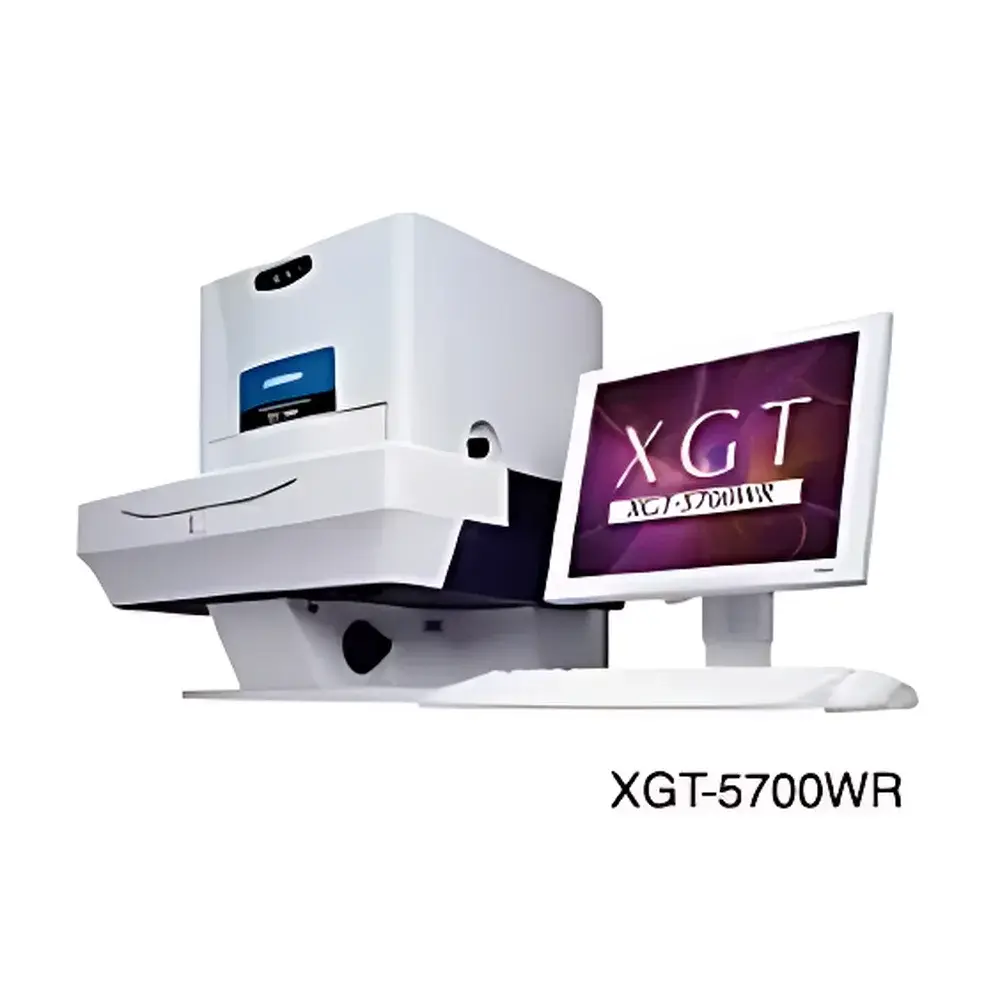
Rigaku XGT-5700 Wavelength Dispersive X-Ray Fluorescence Microscope
| Origin | Japan |
|---|---|
| Manufacturer Type | Authorized Distributor |
| Origin Category | Imported |
| Model | XGT-5700 |
| Price Range | USD 42,000–70,000 (FOB) |
| Instrument Type | Scanning Micro-XRF |
| Analytical Element Range | Na (Z=11) to U (Z=92) |
| Primary Beam Diameter Options | 3 mm (standard), 100 µm, 10 µm |
| Primary Beam Filtration | Auto-switching for 3 mm beam (4 filters) |
| Secondary Beam Filtration | Motorized ON/OFF filter for enhanced sensitivity in regulated heavy metal analysis (e.g., Pb, Cd, Hg, Cr, Br) |
| Detector | Liquid-nitrogen-cooled, high-purity Si(Li) detector (3 L Dewar capacity) |
| Maximum Sample Dimensions | 350 × 400 × 40 mm |
| Stage Scan Range | Standard 100 × 100 mm |
Overview
The Rigaku XGT-5700 is a benchtop wavelength dispersive X-ray fluorescence (WDXRF) microscope engineered for spatially resolved elemental mapping and quantitative microanalysis of solid, heterogeneous, and layered samples. Unlike energy dispersive systems (EDXRF), the XGT-5700 employs sequential crystal diffraction—using analyzing crystals such as LiF(200), PET, or TAP—to isolate characteristic X-ray lines with high spectral resolution (FWHM < 10 eV at Mn Kα), minimizing peak overlap and enabling accurate quantification of adjacent elements (e.g., S/Cl, Cr/Mn, Fe/Co/Ni). Its scanning microprobe architecture integrates a focused X-ray source, motorized multi-filter primary beam optics, and a cryogenically stabilized Si(Li) detector, delivering sub-100 µm lateral resolution and detection limits in the low ppm range for most elements from sodium (Na) through uranium (U). Designed for materials science laboratories, electronics failure analysis, geoscience core logging, and regulatory compliance testing (e.g., RoHS, ELV, ASTM F2617), the system operates under vacuum or helium purge to enhance light-element sensitivity (down to Na) without requiring ultra-high vacuum infrastructure.
Key Features
- Motorized, auto-switching primary beam collimation: supports three probe sizes—3 mm (for bulk averaging), 100 µm, and 10 µm—with programmable filter selection (four options for 3 mm mode) to optimize excitation efficiency and matrix absorption for diverse sample types.
- Dedicated secondary beam filtration: electronically controlled, motor-driven filter positioned between sample and detector to suppress scattered background and enhance signal-to-noise ratio for trace heavy metals—critical for compliance screening per IEC 62321-5 and US EPA Method 6200.
- Cryogenic Si(Li) detector: 3 L liquid nitrogen Dewar ensures stable long-term operation (>8 hours continuous cooling), maintaining optimal energy resolution and count-rate linearity up to 50,000 cps.
- High-precision XYZ stage: standard 100 × 100 mm travel with ±0.5 µm repeatability; optional 200 × 200 mm extended stage accommodates larger PCBs, geological thin sections, or coated metal panels.
- Integrated vacuum/helium purge chamber: enables rapid atmospheric control (< 60 s evacuation to 10 Pa) and maintains consistent light-element response across analytical sessions—fully compatible with GLP documentation requirements.
Sample Compatibility & Compliance
The XGT-5700 accepts flat, irregular, or slightly curved solid specimens up to 350 × 400 × 40 mm (L × W × H), including metallurgical cross-sections, polymer composites, solder joints, mineral grains, and painted substrates. No conductive coating is required, eliminating charging artifacts common in SEM-EDS. All measurement protocols support traceable calibration via NIST-traceable multielement standards (e.g., NIST SRM 2711a, 610, 612) and are fully compliant with ISO 22083:2022 (micro-XRF for electronic components), ASTM E1621 (WDXRF for metals), and JIS Z 3217 (RoHS screening). Data acquisition and reporting modules include full audit trails, user access controls, and electronic signatures aligned with FDA 21 CFR Part 11 and EU Annex 11 expectations for regulated environments.
Software & Data Management
Rigaku’s proprietary Quant’X software provides integrated control of beam parameters, stage motion, detector settings, and spectral acquisition. It supports both point analysis and automated raster mapping (up to 1000 × 1000 pixel grids), with real-time elemental distribution visualization using false-color overlays. Quantitative analysis employs fundamental parameter (FP) algorithms with matrix correction (e.g., α-corrected ZAF), validated against certified reference materials. All raw spectra, map metadata, calibration logs, and processing history are stored in an encrypted SQLite database with automatic daily backup. Export formats include CSV, TIFF, CDF, and ASTM E1346-compliant XML for LIMS integration.
Applications
- Failure analysis of solder voids, intermetallic compound (IMC) growth, and plating thickness nonuniformity in PCB assemblies.
- Quantitative depth profiling of diffusion layers in thermal barrier coatings and galvanized steel.
- Mineral phase identification and trace element zoning in petrographic thin sections without destructive sectioning.
- Screening for restricted substances (Pb, Cd, Hg, Cr⁶⁺, Br) in plastics, cables, and consumer goods per EU RoHS Directive and China GB/T 26572.
- Forensic analysis of paint chips, glass fragments, and gunshot residue particles with spatial correlation of elemental co-localization.
FAQ
Does the XGT-5700 require liquid nitrogen refills during routine operation?
Yes—the Si(Li) detector requires periodic LN₂ replenishment. The 3 L Dewar provides ≥8 hours of continuous operation; automated level monitoring alerts users 30 minutes before depletion.
Can the system analyze liquids or powders?
No—it is designed exclusively for solid, self-supporting samples. Powders must be pressed into pellets; liquids require encapsulation in X-ray transparent films (e.g., polyimide) and are not recommended for routine use due to volatility and beam-induced degradation.
Is WDXRF calibration transferable between instruments?
Calibration models are instrument-specific due to optical alignment, crystal orientation, and detector response variation. Cross-instrument transfer requires revalidation using site-specific CRMs and is not supported out-of-the-box.
What vacuum level is required for Na detection?
For reliable Na Kα quantification (1.04 keV), the chamber must achieve ≤10 Pa under vacuum or be purged with helium gas at ≥99.999% purity to minimize air absorption.
How does the XGT-5700 differ from EDXRF microprobes?
WDXRF delivers superior spectral resolution (5–10× better than EDXRF), enabling unambiguous separation of overlapping peaks (e.g., V Kβ/Cr Kα, As Kα/Se Kα) and lower detection limits for mid-Z elements—making it preferred for regulatory-grade quantification where accuracy >95% recovery is mandated.
Related Products




