
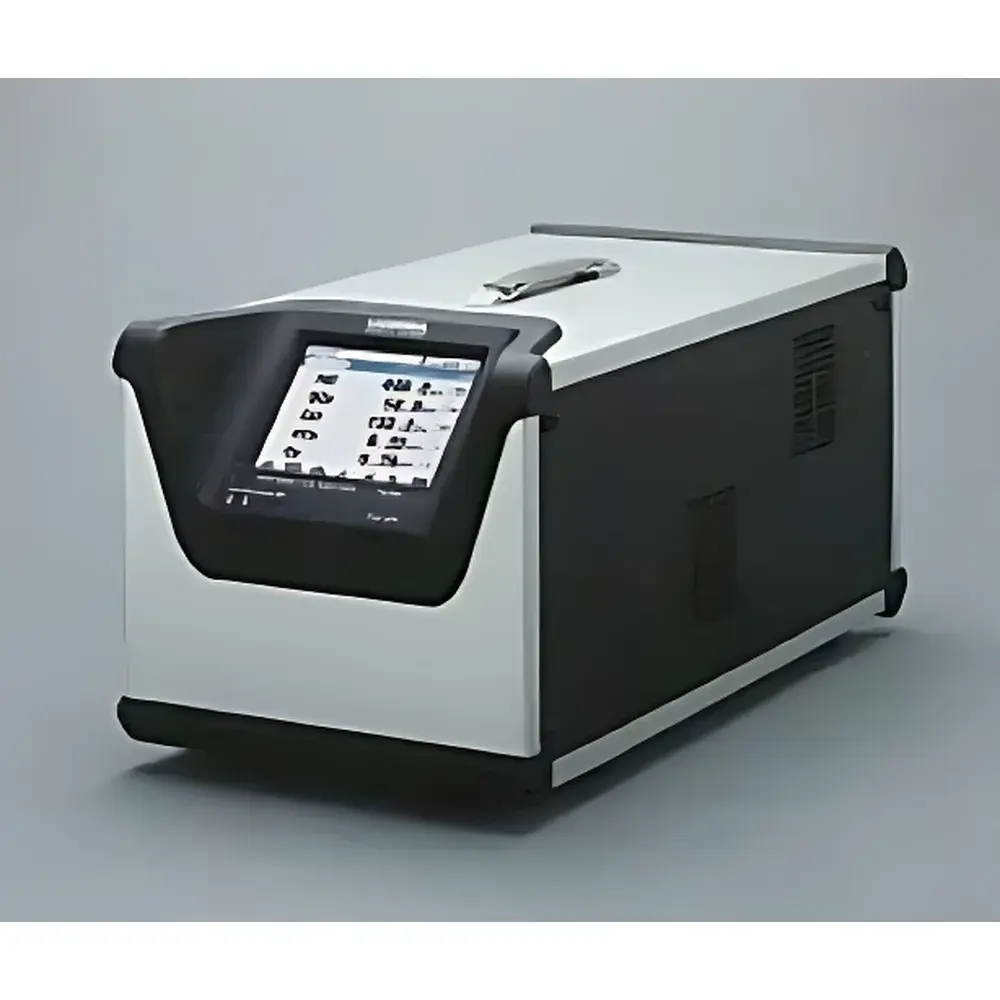
Horiba PG-300 Portable Flue Gas Analyzer
| Origin | Japan |
|---|---|
| Manufacturer Type | Authorized Distributor |
| Origin Category | Imported |
| Model | PG-300 |
| Instrument Type | Portable Flue Gas Analyzer |
| Measurement Accuracy | ≤5% of reading |
| Repeatability | ±1.0% F.S. |
| Response Time (T90) | ≤45 s (SO₂: ≤180 s) |
| Stability | ≤5% F.S. over 24 h |
| Zero Drift | ±1.0% F.S./day (SO₂: ±2.0% F.S./day) |
| Span Drift | ±1.0% F.S./day |
| Linearity Error | ±2.0% F.S. |
| Sample Flow Rate | ~0.5 L/min |
| Power Supply | 100–120 VAC / 200–240 VAC, 50/60 Hz |
| Operating Temperature | 5–40 °C |
| Relative Humidity | ≤85% RH (non-condensing) |
| Dimensions (W×H×D) | 226 × 265 × 510 mm |
| Weight | ~14 kg |
| Data Storage | SD card |
| Output Interfaces | 4–20 mA analog output, Ethernet |
| Warm-up Time | 30 min (±2.0% F.S. drift within 2 h) |
Overview
The Horiba PG-300 Portable Flue Gas Analyzer is an engineered solution for on-site, real-time measurement of combustion exhaust gases in industrial, municipal, and regulatory compliance applications. Designed and manufactured in Japan, the PG-300 employs a multi-principle detection architecture to ensure high specificity and metrological integrity across six key gas species: SO₂, NOₓ (NO + NO₂), CO, CO₂, O₂, and optionally CH₄. Its core analytical methods include alternating flow modulation chemiluminescence (AFCM) for NOₓ, alternating flow modulation non-dispersive infrared (AFM-NDIR) for SO₂, CO, and CH₄, conventional non-dispersive infrared (NDIR) for CO₂, and electrochemical (galvanic cell) sensing for O₂. This hybrid sensor strategy eliminates cross-sensitivity issues common in single-technology platforms and enables simultaneous, independent quantification under variable stack conditions — including fluctuating temperature, moisture content, and particulate load. The instrument meets the fundamental performance expectations of ISO 12039, EN 15267-3, and EPA Method 6C/7E for portable emission monitoring systems, and is routinely deployed for periodic stack testing, boiler efficiency audits, and pre-commissioning verification per local environmental authority requirements.
Key Features
- Multi-gas capability with factory-calibrated, field-replaceable sensor modules for SO₂, NOₓ, CO, CO₂, O₂, and optional CH₄
- Seven selectable NOₓ ranges (0–25 to 0–2500 ppm), four SO₂ ranges (0–200 to 0–3000 ppm), five CO ranges (0–200 to 0–5000 ppm), three CO₂ and O₂ ranges (0–10/20/30 vol% and 0–5/10/25 vol%, respectively)
- High-stability AFCM and AFM-NDIR optical systems delivering ≤5% measurement uncertainty and ±1.0% F.S. repeatability (SO₂: ±2.0% F.S./day drift)
- Integrated sample conditioning: heated sampling probe (optional), particulate filter, water trap, and flow-controlled bypass system maintaining constant 0.5 L/min sample draw
- Real-time display of current gas concentrations (3–4 digit resolution), active range, and actual flow rate on a backlit LCD interface
- Dual-output architecture supporting 4–20 mA analog signals for PLC integration and Ethernet (TCP/IP) for remote data logging and configuration via web-based interface
- Onboard SD card storage with timestamped, CSV-formatted records compliant with GLP traceability requirements
Sample Compatibility & Compliance
The PG-300 is validated for use with flue gases from coal-, oil-, gas-, and biomass-fired combustion sources, including boilers, incinerators, kilns, and cogeneration units. It accommodates gas temperatures up to 200 °C at the probe inlet (with optional high-temp probe) and handles dew points down to 4 °C post-conditioning. All gas path materials are chemically inert (e.g., PTFE-lined tubing, stainless steel fittings), minimizing adsorption or catalytic interference. The analyzer conforms to electromagnetic compatibility standards IEC 61326-1 and safety standard IEC 61010-1. Its measurement methodology aligns with ISO 7933 (CO), ISO 6974-4 (CH₄), and ASTM D6522 (NOₓ), and supports audit-ready documentation for ISO 14001 environmental management systems and EU Industrial Emissions Directive (IED) reporting obligations.
Software & Data Management
Data acquisition and instrument control are managed through Horiba’s proprietary PG-Link software suite, compatible with Windows OS. The software provides live graphing, automatic calibration logging, alarm threshold configuration (high/low limits per channel), and batch export of SD card data with metadata (date/time, operator ID, location tag). Audit trail functionality records all parameter changes, zero/span events, and firmware updates with user authentication. Exported datasets comply with ASTM E2500-17 data integrity guidelines and support direct import into LIMS platforms. Remote diagnostics and firmware updates are supported via secure Ethernet connection under TLS 1.2 encryption, satisfying FDA 21 CFR Part 11 requirements for electronic records where applicable.
Applications
- Periodic stack emission testing per national air quality regulations (e.g., China’s GB 13271, U.S. EPA 40 CFR Part 60)
- Combustion optimization studies to minimize excess O₂ and maximize thermal efficiency
- Pre- and post-SCR/SNCR system performance validation
- Leak detection and fugitive emission screening in refinery and petrochemical facilities
- Environmental due diligence during facility acquisition or decommissioning
- Educational and research use in chemical engineering and environmental science laboratories
FAQ
What calibration gases are required for routine operation?
Certified NIST-traceable span gases (e.g., 500 ppm NO in N₂, 1000 ppm SO₂ in N₂) and zero air are recommended. Calibration frequency follows ISO 14001 internal procedure requirements — typically before each daily use or after transport-induced shock.
Can the PG-300 measure H₂S or NH₃?
No. The PG-300 is not configured for H₂S or NH₃ detection. These species require dedicated electrochemical or tunable diode laser (TDL) sensors not integrated into this platform.
Is the instrument suitable for continuous unattended monitoring?
It is designed for periodic, operator-present measurements rather than 24/7 operation. For permanent installation, Horiba offers the fixed-mount AP-370 series with redundant power, climate control, and automated calibration.
How is moisture handled in hot, wet flue gas streams?
The built-in condensate trap and Nafion™ dryer maintain sample dew point below 4 °C prior to optical cells. Optional heated probe and line prevent condensation upstream of the analyzer.
Does the PG-300 support Modbus RTU or TCP protocols?
Modbus TCP is supported over Ethernet; Modbus RTU is not available. Analog 4–20 mA outputs may be mapped to individual gas channels for SCADA integration.
Related Products







