
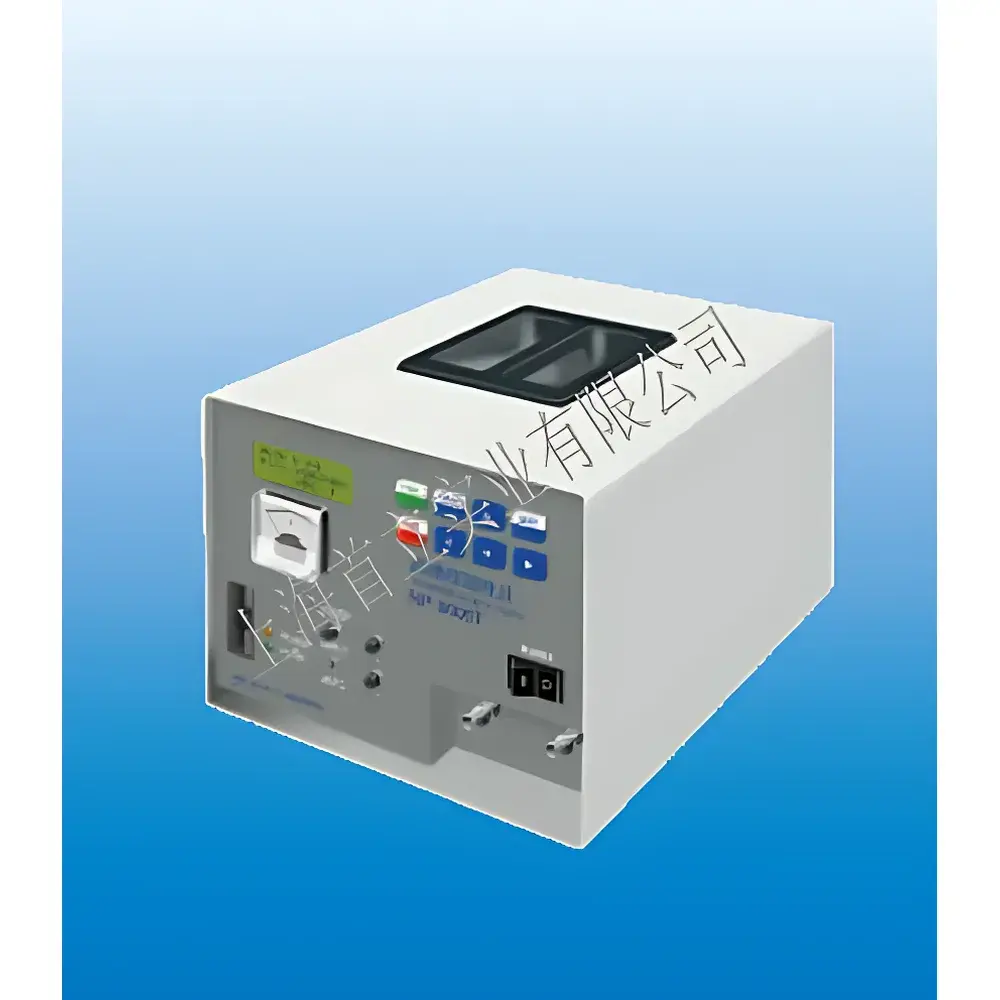
NIPPON DENSHOKU NP6000T High-Sensitivity Turbidimeter & Particle Counter
| Brand | NIPPON DENSHOKU |
|---|---|
| Origin | Japan |
| Model | NP6000T |
| Form Factor | Benchtop Laboratory Instrument |
| Turbidity Range | 0.0000–2.0000 NTU (FS) |
| Particle Size Channels | 0.5–1, 1–3, 3–7, 7–12, 12–15, ≥15 µm |
| Resolution | 0.0001 NTU (turbidity), 1 particle/mL (counting) |
| Flow Rate | 50 mL/min |
| Operating Temperature | 15–35 °C |
| Accuracy | ±2% FS (0–0.5000 NTU), ±5% FS (0.5001–2.0000 NTU) |
| Repeatability (CV) | ≤5% at 0.1000 NTU and 1.4×10⁴ particles/mL (0.5 µm) |
| Light Source | Semiconductor Laser |
| Output Options | 4–20 mA DC (4 channels), RS-232C, Relay Contacts (optional) |
| Dimensions | 257 × 315 × 233 mm (W×D×H) |
| Weight | 9.2 kg |
Overview
The NIPPON DENSHOKU NP6000T is a benchtop high-sensitivity turbidimeter and optical particle counter engineered for simultaneous, real-time quantification of turbidity and suspended particle concentration in low-turbidity aqueous samples—particularly critical in membrane filtration process monitoring, ultrapure water systems, and drinking water treatment validation. It employs the nephelometric principle of single-beam forward scatter detection, optimized for sensitivity in the sub-0.1 NTU range where conventional turbidimeters exhibit diminished resolution and signal-to-noise ratio. The integrated peristaltic sampling pump enables direct aspiration from standard beakers or inline flow cells, minimizing sample handling errors and contamination risk. Its dual-function architecture satisfies both regulatory-grade turbidity compliance (e.g., EPA Method 180.1, ISO 7027-1:2016) and particle-based process control requirements aligned with WHO Guidelines for Drinking-water Quality and USP particulate matter testing.
Key Features
- Simultaneous measurement of turbidity (0.0000–2.0000 NTU) and six discrete particle size distributions: 0.5–1, 1–3, 3–7, 7–12, 12–15, and ≥15 µm—enabling detection of cryptosporidium- and giardia-relevant particulates per EPA Guidance Manual for Filter Performance Monitoring.
- Integrated semiconductor laser source with real-time output intensity monitoring to ensure optical stability and long-term measurement traceability.
- Dedicated detector chamber with electronic dehumidification and continuous contamination monitoring—reducing drift and maintenance intervals in high-humidity laboratory or plant-floor environments.
- Onboard data logging: automatic timestamped storage of turbidity values, total and size-resolved particle counts, flow status, and system diagnostics into hierarchical folders (by date/time).
- Optional compressed-air degassing unit mitigates microbubble interference—a known source of false positives in low-turbidity applications such as RO permeate or pharmaceutical water systems.
- Modular I/O architecture supporting 4-channel 4–20 mA analog outputs (configurable for turbidity + three particle bands), RS-232C serial communication, and dry-contact relay alarms for out-of-spec conditions.
Sample Compatibility & Compliance
The NP6000T accepts liquid samples via 4 mm OD PTFE tubing and operates continuously at 50 mL/min flow rate, compatible with filtered tap water, membrane filtrate, ultrapure water (UPW), and clarified process streams. Its optical design conforms to ISO 7027-1:2016 (infrared 860 nm light source, 90° scatter geometry) for turbidity, while particle counting adheres to ISO 21501-4:2018 principles for light-scattering particle sizers. Data integrity meets GLP/GMP expectations through audit-trail-capable firmware (with optional time-stamped user login and parameter change logs). When paired with validated data transfer software, reports—including daily/weekly/monthly trend summaries—support internal QA documentation and regulatory submissions under FDA 21 CFR Part 11 (with appropriate system configuration and administrative controls).
Software & Data Management
Raw measurement data—including turbidity (NTU), total particle count (particles/mL), and six size-bin counts—are stored locally in non-volatile memory with millisecond-level timestamps. A dedicated Windows-based data management application (sold separately) provides secure import, visualization, and export functions. Users generate customizable reports: time-series plots, statistical summaries (mean, SD, CV%), pass/fail flagging against configurable thresholds, and CSV/PDF exports compliant with LIMS integration protocols. All exported files retain embedded metadata (instrument ID, calibration date, operator ID, environmental conditions) to satisfy traceability requirements in regulated laboratories.
Applications
- Monitoring low-turbidity effluent from ultrafiltration (UF) and reverse osmosis (RO) systems in municipal and industrial water treatment plants.
- Validation of filter integrity and breakthrough detection during pharmaceutical water-for-injection (WFI) and purified water (PW) production.
- Research on colloidal stability, coagulation efficiency, and disinfectant by-product precursor removal in pilot-scale studies.
- Quality control of optical-grade solvents and reagents where sub-0.01 NTU clarity is specified (e.g., semiconductor manufacturing).
- Environmental monitoring of treated wastewater discharge points requiring simultaneous turbidity and pathogen surrogate particle reporting.
FAQ
What turbidity standards are supported for calibration?
The NP6000T supports calibration using formazin, AMCO AEPA, or primary-standard StablCal® suspensions traceable to NIST SRM 2001 series. Calibration routines follow ISO 7027-1 procedures with multi-point verification across the full 0–2.0000 NTU range.
Can the particle size bins be reconfigured?
Yes—optional firmware upgrades allow adjustment of lower and upper size thresholds within defined limits; factory-default bins align with EPA Cryptosporidium monitoring guidance (0.5–1 µm and ≥15 µm being most critical).
Is the instrument suitable for unattended 24/7 operation?
Yes—its robust thermal management, sealed optical path, and built-in pump duty-cycle control enable continuous operation. Optional relay outputs support integration with SCADA for alarm escalation and automated shutdown protocols.
How is data security handled during transfer?
Data transmission via RS-232C uses hardware handshaking and CRC error checking. When used with the official data manager, encrypted local database storage and role-based access control (RBAC) options are available to meet GxP data governance policies.
Does the NP6000T comply with USP for injectable solutions?
While designed for water system monitoring—not direct pharmaceutical product testing—the NP6000T’s particle counting performance (CV ≤5%, ±5% FS accuracy at 0.5 µm) meets the sensitivity and repeatability benchmarks referenced in USP , provided method suitability is demonstrated per Chapter requirements.




