
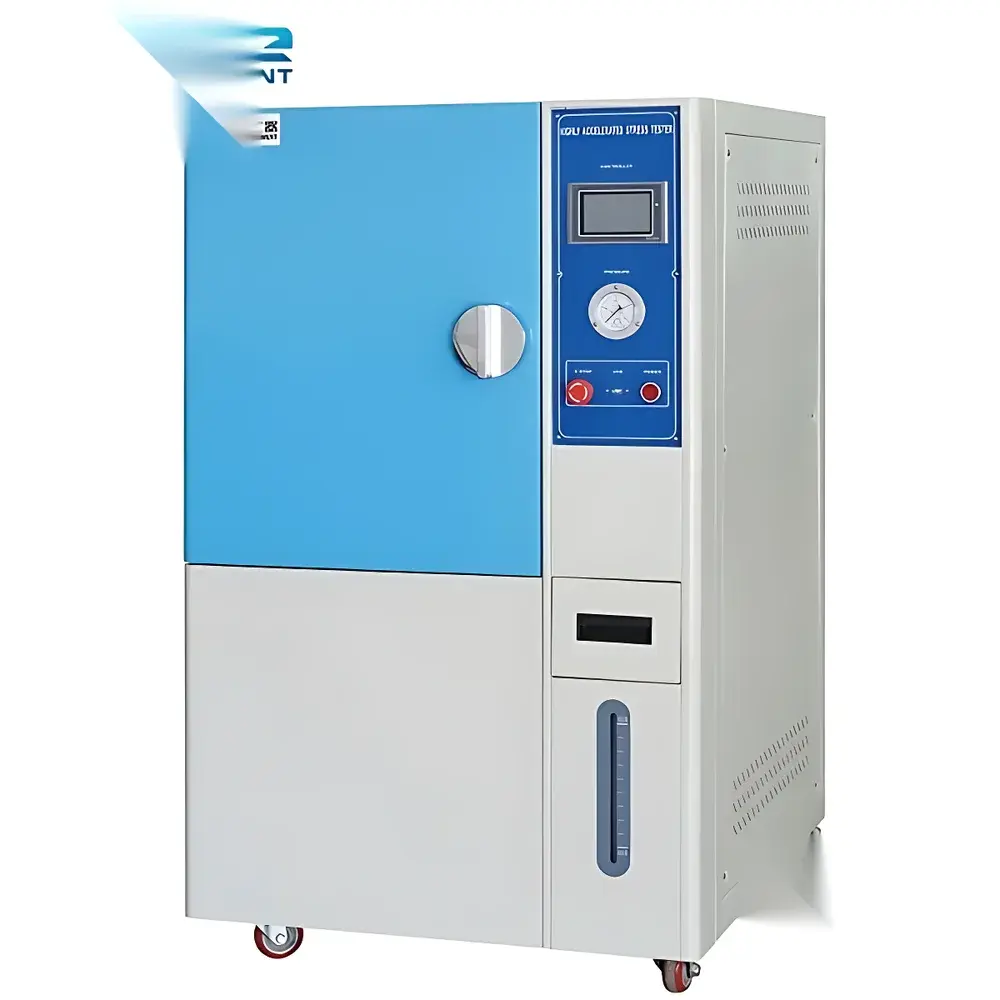
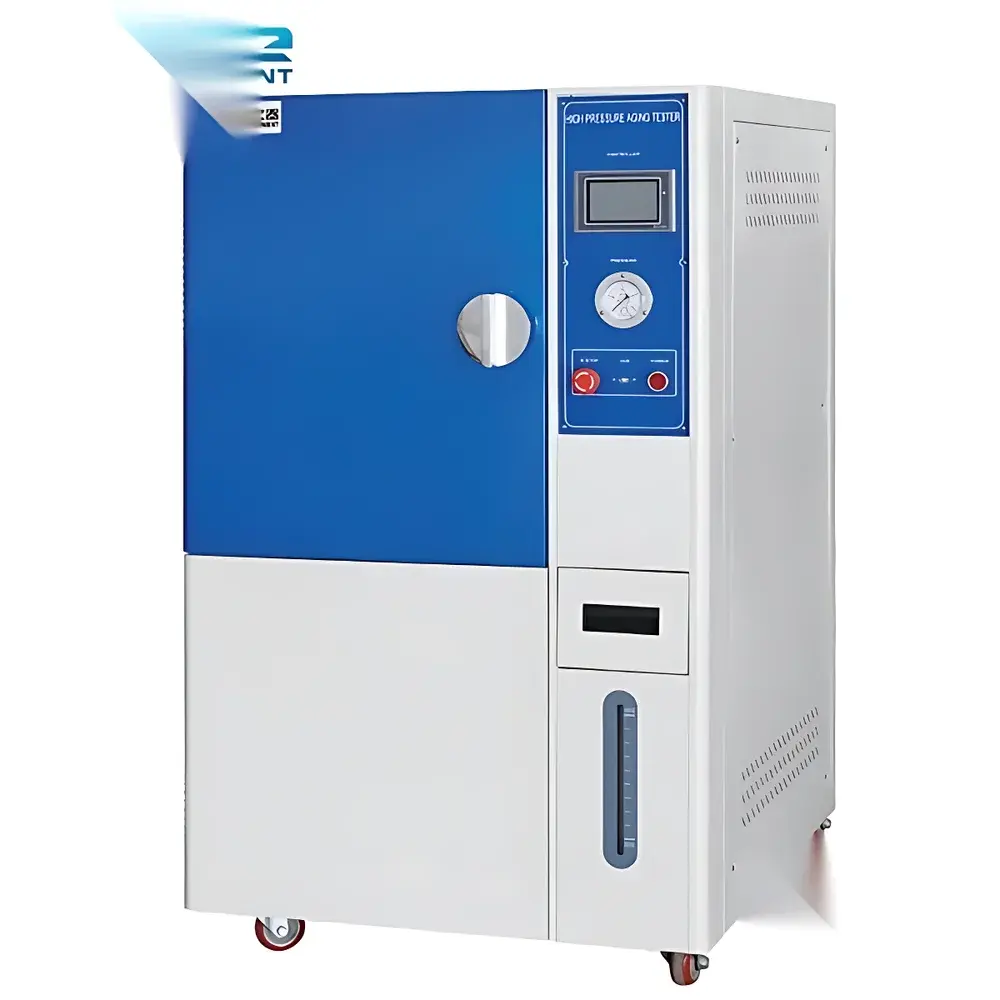
OK-PCT Series High-Pressure Saturated Steam Aging Test Chamber
| Brand | OK |
|---|---|
| Model | OK-PCT-35 / OK-PCT-45 / OK-PCT-55 / OK-PCT-65 |
| Type | High-Pressure Accelerated Aging Test Chamber (PCT) |
| Temperature Range | 121 °C, 132 °C (143 °C optional) |
| Operating Pressure | 0–2.0 kg/cm² (gauge), up to 3.0 kg/cm² (custom) |
| Humidity | 100 % RH saturated steam |
| Uniformity | ±2 °C temperature, ±3 % RH |
| Chamber Geometry | Cylindrical stainless steel inner chamber |
| Safety Systems | Dual-pressure interlocked door, mechanical safety valve, auto-water replenishment, dry-run & overtemperature cutoffs |
| Power Supply | AC 220 V ±5 %, 50 Hz ±0.5 Hz |
| Compliance | Designed per IEC 60068-2-66, JIS C 60068-2-66, MIL-STD-202 Method 108, and aligned with IPC-TM-650 2.6.25 for pressure cooker test (PCT) qualification of electronic assemblies |
Overview
The OK-PCT Series High-Pressure Saturated Steam Aging Test Chamber is an engineered environmental stress test system designed to perform accelerated moisture resistance evaluation under controlled high-pressure saturated steam conditions. Based on the fundamental principle of pressure-enhanced water vapor diffusion, the chamber subjects test specimens—particularly hermetically sealed or multilayer electronic components—to elevated temperature and absolute pressure environments that significantly accelerate hydrolytic degradation mechanisms. Unlike ambient-pressure humidity chambers, the PCT chamber operates at pressures above atmospheric (up to 300 kPa gauge), enabling rapid saturation of moisture-sensitive interfaces (e.g., die attach, wire bonds, molding compound–leadframe boundaries) without requiring prolonged exposure times. This makes it indispensable for reliability qualification in aerospace, automotive electronics (AEC-Q200), medical device packaging, and semiconductor manufacturing, where early detection of delamination, popcorning, or corrosion-induced failure modes is critical during design validation and process qualification phases.
Key Features
- Cylindrical stainless steel inner chamber conforming to ASME BPVC Section VIII Div. 1 design principles for pressure vessels—ensures structural integrity and long-term corrosion resistance under repeated thermal cycling and saturated steam exposure.
- Microprocessor-based PID controller with LED digital display for precise regulation of saturated steam temperature (±0.5 °C setpoint stability) and real-time monitoring of chamber pressure (0–300 kPa gauge).
- Patented dual-interlock safety door mechanism: integrated pressure-sensing lock prevents door opening when internal pressure exceeds 10 kPa above ambient; increasing internal pressure enhances sealing force via reverse-pressure clamping—eliminating conventional gasket compression fatigue.
- Optimized steam distribution geometry with radial inner liner minimizes direct condensate impingement on samples, reducing localized thermal shock and improving test reproducibility across load configurations.
- Auto-replenishment water reservoir with level sensor and fail-safe dry-run protection—supports uninterrupted operation for up to 200 hours per fill cycle, reducing operator intervention and ensuring protocol compliance.
- Integrated mechanical safety relief valve (ASME-certified) calibrated to vent at 10% above maximum rated working pressure—provides redundant overpressure protection independent of electronic controls.
- LED time controller with programmable soak duration (0–999 hours), compatible with standard test profiles including JEDEC JESD22-A102 (PCT), IPC-TM-650 2.6.25, and MIL-STD-202 Method 108.
Sample Compatibility & Compliance
The OK-PCT chamber accommodates a wide range of sample geometries—including IC packages (QFP, BGA, CSP), PCBAs, MEMS sensors, LED modules, medical implant housings, and automotive ECUs—via adjustable stainless steel shelving. Its cylindrical cavity design ensures uniform steam penetration regardless of part orientation, mitigating shadowing effects common in rectangular chambers. The system meets functional requirements of multiple international standards governing accelerated moisture sensitivity testing: IEC 60068-2-66 (damp heat, accelerated), JIS C 60068-2-66, and IPC-J-STD-020 (Moisture Sensitivity Level classification). While not certified as a Class I medical device, its construction and control architecture support GLP-compliant documentation workflows when paired with external audit-trail-capable data loggers.
Software & Data Management
The chamber operates as a standalone hardware platform with embedded firmware; no proprietary software is required for basic operation. All critical parameters—temperature, pressure, elapsed time, and water level—are continuously logged to non-volatile memory and displayed in real time on the front-panel LED interface. Optional RS-485 Modbus RTU output enables integration with third-party SCADA systems or LIMS platforms for automated data capture, trend analysis, and 21 CFR Part 11–compliant electronic records (when deployed with validated timestamping and user-access controls). Calibration certificates for temperature and pressure sensors are provided traceable to NIST or equivalent national metrology institutes.
Applications
- Qualification of moisture barrier performance in plastic-encapsulated microcircuits (PEMs) prior to reflow soldering.
- Accelerated life testing of conformal coatings, potting compounds, and encapsulants used in harsh-environment electronics.
- Validation of hermetic seal integrity in optoelectronic modules and MEMS pressure sensors.
- Process capability assessment of wafer-level packaging (WLP) and fan-out wafer-level packaging (FOWLP) technologies.
- Failure mode analysis (FMA) of popcorning, wire bond lift-off, and mold compound cracking under combined thermal-mechanical-hygroscopic stress.
- Supporting accelerated aging protocols for ISO 10993-12 biocompatibility assessments of polymer-based medical device housings.
FAQ
What is the maximum allowable operating pressure for standard OK-PCT models?
Standard units are rated for 200 kPa gauge (≈30 psi), with optional 300 kPa gauge configuration available upon request.
Does the chamber support automated data export?
Yes—via RS-485 Modbus RTU interface; raw parameter streams can be ingested by LabVIEW, Ignition SCADA, or custom Python-based logging tools.
Is calibration performed before shipment?
Each unit ships with factory calibration reports for temperature (PT100 sensor) and pressure (piezoresistive transducer), both traceable to national standards.
Can the chamber be used for non-electronic materials such as adhesives or elastomers?
Yes—provided the material’s thermal decomposition temperature exceeds 143 °C and it does not react chemically with saturated steam at elevated pressure.
What maintenance intervals are recommended?
Quarterly inspection of door seal integrity, annual verification of safety valve setpoint, and biannual cleaning of the water reservoir and steam generator chamber using deionized water.



