
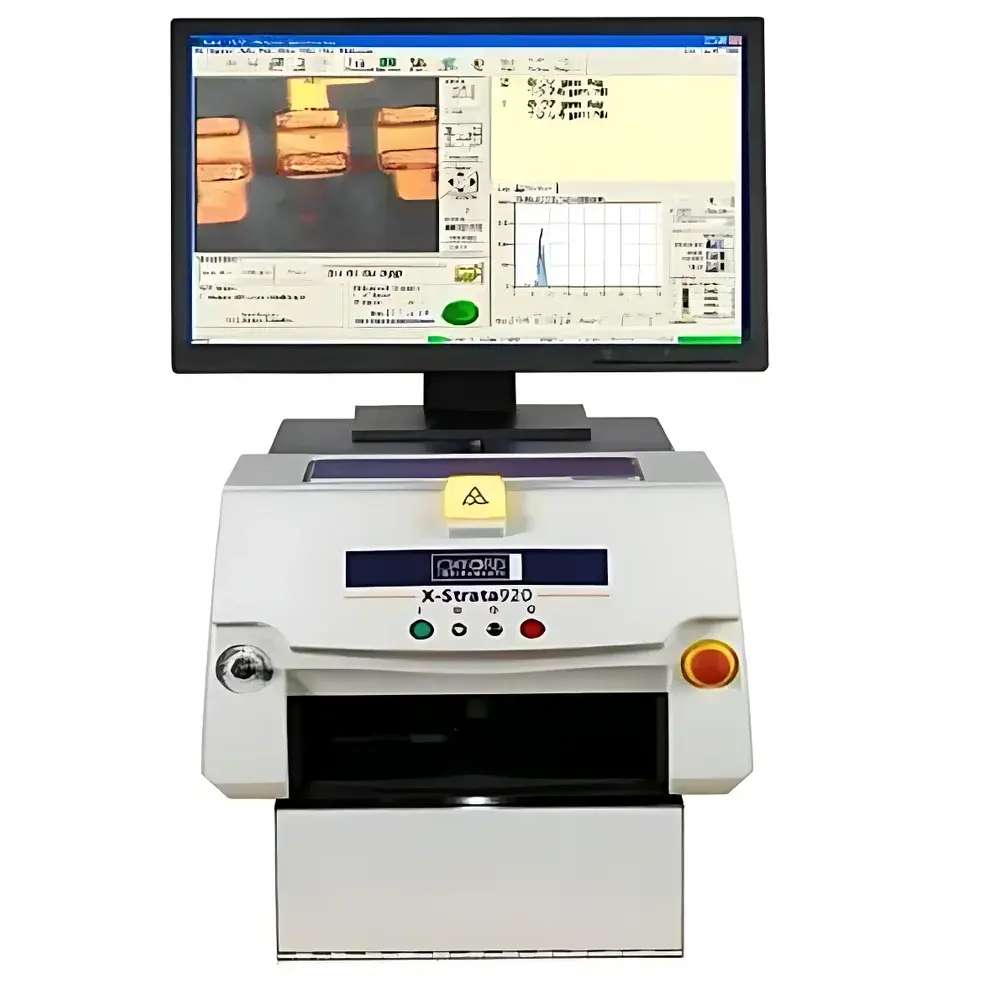
Hitachi X-Strata920 Benchtop Energy Dispersive X-ray Fluorescence (EDXRF) Coating Thickness Analyzer
| Origin | Japan |
|---|---|
| Manufacturer Type | Authorized Distributor |
| Origin Category | Imported |
| Model | X-Strata920 |
| Price Range | USD 68,000 – 136,000 |
Overview
The Hitachi X-Strata920 is a benchtop energy dispersive X-ray fluorescence (EDXRF) analyzer engineered for high-precision, non-destructive measurement of metallic and alloy coating thicknesses on solid substrates. Operating on the fundamental principle of characteristic X-ray emission following primary X-ray excitation, the system quantifies elemental composition and layer mass per unit area—converted to thickness using matrix-matched calibration standards and fundamental parameter (FP) algorithms. Designed for routine quality control in industrial manufacturing environments, the X-Strata920 delivers traceable, repeatable results compliant with internationally recognized test methods including ISO 3497 (Metallic coatings — Measurement of coating thickness — X-ray spectrometric methods) and ASTM B568 (Standard Test Method for Measurement of Coating Thickness by X-Ray Spectrometry). Its robust mechanical architecture and optimized X-ray optics support stable long-term performance without requiring liquid nitrogen cooling or vacuum pumping—enabling operation in standard laboratory or near-line production settings.
Key Features
- Non-destructive, rapid EDXRF analysis with typical measurement times under 60 seconds per spot
- Simultaneous quantification of up to 25 elements—from titanium (Z = 22) to uranium (Z = 92)—enabling multi-layer stack characterization (up to 4 layers + substrate)
- Automated spectral deconvolution with overlap correction for interfering X-ray lines (e.g., Cr Kβ / Fe Kα, Pb Mα / Sb Kα), ensuring accuracy in complex plating systems
- Dual-mode sample chamber: “Deep-well” configuration (max. sample height: 160 mm / 6.3″) with four-position Z-adjustable stage slots; “Slot-type” mode for oversized flat samples such as PCBs exceeding instrument width
- Motorized Z-axis control with 43 mm (1.7″) travel range, enabling precise focal distance optimization for variable sample topography
- Compact footprint (W × D × H: 380 × 530 × 430 mm) suitable for integration into QC labs or adjacent to production lines
- Integrated USB 2.0 and Ethernet interfaces for direct connection to printers, external storage, and enterprise LIMS or MES networks
Sample Compatibility & Compliance
The X-Strata920 accommodates a broad range of sample geometries—from small electronic components (e.g., connector pins, SMD terminals) to large-area substrates (e.g., automotive body panels, printed circuit boards >300 mm wide). The chamber interior dimensions (152 × 279 × 508 mm H × W × D) provide unobstructed access while maintaining optimal take-off geometry for consistent excitation-detection efficiency. All measurements adhere to ISO/IEC 17025 traceability requirements when performed using certified reference materials (CRMs) and validated calibration curves. The system supports GLP-compliant workflows through audit-trail-enabled software logging, user-access controls, and electronic signature capability—meeting foundational expectations for FDA 21 CFR Part 11 readiness in regulated electronics and medical device manufacturing.
Software & Data Management
Controlled via Hitachi’s proprietary XRFQuant software, the X-Strata920 provides intuitive method setup, real-time spectral visualization, and automated report generation in PDF or CSV formats. Calibration models are stored with metadata (date, operator, instrument ID, CRM lot number), supporting full data lineage. Batch analysis mode enables sequential measurement of multiple points across a single part or across a production lot, with pass/fail thresholds defined per layer and element. Raw spectra and processed results are exportable for third-party statistical process control (SPC) platforms. Software updates are delivered via secure HTTPS channels, with version history maintained in the system log.
Applications
- Electroplating QC: Thickness verification of Ni, Cu, Sn, Au, Ag, Pd, Rh, and Cr layers on PCBs, semiconductor leadframes, and automotive fasteners
- Decorative finishing: Quantitative analysis of brass, bronze, or stainless steel substrates coated with Zn-Ni, Cr, or TiN
- Jewelry authentication: Non-invasive assessment of karat gold plating over base alloys (e.g., Cu/Zn substrates) and detection of surface enrichment artifacts
- Aerospace component certification: Verification of anodized Al oxide thickness and sealant composition per AMS 2469 or MIL-A-8625
- Recycled metal sorting: Rapid identification and quantification of alloying elements in scrap feedstock prior to remelting
FAQ
Does the X-Strata920 require vacuum or helium purge for light element analysis?
No—the system operates in ambient air and is optimized for elements from Ti upward; light elements (e.g., Mg, Al, Si) are not routinely quantified due to atmospheric absorption limitations.
Can it measure organic or polymer-based coatings?
No—EDXRF is insensitive to low-Z matrices; the X-Strata920 is intended exclusively for inorganic metallic and alloy coatings on conductive or semi-conductive substrates.
Is hardware calibration required after shipment?
Yes—a factory-performed energy calibration and geometric alignment are verified during installation; annual recalibration using NIST-traceable CRMs is recommended for ISO 17025 compliance.
What is the minimum measurable coating thickness?
Detection limits vary by element pair and substrate but typically range from 0.01 µm (for high-Z coatings on low-Z substrates, e.g., Au/Ni) to 0.5 µm (for low-Z coatings on high-Z substrates, e.g., Zn/Fe).
Is remote diagnostics supported?
Yes—optional remote maintenance module enables secure, encrypted technician access for firmware updates and diagnostic troubleshooting under customer IT policy approval.



