
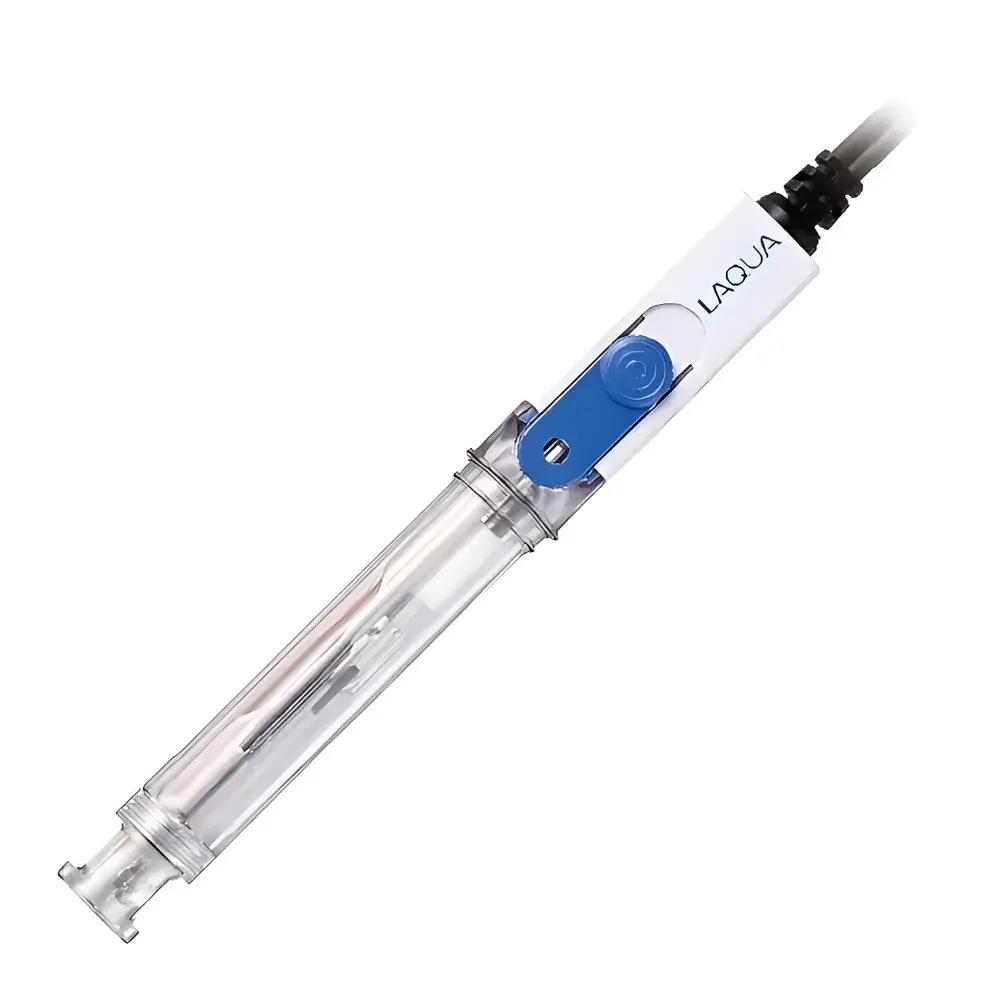
HORIBA 9630-10D Conventional Five-Parameter Water Quality Analyzer
| Origin | Japan |
|---|---|
| Manufacturer Type | Authorized Distributor |
| Origin Category | Imported |
| Model | 9630-10D |
| Price Range | USD 1,400–7,000 |
| Instrument Type | Benchtop Laboratory Analyzer |
| Temperature Range | 0–50 °C |
| pH Range | 0–16 |
| Dissolved Oxygen (DO) | 0–50.00 mg/L (or 0–5000% saturation, depending on calibration mode) |
| Conductivity Range | 0–5000 µS/cm |
| Turbidity Range | 0–1000 NTU |
Overview
The HORIBA 9630-10D is a benchtop laboratory-grade five-parameter water quality analyzer engineered for precise, simultaneous measurement of temperature, pH, dissolved oxygen (DO), electrical conductivity (EC), and turbidity in freshwater, drinking water, and treated effluent samples. Built upon HORIBA’s legacy in electrochemical and optical sensing technologies, the instrument employs potentiometric pH detection with low-conductivity-optimized electrodes, galvanic DO sensors with temperature-compensated diffusion membranes, four-electrode conductivity cells for stable high-range measurements, and ISO 7027-compliant 90° scattered-light turbidimetry. Its architecture supports traceable, repeatable analysis under controlled lab conditions—making it especially suited for regulatory verification, process validation, and method development in municipal water treatment facilities, environmental testing laboratories, and academic research settings where compliance with ASTM D1293 (pH), ASTM D888 (DO), ASTM D1125 (conductivity), and EPA Method 180.1 (turbidity) is required.
Key Features
- Integrated multi-sensor probe interface supporting interchangeable, field-calibratable sensor modules—each with embedded NIST-traceable calibration memory.
- Dedicated low-conductivity pH electrode with double-junction reference system and polymer electrolyte gel, minimizing junction potential drift in samples <50 µS/cm (e.g., finished drinking water, deionized water).
- Galvanic DO sensor with Teflon®-coated membrane and built-in temperature compensation (±0.1 °C resolution), delivering <2% RSD repeatability at 2–10 mg/L across 15–25 °C.
- Four-electrode conductivity cell (cell constant K = 1.0 cm⁻¹) enabling linear response from 0.1 to 5000 µS/cm without range switching or manual cell constant adjustment.
- Optical turbidity module compliant with ISO 7027:2016, using an 860 nm LED light source and precision 90° scatter detection—validated against Formazin and AMCO-AE standards.
- Built-in real-time data logging (up to 10,000 records), USB-C connectivity, and GLP-compliant audit trail including operator ID, calibration timestamps, and sensor serial numbers.
Sample Compatibility & Compliance
The 9630-10D is validated for use with potable water, surface water, groundwater, and clarified wastewater. It meets design requirements for ISO/IEC 17025:2017 accredited laboratories and supports documentation necessary for FDA 21 CFR Part 11 compliance when paired with HORIBA’s optional LabSolutions QA software (version 3.2+). All sensor modules comply with RoHS 2011/65/EU and carry CE marking per Directive 2014/30/EU (EMC) and 2014/35/EU (LVD). Calibration protocols align with USP (turbidity), USP (pH), and ISO 5814:2012 (electrochemical DO determination).
Software & Data Management
Data acquisition and reporting are managed via HORIBA’s LabSolutions QA desktop application (Windows 10/11, 64-bit), which provides automated calibration curve generation, statistical QC charting (X-bar/R, trend analysis), and export to CSV, PDF, or LIMS-compatible XML formats. The software enforces electronic signature workflows, full audit trail retention (>18 months), and user role-based access control (admin, analyst, reviewer). Raw sensor outputs—including mV, µA, and digital counts—are accessible for metrological review. Instrument firmware supports over-the-air updates via secure HTTPS endpoint.
Applications
- Verification of finished drinking water quality per WHO Guidelines and national standards (e.g., China GB 5749-2022, US EPA Drinking Water Standards).
- Performance evaluation of filtration, disinfection, and softening units in water treatment plants.
- Method validation and interlaboratory comparison studies requiring multi-parameter correlation analysis.
- Educational labs conducting AP Chemistry or environmental science curricula on water chemistry fundamentals.
- Supporting ISO 14001 environmental management system audits through documented, repeatable parameter tracking.
FAQ
Can the 9630-10D be used for field sampling?
No—it is designed exclusively as a benchtop laboratory instrument; no IP rating, battery power, or ruggedized housing is provided.
Is the pH electrode compatible with high-chloride or seawater samples?
Not recommended; the low-conductivity electrode is optimized for freshwater matrices (<1000 µS/cm); use HORIBA’s 9630-10S seawater-specific probe for marine applications.
Does the turbidity module require periodic cleaning or lamp replacement?
The LED light source has a rated lifetime of >50,000 hours; optical windows should be cleaned with lint-free wipes and isopropyl alcohol after every 200 measurements in high-turbidity samples (>500 NTU).
How is conductivity accuracy maintained across wide concentration ranges?
The four-electrode cell eliminates polarization error and contact resistance effects; calibration at two points (e.g., 1413 µS/cm and 12.88 mS/cm KCl standards) ensures linearity per ASTM D1125 Annex A1.
Can raw sensor data be exported for third-party statistical analysis?
Yes—CSV exports include timestamp, parameter value, uncertainty estimate, sensor ID, and calibration status flags, fully compatible with JMP, Minitab, and Python pandas workflows.







