
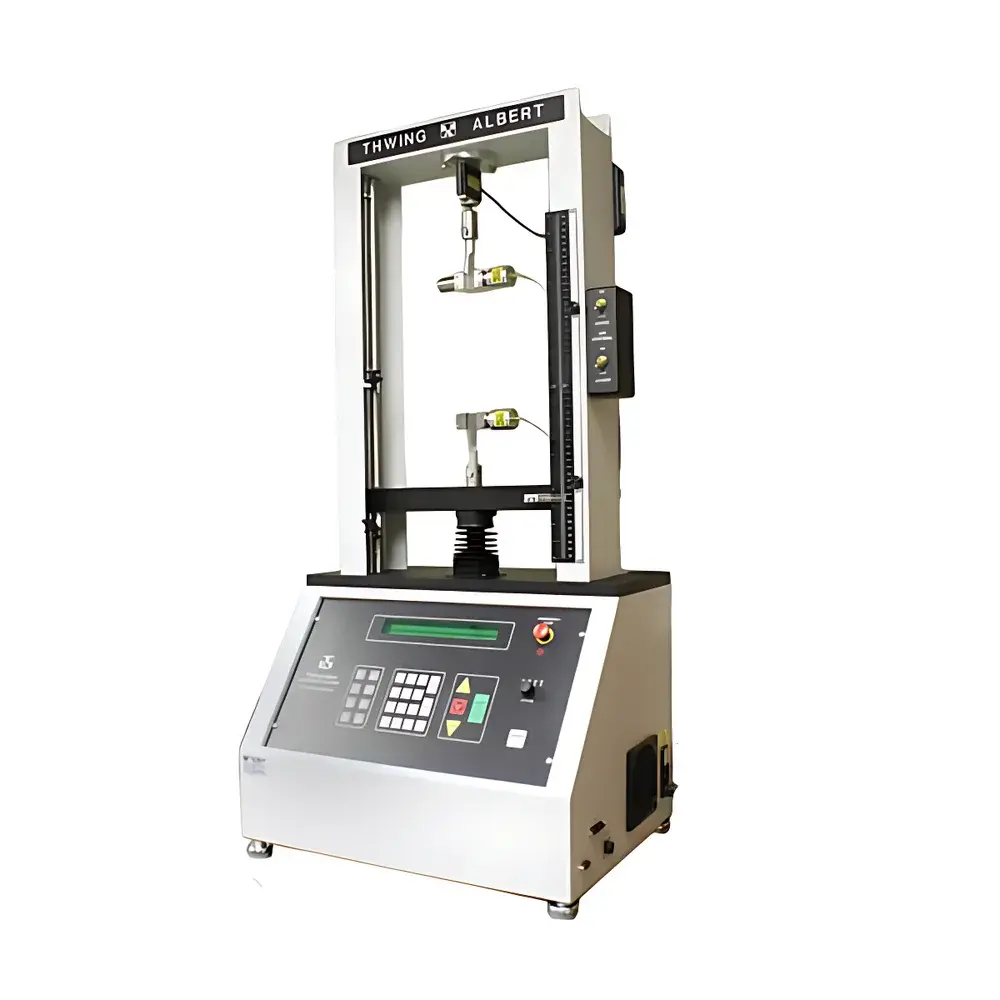
Thwing-Albert QC-3A Universal Testing Machine
| Origin | USA |
|---|---|
| Manufacturer Type | Authorized Distributor |
| Origin Category | Imported |
| Model | QC-3A |
| Price Range | USD 42,000–70,000 |
| Instrument Type | Electromechanical Universal Testing Machine |
Overview
The Thwing-Albert QC-3A Universal Testing Machine is an electromechanical force measurement system engineered for precision mechanical property evaluation of flexible and semi-rigid materials under tension, compression, peel, shear, and coefficient-of-friction conditions. Based on a single-column screw-driven architecture, it operates on the fundamental principle of controlled displacement actuation with high-fidelity load transduction—enabling direct correlation between applied force (measured via calibrated load cell) and specimen deformation (tracked via crosshead travel or extensometer input). Designed specifically for quality control laboratories and production-floor environments, the QC-3A delivers repeatable, traceable mechanical test data compliant with standardized test methods including ASTM D882 (tensile properties of thin plastic sheeting), ASTM D638 (tensile properties of plastics), ASTM F88 (peel strength of flexible barrier materials), TAPPI T494 (tensile strength of paper and paperboard), and ISO 1798 (flexible cellular polymeric materials). Its ruggedized enclosure, dust-resistant construction, and front-panel digital peak-force display support robust operation in non-climate-controlled industrial settings.
Key Features
- Single-column, screw-driven frame delivering up to 5 kN (1100 lbf / 500 kgf) tensile capacity with consistent linearity across full load range
- Digital load controller with integrated signal conditioning, supporting multiple load cell ranges (e.g., 100 N to 5 kN) and automatic unit conversion (lbf, kgf, N, kN)
- RS-232 serial interface for real-time data streaming and automated test result export to Windows-based PCs
- Menu-driven software enabling programmable test profiles: dual-speed control (pre-test approach + test speed), distance- and load-triggered stop conditions, preload application, and user-defined hold times
- Fixed and variable crosshead speeds (0.01–20 in/min or 0.25–508 mm/min) with closed-loop velocity regulation
- Standard travel options: 10″ (254 mm), 18″ (457 mm), and extended-frame configurations (up to 53″/135 cm height) accommodating large specimens or oversized grips
- On-board digital display showing real-time load, peak force, and travel; no external PC required for basic operation
- Statistical analysis module calculating mean, standard deviation, CV%, min/max, and pass/fail thresholds per test batch
Sample Compatibility & Compliance
The QC-3A accommodates a broad spectrum of low-to-medium modulus materials commonly processed in packaging, medical device manufacturing, pulp & paper, and flexible electronics industries. Compatible specimen geometries include films, foils, laminates, nonwovens, elastomeric sheets, corrugated board, adhesive tapes, and thin-walled tubing. Grip configurations—such as pneumatic, wedge, roller, and specialized peel fixtures—are interchangeable without tooling. All mechanical tests align with regulatory expectations for GLP and GMP environments: raw data integrity is preserved via timestamped audit trails, electronic signatures are supported in software-enabled workflows, and instrument calibration certificates comply with ISO/IEC 17025 requirements. The system meets electromagnetic compatibility (EMC) standards per FCC Part 15 Class A and CE directives for industrial equipment.
Software & Data Management
The QC-3A’s native software suite runs on Windows OS and supports both standalone operation and networked deployment. It records force-displacement curves at configurable sampling rates (up to 100 Hz), stores metadata (operator ID, sample ID, test method, environmental notes), and exports ASCII or Excel-compatible CSV files for LIMS integration. Software features include customizable report templates (PDF/HTML), graphical overlay of comparative test curves, automatic calculation of modulus, elongation-at-break, yield point, and peel adhesion energy. Data security protocols conform to FDA 21 CFR Part 11 when used with validated configurations—including electronic signature enforcement, role-based access control, and immutable audit logs covering all test parameter modifications and result deletions.
Applications
- Peel strength validation of pressure-sensitive adhesives (PSAs) per ASTM D3330 and FINAT FTM 1
- Tensile testing of medical-grade films, sterile barrier packaging, and biodegradable substrates
- Compression resistance of corrugated fiberboard (ECT/BCT) and molded pulp trays
- Coefficient of friction (COF) measurement for food packaging films using sled or horizontal plane methods (ASTM D1894)
- Seal strength evaluation of heat-sealed pouches and blister lidding foils
- Mechanical characterization of hydrogels, wound dressings, and soft tissue simulants
- Quality release testing of label facestocks, release liners, and transfer tapes
FAQ
What load cell capacities are available for the QC-3A?
Standard configurations include 100 N, 500 N, 1 kN, and 5 kN load cells; custom ranges may be specified during order placement.
Does the QC-3A support extensometry?
Yes—optional contact and non-contact extensometers can be integrated via analog voltage input or digital encoder interface for strain measurement.
Can test methods be password-protected?
Yes—user roles (Administrator, Technician, Viewer) restrict access to method editing, calibration, and data deletion functions.
Is IQ/OQ documentation available?
Thwing-Albert provides factory-verified Installation Qualification (IQ) and Operational Qualification (OQ) protocols compliant with pharmaceutical and medical device quality systems.
What maintenance is required?
Annual verification of load cell linearity, crosshead alignment, and drive screw lubrication is recommended; no routine calibration is needed between certified intervals.
Related Products



