
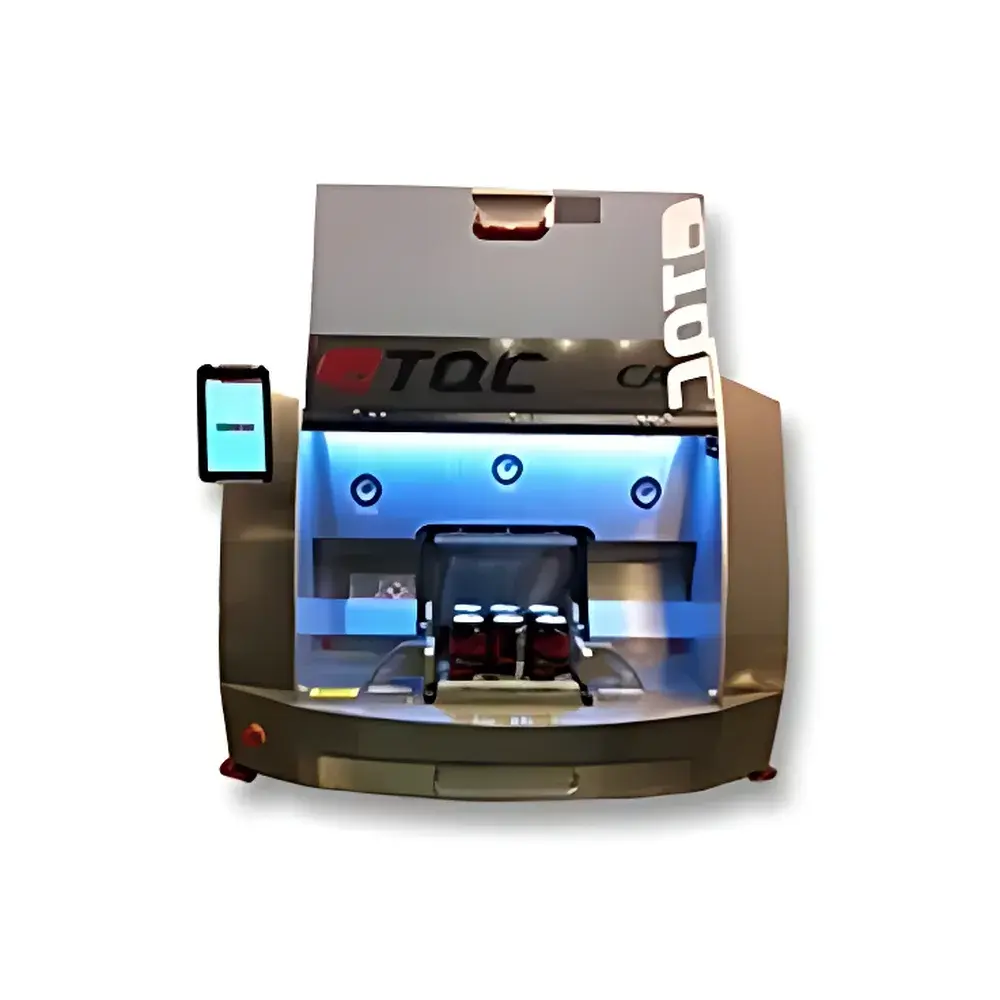
TQC GV Cat Beverage Can Coating Abrasion Tester
| Origin | Netherlands |
|---|---|
| Manufacturer Type | Authorized Distributor |
| Origin Category | Imported |
| Model | GV Cat |
| Price Range | USD 14,000 – 70,000 |
| Instrument Type | Specialty Tribological Tester for Canned Packaging |
| Max Friction Force | Not Specified |
| Friction Force Resolution | mN |
| Oscillation Frequency | 0–2.5 Hz |
| Stroke Length | 0.5–2 in (12.7–50.8 mm) |
| Test Duration | 0–24 h |
Overview
The TQC GV Cat Beverage Can Coating Abrasion Tester is a purpose-built tribological testing instrument engineered to evaluate the mechanical durability and abrasion resistance of polymer-based protective coatings applied to aluminum and steel beverage cans. Unlike generic pin-on-disk or reciprocating wear testers, the GV Cat replicates real-world handling conditions—specifically the lateral rubbing, stacking pressure, and vibration-induced contact experienced during high-speed filling, packaging, palletizing, and transport. Its core operating principle relies on controlled reciprocating oscillation under defined normal load, simulating the repetitive tangential stress between adjacent can surfaces. The system employs a precision-machined cradle mechanism that secures individual cans in upright orientation while subjecting the coated sidewall to calibrated abrasive motion via a motor-driven eccentric drive. This configuration ensures reproducible surface contact geometry and eliminates edge effects common in flat-substrate testers—critical for assessing coating integrity at curvature-sensitive zones such as the body-to-chime transition.
Key Features
- Adjustable cradle assembly accommodating standard beverage can diameters (202–307 ends) and heights (up to 180 mm), with quick-release tool-free interchange of top support brackets for different can geometries.
- Optically transparent polycarbonate safety lid enabling real-time visual monitoring of coating wear progression without interrupting test cycles.
- Integrated electrical penetration detection system: six gold-plated contact points mounted on the upper support frame form a distributed sensing array; high-frequency impedance monitoring identifies localized coating failure (i.e., substrate exposure) and spatially resolves up to seven discrete breach locations along the tested circumference.
- Detachable digital control unit connected via reinforced industrial-grade cable (length ≥ 3 m), permitting remote operation inside environmental chambers (e.g., 5–40 °C, 30–80% RH) or confined laboratory spaces.
- Menu-driven LCD interface with non-volatile memory storing up to 20 user-defined test protocols—including frequency (0–2.5 Hz), stroke amplitude (0.5–2 in), and duration (0–24 h)—and recalling prior session parameters for GLP-compliant repeatability.
- Over-engineered actuation components: oversized brushless DC motor and reinforced pneumatic damping system ensure long-term stability and minimal drift over extended test durations (>10,000 cycles).
Sample Compatibility & Compliance
The GV Cat accepts standard two-piece aluminum beverage cans (e.g., 330 mL, 500 mL formats) and three-piece steel variants with conventional lacquer, epoxy-phenolic, or BPA-free polymer coatings. It complies with fundamental mechanical test principles referenced in ASTM D4060 (Abrasion Resistance of Organic Coatings), ISO 5470-1 (Erosive Wear of Metallic Materials), and aligns with internal quality assurance protocols used by global can manufacturers (e.g., Ball Corporation, Crown Holdings). While not certified to IEC 61000-6-2/4 or UL 61010-1 out-of-the-box, its modular architecture supports third-party validation for ISO/IEC 17025-accredited laboratories conducting routine QC audits per GMP Annex 11 requirements for equipment qualification (IQ/OQ/PQ).
Software & Data Management
The GV Cat operates as a standalone hardware platform with no proprietary PC software dependency. All operational parameters, runtime logs, and event timestamps (including penetration detection triggers) are stored locally in EEPROM with UTC-synchronized clock backup. Export is facilitated via USB-A port supporting CSV-formatted reports compatible with LIMS integration (e.g., LabWare, Thermo Fisher SampleManager). Audit trail functionality records operator ID (via optional RFID badge reader), parameter changes, and system error codes—meeting FDA 21 CFR Part 11 requirements when deployed with validated electronic signature workflows. Firmware updates are delivered via encrypted firmware image files verified using SHA-256 checksums.
Applications
- Accelerated evaluation of new interior/exterior lacquer formulations for corrosion resistance and scuff resistance under simulated warehouse stacking loads.
- Comparative benchmarking of coating adhesion performance across different cure profiles (thermal vs. UV) and substrate pre-treatments (chromate vs. zirconium-based).
- Root cause analysis of field-reported “can marking” defects during high-speed line trials.
- Supporting regulatory submissions for food-contact compliance (e.g., EU Framework Regulation (EC) No 1935/2004, FDA 21 CFR §175.300) by generating traceable abrasion failure thresholds.
- Qualification of recycled aluminum feedstock impact on coating uniformity and interfacial toughness.
FAQ
Does the GV Cat measure quantitative friction coefficient values?
No. It is designed exclusively for pass/fail abrasion endurance assessment and spatial localization of coating breaches—not for tribological coefficient derivation.
Can it test full production-line can batches without manual repositioning?
Each test cycle accommodates one can. High-throughput labs typically deploy multiple GV Cat units in parallel or integrate them into automated sample-handling jigs (custom engineering required).
Is calibration traceable to national metrology institutes?
Oscillation frequency and stroke length are factory-calibrated against NIST-traceable laser interferometry standards; certificate included with shipment. Friction force transduction is not implemented.
What maintenance intervals are recommended for daily QC use?
Visual inspection of cradle liners and contact pins every 500 test hours; replacement of polyurethane wear pads every 2,000 cycles; annual verification of encoder linearity and impedance baseline stability.
Does TQC provide application support for method development?
Yes—TQC’s Applications Lab (Rotterdam) offers remote method optimization services, including protocol adaptation for specialty containers (e.g., aerosol cans, wine closures) and correlation studies against industry-standard scratch or tape-adhesion tests.



