
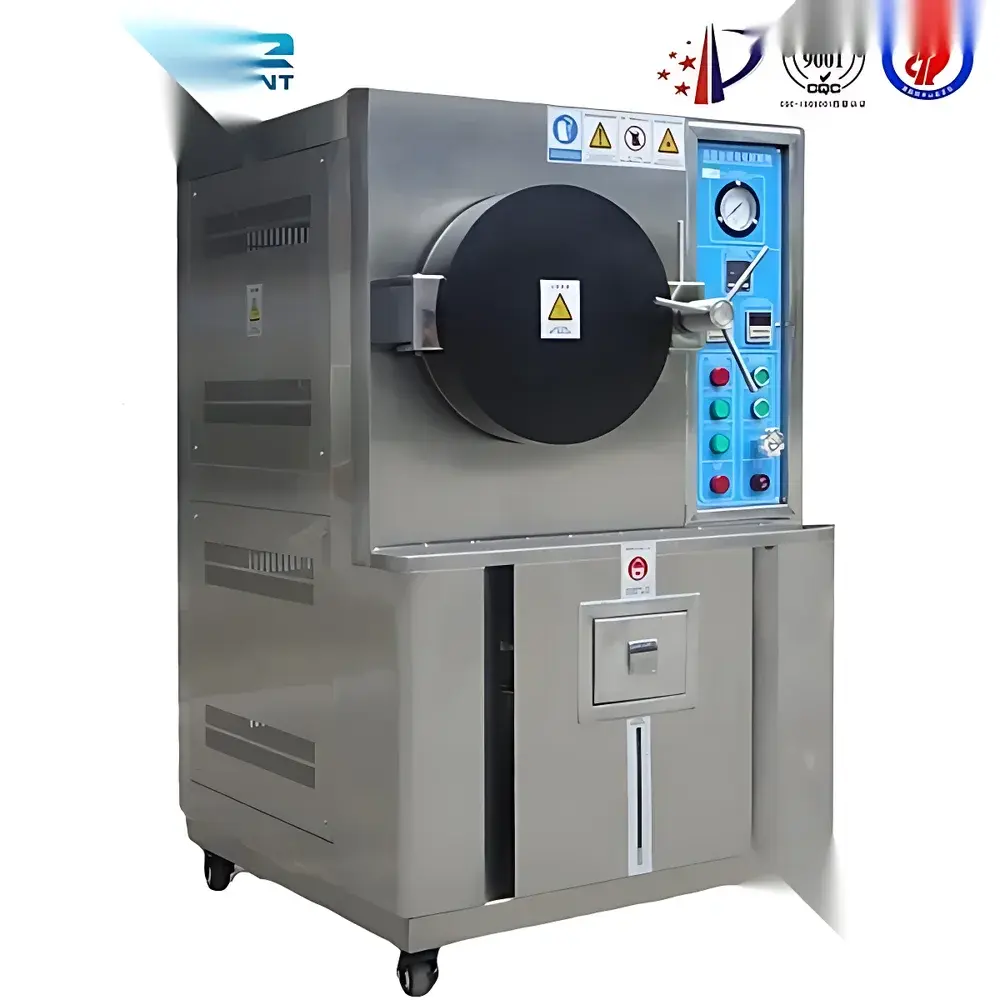
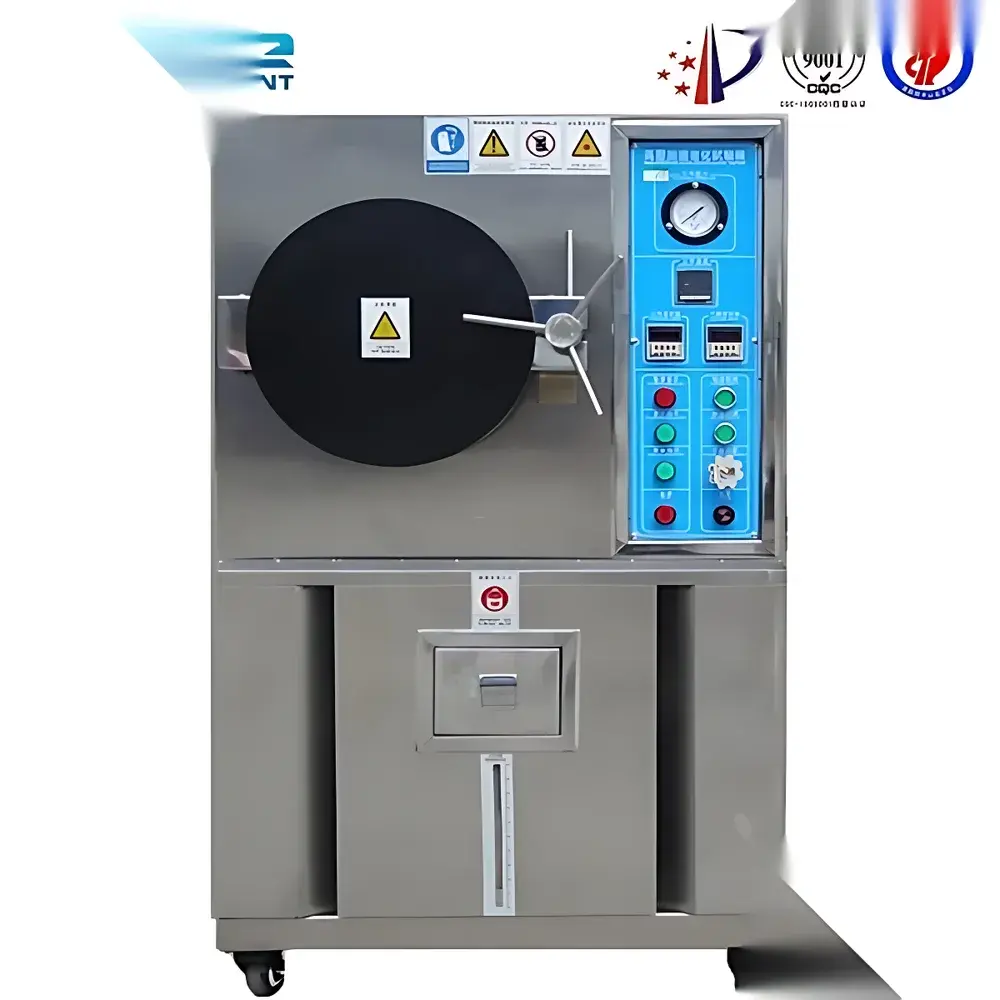
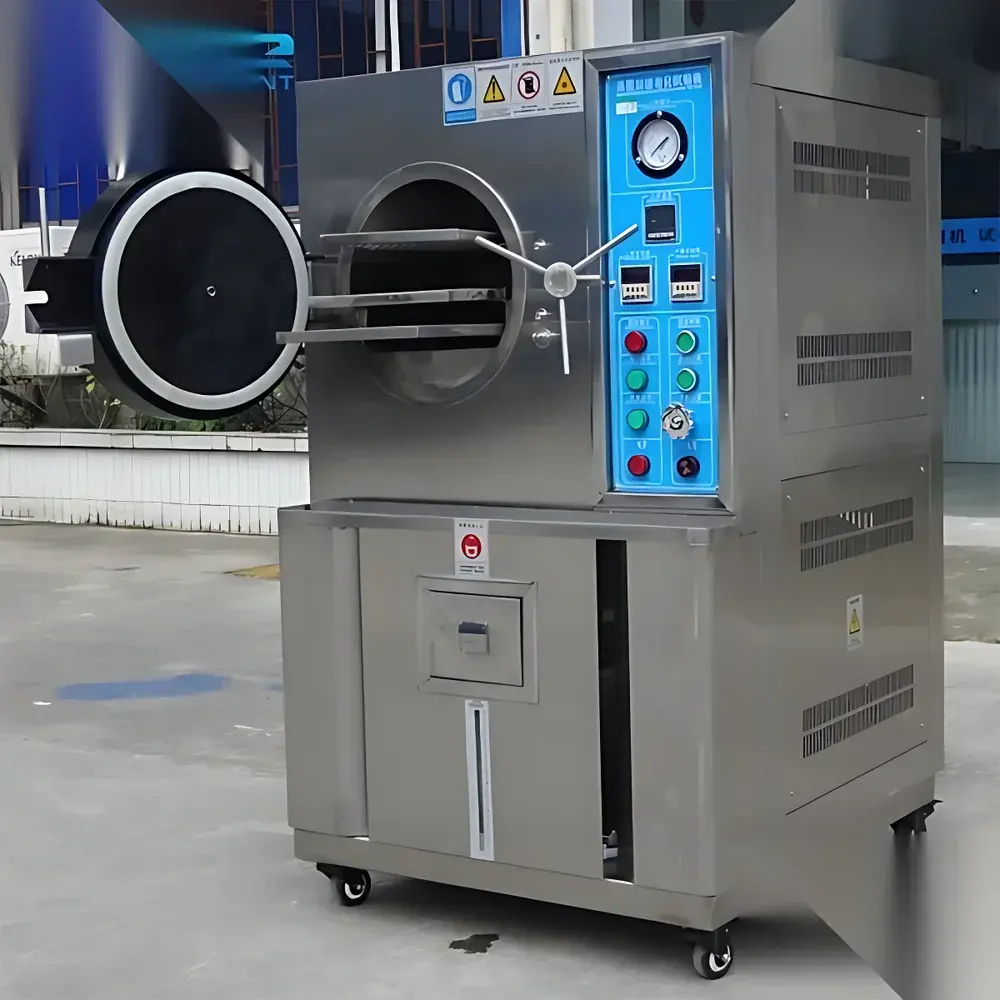
PTC High-Pressure Accelerated Aging Test Chamber
| Brand | OEM |
|---|---|
| Internal Chamber Dimensions | ∅250×450 mm (OK-PTC-25) or ∅350×500 mm (OK-PTC-35) |
| Temperature Range | RT+10°C to 132°C |
| Humidity Range | 100% RH |
| Pressure Range | 0.0–2.8 kg/cm² (gauge), max working pressure 3.0 kg/cm² (absolute), safety limit 4.0 kg/cm² |
| Temp. Uniformity | ±1.5°C |
| Temp. Control Accuracy | ±0.5°C |
| Temp. Resolution | 0.1°C |
| Pressurization Time (0 → 2.0 kg/cm²) | ~30 min |
| Inner Chamber Material | SUS304 stainless steel |
| Outer Cabinet | SECC steel with electrostatic powder coating |
| Compliance | ASTM D2247, DIN 50017, IEC 60068-2-66, ISO 11357-4, JIS C 0045, MIL-STD-810H, UL 1598, NACE TM0177, BS EN 60068-2-30 |
Overview
The PTC High-Pressure Accelerated Aging Test Chamber is an engineered environmental stress test system designed for reliability validation of electronic components, packaging materials, PCBs, conformal coatings, and hermetic seals under combined high-temperature, saturated steam, and elevated pressure conditions. Operating on the principle of accelerated moisture ingress via pressurized saturated vapor (commonly referred to as Pressure Cooker Test or PCT per JEDEC JESD22-A102 and IPC-TM-650 2.6.25), this chamber subjects samples to thermodynamically intensified humidity exposure—effectively reducing time-to-failure by orders of magnitude compared to standard 85°C/85% RH testing. The chamber achieves full saturation at 100% relative humidity across its entire temperature range (RT+10°C to 132°C), while maintaining precise control over both thermal and mechanical variables critical to failure mode replication—including intermetallic growth, wire bond corrosion, delamination, and popcorning in plastic-encapsulated microcircuits.
Key Features
- Two standardized chamber configurations: OK-PTC-25 (∅250 × 450 mm depth) and OK-PTC-35 (∅350 × 500 mm depth), optimized for batch throughput and spatial uniformity.
- Dual-circuit PID + SSR control architecture ensures stable regulation of saturated steam temperature with ±0.5°C setpoint accuracy and 0.1°C digital resolution.
- Integrated platinum resistance thermometer (Pt100) sensing paired with insulated, high-durability heating elements enables repeatable thermal ramping and dwell stability.
- Motor-driven magnetic blower system facilitates natural convection circulation of saturated vapor—eliminating hot/cold spots and ensuring ±1.5°C temperature distribution across the working volume.
- Robust safety architecture includes dual redundant pressure sensors, automatic depressurization valves, vacuum-assisted air purge, and fail-safe door interlock activated by internal gauge pressure differential.
- Circular horizontal chamber geometry minimizes condensate accumulation and prevents direct steam jetting toward operators during loading/unloading—enhancing both process integrity and user protection.
- Automated water replenishment supports continuous operation up to 100 hours per fill; optional fully integrated auto-fill system available upon request.
Sample Compatibility & Compliance
This chamber accommodates a broad spectrum of non-volatile, non-explosive test specimens—including bare die, surface-mount packages (QFN, BGA, SOIC), flex circuits, automotive ECUs, medical device housings, and aerospace-grade composites. All internal wetted surfaces are fabricated from SUS304 stainless steel, ensuring long-term corrosion resistance against repeated exposure to condensed steam and chloride-laden environments. External housing utilizes SECC steel with industrial-grade electrostatic powder coating for mechanical durability and chemical resistance. The system conforms to multiple international standards governing accelerated aging protocols: ASTM D2247 (water immersion), DIN 50017 (condensation test), IEC 60068-2-66 (damp heat, steady state, accelerated), ISO 11357-4 (thermal analysis of polymers), JIS C 0045 (humidity testing), MIL-STD-810H Method 507.6 (humidity), UL 1598 (luminaire moisture resistance), NACE TM0177 (sulfide stress cracking), and BS EN 60068-2-30 (cyclic damp heat). It is also compatible with GLP/GMP documentation workflows when used with validated software modules.
Software & Data Management
While the base configuration features LED-based local control with analog pressure gauges and discrete thermal displays, optional RS485/Modbus RTU or Ethernet-enabled controllers support integration into centralized lab management systems. Data logging (temperature, pressure, runtime, alarm events) can be exported in CSV format for traceability and audit readiness. When deployed in regulated environments (e.g., ISO 13485-certified medical device manufacturing or IATF 16949 automotive supply chains), the system may be qualified to meet FDA 21 CFR Part 11 requirements through third-party validation services—supporting electronic signatures, audit trails, and role-based access control when paired with compliant SCADA or LIMS platforms.
Applications
- Qualification of moisture sensitivity levels (MSL) per JEDEC J-STD-020.
- Evaluation of package integrity and mold compound susceptibility to popcorn cracking.
- Assessment of solder joint reliability under thermo-hygro-mechanical stress.
- Validation of conformal coating performance against blistering, adhesion loss, or ionic contamination.
- Corrosion resistance testing of metallic contacts, connectors, and battery enclosures.
- Accelerated life testing of encapsulated optoelectronic devices and LED modules.
- Process qualification of wafer-level packaging and fan-out wafer-level packaging (FOWLP).
FAQ
What is the maximum allowable test duration per cycle without manual intervention?
Standard configuration supports uninterrupted operation for up to 100 hours on a single water fill. Extended runtime options with automated refill systems are available for unattended multi-day validation studies.
Does the chamber support vacuum pre-conditioning prior to pressurization?
Yes—the integrated vacuum system evacuates ambient air before introducing saturated steam, minimizing oxygen content and enabling controlled inerting if required for oxidation-sensitive samples.
Can the chamber be calibrated and certified to ISO/IEC 17025 standards?
Yes—third-party calibration services are available for temperature, pressure, and humidity sensors, including uncertainty reporting and accredited certificates traceable to NIST or PTB.
Is the pressure reading displayed as absolute or gauge pressure?
The primary display shows gauge pressure (kg/cm²), referenced to atmospheric pressure. Absolute pressure is calculated as 1.0 kg/cm² (1 atm) + gauge value, with safety cutoff enforced at 4.0 kg/cm² absolute (3.0 kg/cm² gauge).
How is door safety ensured during pressurized operation?
A passive mechanical interlock uses internal pressure differential to reinforce the seal between the circular test chamber and safety door—preventing opening until pressure drops below atmospheric level, eliminating risk of explosive decompression.



