
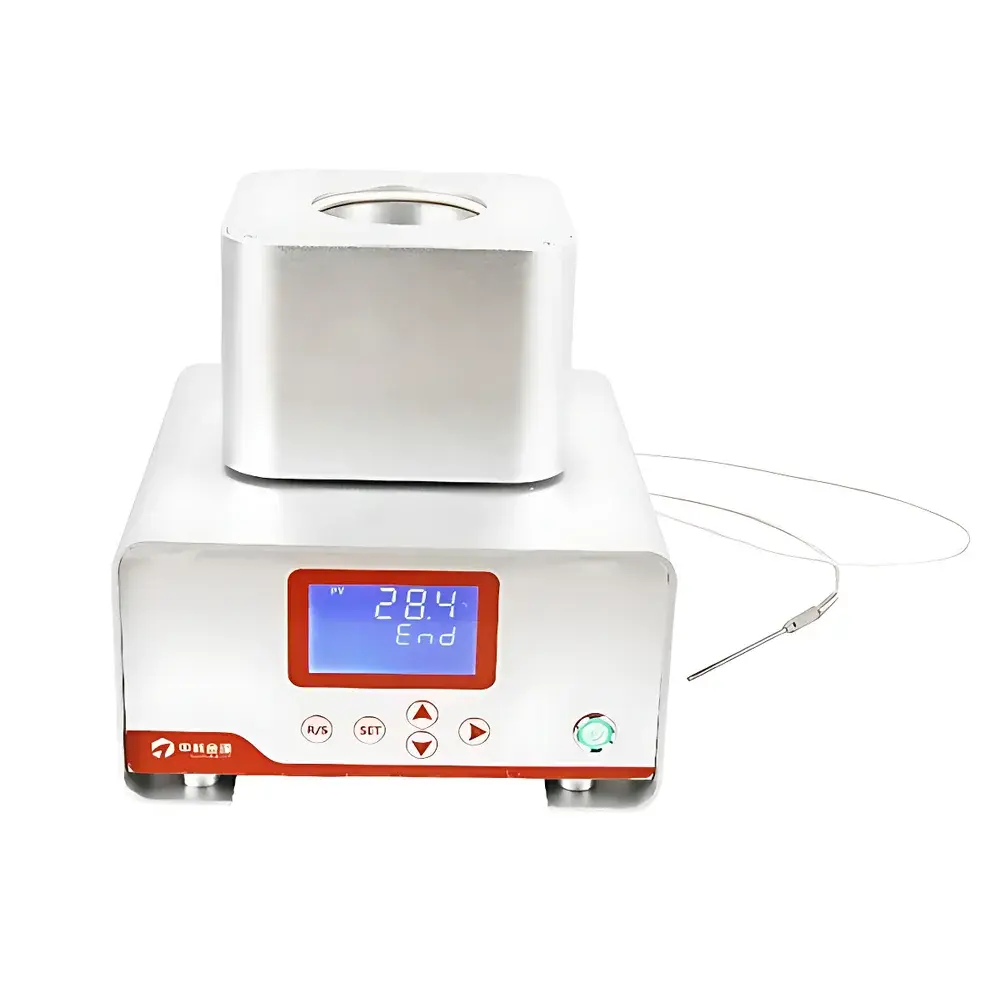
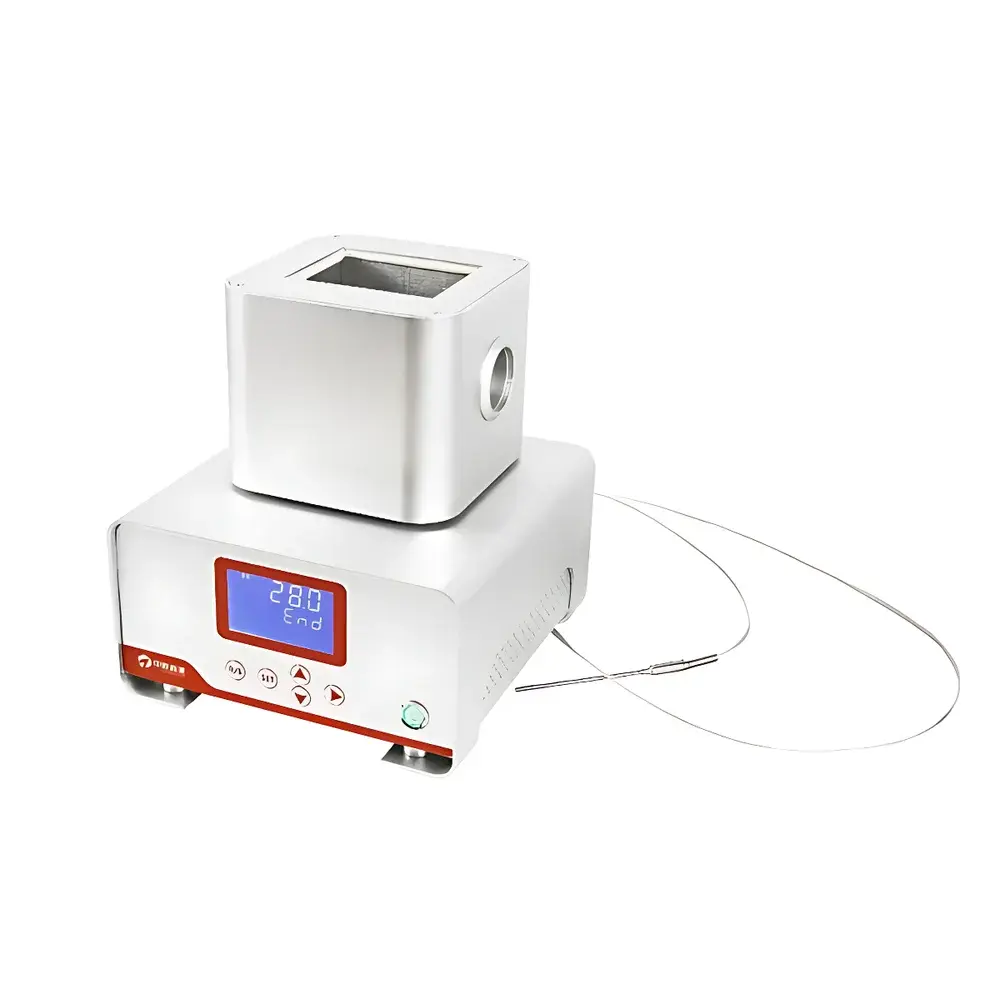
CEL-HKT Dedicated Heating and Temperature-Controlled Base for Laboratory Reactors
| Brand | CEL (Zhongjiao Jin Yuan) |
|---|---|
| Model | CEL-HKT |
| Origin | Beijing, China |
| Manufacturer Type | Direct Manufacturer |
| Country of Origin | China |
| Heating Power | 1000 W |
| Temperature Range | –20 to 350 °C (measurement), Ambient to 250 °C (heating) |
| Control Accuracy | ±1 °C (in water medium) |
| Display Resolution | 0.1 °C |
| Stirring Method | Dual-directional magnetic stirring |
| Speed Range | 100–2000 rpm |
| External Dimensions (L×W×H) | 245 × 239 × 235 mm |
| Humidity Operating Range | 40–93% RH |
| Safety Features | Over-temperature and fault alarm |
Overview
The CEL-HKT Dedicated Heating and Temperature-Controlled Base is an engineered thermal management platform designed specifically for integration with laboratory-scale high-pressure and photochemical reactors manufactured by Zhongjiao Jin Yuan (CEL). It operates on a dual-loop temperature control principle—combining real-time internal reaction temperature feedback with precise external heating surface regulation—to eliminate thermal overshoot (“temperature surge”) commonly observed in single-sensor PID systems. This architecture ensures stable, reproducible thermal conditions across extended experimental durations, particularly critical for kinetic studies, catalytic screening, and photoreactor-based synthesis where thermal drift directly impacts reaction selectivity and yield. The base supports operation from –20 °C (via external cooling loop integration) up to 350 °C measurement capability, with sustained heating output rated to 250 °C under standard ambient conditions. Its 1000 W resistive heating element is thermally coupled to a high-thermal-conductivity aluminum alloy baseplate, enabling rapid heat transfer and uniform thermal distribution beneath reactor vessels.
Key Features
- Dual-loop temperature control system: Independent monitoring of both heater surface temperature and internal reactor fluid temperature, enabling dynamic compensation and eliminating overshoot during setpoint transitions.
- Integrated dual-directional magnetic stirring: Motor-driven stirrer provides programmable rotation from 100 to 2000 rpm with reversible polarity, supporting heterogeneous mixing in viscous or precipitating reaction media.
- High-resolution thermal interface: Digital display resolution of 0.1 °C; certified control accuracy of ±1 °C when calibrated using aqueous reference media per ASTM E74-22 guidelines.
- Modular mechanical compatibility: Designed to accommodate multiple CEL reactor models including CEL-HPR100T, CEL-MPR100, KPR10, CEL-HPR250T, CEL-MPR250, KPR250, CEL-HPR250S, and HPRS-PEC250 via standardized mounting geometry and thermal contact alignment.
- Robust safety architecture: Embedded over-temperature cutoff, open-circuit detection, and real-time fault logging—compliant with IEC 61010-1:2010 requirements for laboratory electrical equipment.
Sample Compatibility & Compliance
The CEL-HKT base is validated for use with glass, quartz, and stainless-steel reactor vessels rated for pressures up to 10 MPa and temperatures up to 300 °C. Its thermal footprint and clamping interface conform to CEL’s mechanical design specifications for reactor interchangeability. While the unit itself is not CE-marked as a standalone medical device, its construction adheres to RoHS Directive 2011/65/EU for hazardous substance restriction. For GLP-compliant laboratories, the instrument supports manual audit trail documentation of temperature setpoints, actual readings, and stirring parameters—though native electronic record retention requires external data acquisition via RS485 or analog 0–5 V output (optional interface module available). It is routinely deployed in applications aligned with ISO 17025-accredited testing protocols for catalyst thermal stability evaluation and photochemical quantum yield determination.
Software & Data Management
The CEL-HKT operates via an embedded microcontroller with local front-panel control only—no proprietary software driver or PC connectivity is required for basic operation. All parameters (set temperature, actual temperature, stirring speed, direction, and alarm status) are displayed on a high-contrast LCD with backlighting. For laboratories requiring automated data capture, the unit offers optional analog voltage outputs (0–5 V proportional to temperature and rpm) and RS485 Modbus RTU communication (addressable via standard industrial protocol). Integration with LabVIEW, MATLAB, or SCADA systems is achievable using off-the-shelf Modbus masters. No FDA 21 CFR Part 11 compliance is natively provided; however, third-party electronic lab notebook (ELN) platforms may log timestamped values from external DAQ hardware meeting ALCOA+ principles.
Applications
- Thermal profiling of photocatalytic hydrogen evolution reactions under controlled irradiation and heating.
- Kinetic modeling of heterogeneous catalysis where precise isothermal maintenance at 120–220 °C is required for Arrhenius analysis.
- High-temperature hydrothermal synthesis of metal–organic frameworks (MOFs) and perovskite precursors.
- Accelerated aging studies of polymer electrolytes in solid-state battery R&D.
- Multi-step tandem reactions involving sequential thermal activation and photochemical initiation.
FAQ
Can the CEL-HKT base be used with non-CEL reactor vessels?
Yes—provided the vessel base diameter, curvature radius, and thermal expansion coefficient fall within the mechanical and thermal interface tolerances specified in the CEL-HKT Installation Manual (Rev. 3.1). Custom adapter plates are available upon request.
Is external cooling support integrated into the base?
No—the CEL-HKT does not include active cooling; however, it features threaded ports for connection to external chiller lines (e.g., Huber Ministat) to enable sub-ambient operation down to –20 °C when paired with compatible reactors.
What is the recommended calibration frequency for GLP workflows?
Annual calibration against NIST-traceable RTD standards is advised; verification checks before each high-value experiment using a calibrated immersion thermometer in a water/glycol bath are strongly recommended.
Does the dual-loop control require separate sensor installation in the reactor?
Yes—a Pt100 or thermocouple probe must be inserted into the reactor’s internal temperature port (standard on all compatible CEL models); the base’s built-in surface sensor operates independently to regulate heater power.



