
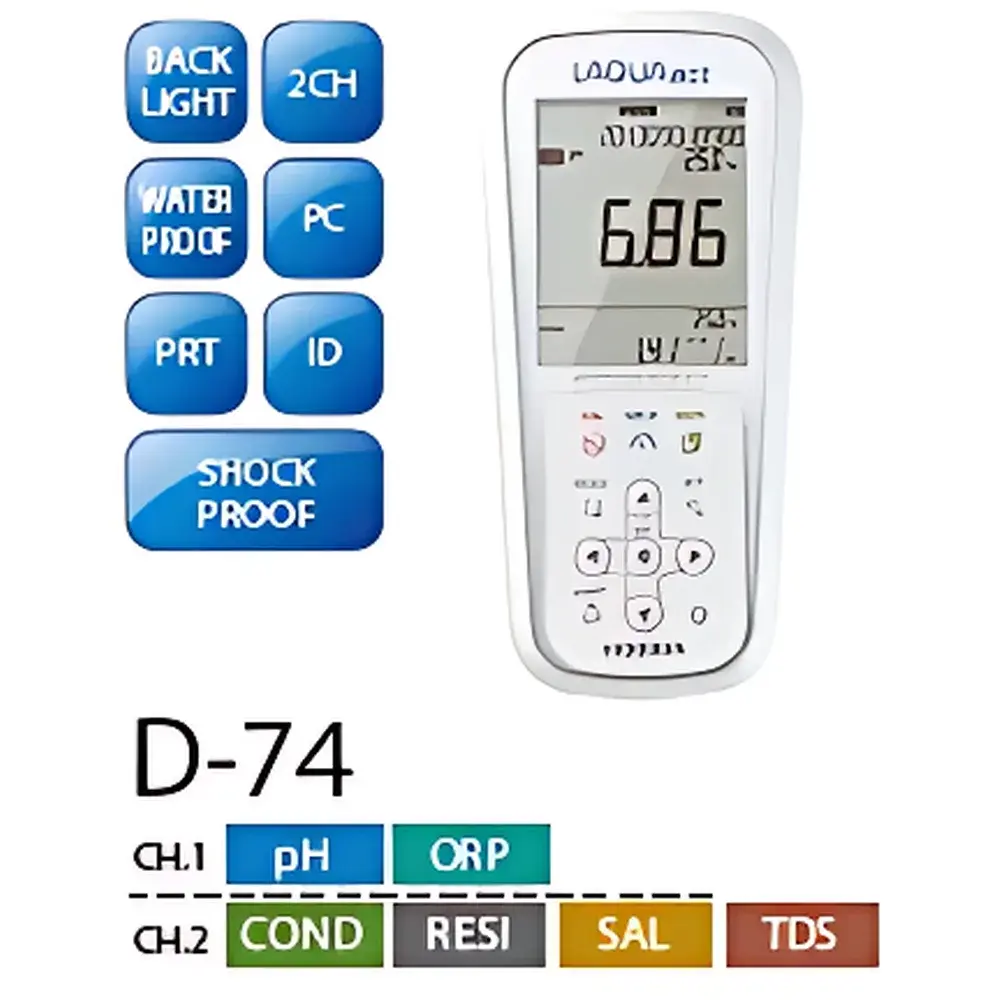
HORIBA LAQUAact D-74 Portable pH/ORP/Conductivity Meter
| Brand | HORIBA |
|---|---|
| Origin | Japan |
| Model | D-74 |
| Type | Handheld Water Quality Analyzer |
| Measurable Parameters | pH, ORP, Conductivity |
| Display | Dual-parameter LCD with backlight |
| Enclosure Rating | IP67 |
| Data Storage | 1,000 measurements |
| Power Life | Approx. 1,000 hours |
| Material | Polycarbonate housing |
| Compliance | GLP/GMP-ready data export (via optional USB cable and free software) |
| Connectivity | PC interface supported (D-74 included) |
Overview
The HORIBA LAQUAact D-74 is a rugged, field-deployable handheld water quality analyzer engineered for high-reliability measurement of pH, oxidation-reduction potential (ORP), and electrical conductivity in diverse environmental, industrial, and municipal applications. Built upon HORIBA’s legacy of electrochemical sensor precision, the D-74 employs temperature-compensated potentiometric and conductometric principles—adhering to standardized methodologies defined in ASTM D1293 (pH), ASTM D3223 (ORP), and ASTM D5391 (conductivity). Its dual-parameter simultaneous display enables real-time correlation of acid-base status and ionic strength—critical for wastewater effluent verification, source water characterization, aquaculture monitoring, and process water validation. Designed for operational continuity across laboratory, plant floor, and remote field sites, the D-74 integrates ergonomic portability with metrological integrity under variable ambient conditions.
Key Features
- Rugged polycarbonate housing—exhibits ~2× higher impact resistance than conventional ABS enclosures and demonstrates chemical stability against ethanol, dilute acids/bases, and hydrocarbon oils, enabling safe on-site decontamination via alcohol wipe-down.
- IP67-rated enclosure—certified to withstand immersion at 1 m depth for 30 minutes (non-operational submersion only), ensuring survivability in rain, splashing, dust-laden environments, and accidental drops onto hard surfaces.
- Dual-parameter LCD with integrated backlight—1.4× larger viewing area versus prior-generation models; supports concurrent numeric readouts of two parameters (e.g., pH + conductivity or ORP + temperature) without menu navigation.
- Ergonomic single-hand operation—three dedicated tactile keys (Mode, Hold, Cal) minimize operational steps; rotating electrode stand (optional accessory) enables stable benchtop use while retaining handheld flexibility.
- Extended battery life—optimized power management delivers up to 1,000 hours of typical operation on standard AA alkaline cells, reducing field downtime and logistical dependency on charging infrastructure.
Sample Compatibility & Compliance
The D-74 is validated for aqueous samples across pH 0–14, ORP ±2,000 mV, and conductivity 0–200 mS/cm (dependent on selected electrode). It accepts HORIBA’s interchangeable LAQUAact series electrodes—including gel-filled pH probes (e.g., 9615S-10D), platinum ORP sensors (e.g., 9678S-10D), and graphite or stainless-steel conductivity cells (e.g., 3551-10D)—all featuring quick-connect BNC or DIN interfaces. The instrument complies with ISO/IEC 17025 traceability requirements when used with NIST-traceable calibration standards. Data export functionality supports GLP/GMP audit readiness: timestamped measurements include electrode ID, calibration history, temperature, and user-defined sample IDs—exportable in CSV format via HORIBA’s free LAQUA Connect software (v2.0+).
Software & Data Management
Internal memory retains 1,000 measurement records with automatic time/date stamping and electrode-specific metadata. Data transfer occurs via optional USB-to-micro-USB cable (HORIBA Part No. 085060-001) to Windows-based PCs running LAQUA Connect—a validated application supporting FDA 21 CFR Part 11–aligned features including electronic signatures, audit trail logging, and role-based access control. Exported datasets are compatible with LIMS integration and statistical process control (SPC) platforms. Printer output (via optional thermal printer module) generates compliant hard-copy reports containing calibration verification stamps and operator identification fields.
Applications
- Environmental field surveys: Stream, river, lake, and groundwater profiling per EPA Method 150.1 (pH), Method 150.2 (conductivity), and Method 150.3 (ORP).
- Municipal water treatment: Influent/effluent QC, disinfection byproduct precursor monitoring, and membrane filtration performance tracking.
- Aquaculture & hydroponics: Real-time pond/tank parameter correlation to prevent stress-induced mortality and optimize nutrient dosing.
- Industrial cooling towers & boiler feedwater: Conductivity-driven TDS estimation and corrosion potential assessment via ORP trends.
- Educational laboratories: Pedagogical tool for teaching electrochemical fundamentals, calibration theory, and environmental sampling protocols.
FAQ
Does the D-74 support automatic temperature compensation (ATC) for all measured parameters?
Yes—integrated NTC thermistor (25 kΩ at 25°C) provides real-time ATC for pH, ORP, and conductivity measurements using industry-standard algorithms (e.g., DIN 19263 for conductivity).
Can the D-74 perform multi-point calibration for pH and conductivity simultaneously?
No—calibration is parameter-specific and sequential; however, calibration coefficients are stored per electrode and recalled automatically upon connection.
Is the instrument compatible with third-party electrodes?
Only HORIBA LAQUAact-series electrodes with standardized BNC/DIN connectors and built-in EEPROM chip recognition are fully supported for auto-ID and calibration recall.
What is the recommended recalibration frequency under continuous field use?
Per ISO 5725-2 guidance, daily verification with certified buffer standards (pH 4.01/7.00/10.01) and KCl solutions (e.g., 1413 µS/cm) is advised; full recalibration every 24–48 hours in high-contamination environments.
Does the D-74 meet regulatory requirements for wastewater discharge reporting?
When operated per manufacturer instructions and calibrated with traceable standards, its measurement uncertainty (±0.02 pH, ±5 mV ORP, ±1% FS conductivity) satisfies reporting thresholds in 40 CFR Part 136 and EU Directive 2000/60/EC Annex V.







