
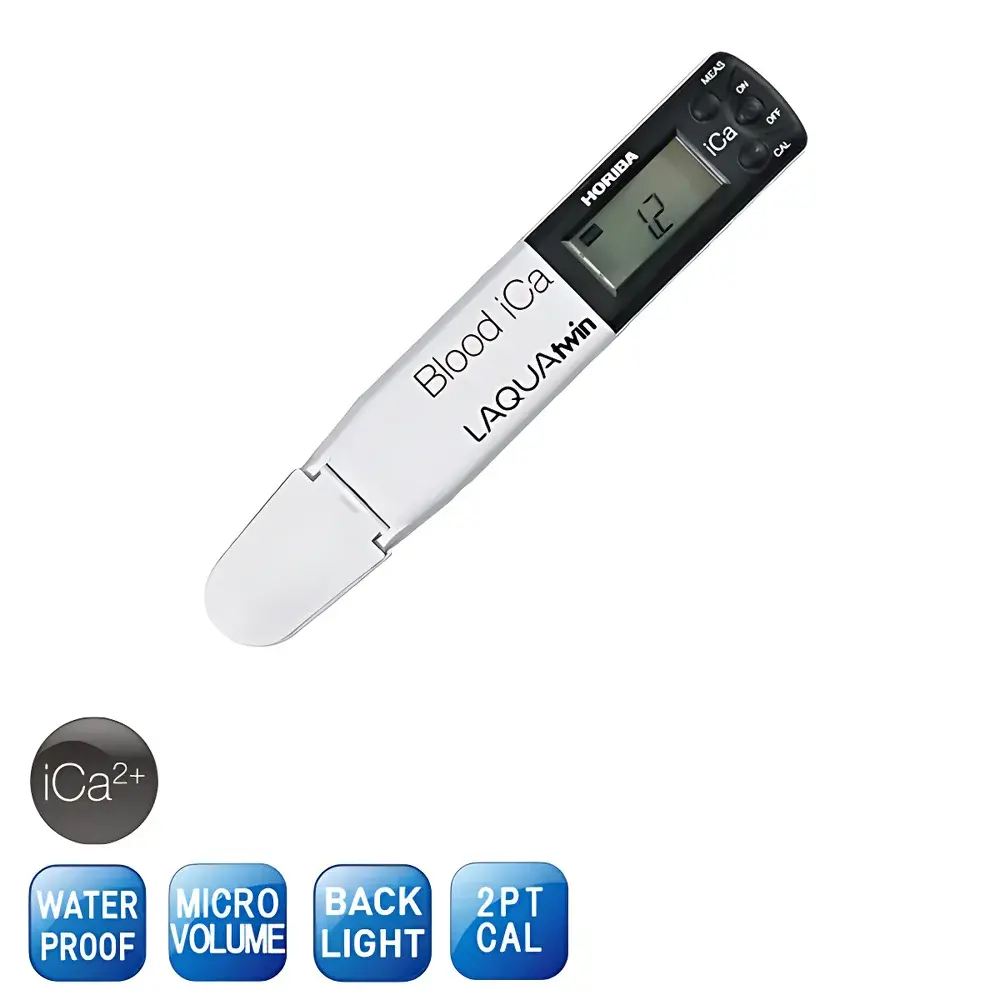
HORIBA LAQUAtwin Ca-11C Calcium Ion Meter
| Brand | HORIBA |
|---|---|
| Origin | Japan |
| Model | Ca-11C |
| Measurement Principle | Ion-Selective Electrode (ISE) |
| Sample Volume | ≥0.3 mL |
| Measurement Range | 0.1–5.0 mmol/L |
| Resolution | 0.1 mmol/L |
| Accuracy | ±20% of reading |
| Calibration Points | 2-point (1.25 mmol/L and 2.50 mmol/L) |
| Display | Backlit monochrome LCD |
| Operating Temperature | 5–40.0 °C |
| Operating Humidity | ≤85% RH (non-condensing) |
| Power Supply | Two CR2032 batteries |
| Housing Material | ABS epoxy resin |
| Dimensions | 164 × 29 × 20 mm (excluding protrusions) |
| Weight | Approx. 55 g (including sensor and batteries) |
| IP Rating | IP67 |
| Key Functions | Auto-standard recognition, auto-hold/auto-stabilize measurement, auto-power-off (30 min), low-battery indicator, replaceable calcium ISE sensor |
Overview
The HORIBA LAQUAtwin Ca-11C is a handheld, field-deployable calcium ion meter engineered for rapid, on-site quantification of free (ionized) calcium concentration in biological and environmental liquid samples—primarily whole blood, serum, plasma, and aqueous solutions. Unlike total calcium assays that measure bound and complexed forms, the Ca-11C employs a solid-state calcium-selective electrode (Ca²⁺-ISE) based on polyvinyl chloride (PVC) membrane technology with a lipophilic ionophore. This enables direct potentiometric detection of biologically active Ca²⁺ ions, delivering clinically relevant data within seconds. Its design addresses critical time-sensitive applications in veterinary practice—especially periparturient hypocalcemia (milk fever) management in dairy cattle—where early identification of subclinical hypocalcemia (<1.2 mmol/L ionized Ca²⁺) significantly improves therapeutic intervention timing and outcomes. The instrument operates on a Nernstian response principle, converting ion activity into millivolt output linearly correlated to log[Ca²⁺], calibrated against traceable standard solutions.
Key Features
- IP67-rated rugged housing ensures reliable operation in barns, mobile clinics, and outdoor sampling environments—resistant to dust ingress, splashes, and temporary immersion.
- Replaceable calcium-specific ISE sensor allows for cost-effective maintenance and consistent long-term performance without recalibration drift from electrode aging.
- Auto-standard recognition eliminates manual input errors during calibration; the device automatically detects and assigns values to preloaded 1.25 mmol/L and 2.50 mmol/L standards.
- Auto-hold and auto-stabilize functions lock the reading once signal variance falls below ±0.02 mmol/L over 2 seconds—critical for non-laboratory users handling viscous or particulate-containing blood samples.
- Backlit monochrome LCD provides high-contrast readability under low-light conditions (e.g., dim barn lighting or early-morning fieldwork).
- Low-power architecture supports >1,000 measurements per battery set (two CR2032 cells), with visual low-battery alert prior to shutdown.
- Compact form factor (164 × 29 × 20 mm) and ultra-light weight (55 g) enable single-hand operation and integration into portable diagnostic kits.
Sample Compatibility & Compliance
The Ca-11C is validated for use with anticoagulated whole blood (EDTA or heparin), serum, plasma, and clarified aqueous matrices—including drinking water, irrigation runoff, and nutrient solutions—provided turbidity is <5 NTU and protein content does not exceed 10 g/L. It complies with ISO 15197:2013 requirements for point-of-care testing devices in terms of precision (within-run CV <5% at 1.25 mmol/L and 2.50 mmol/L), measurement repeatability, and environmental robustness. While not FDA-cleared as an IVD device, its methodology aligns with CLSI EP15-A3 guidelines for user verification of accuracy and imprecision. For regulatory documentation, raw measurement logs (time-stamped, sensor ID-tagged) meet GLP audit requirements when exported via optional IR interface (LAQUA Connect software).
Software & Data Management
Data capture and traceability are supported through HORIBA’s LAQUA Connect PC software (Windows-compatible), which enables bidirectional communication via infrared (IR) port. Users can download measurement history—including date/time stamps, operator ID fields, calibration records, and sensor serial numbers—for inclusion in electronic lab notebooks (ELN) or farm management systems. Audit trails comply with 21 CFR Part 11 principles when configured with user authentication and electronic signature protocols. No cloud storage or proprietary app dependency is required—data remains under institutional control. Firmware updates preserve backward compatibility with legacy Ca-11C units deployed across multi-year herd health monitoring programs.
Applications
- Veterinary diagnostics: Real-time assessment of ionized calcium in transition dairy cows to guide oral or intravenous calcium supplementation protocols.
- Research laboratories: Monitoring Ca²⁺ dynamics in cell culture media, fermentation broths, or soil leachates where free ion activity—not total metal content—governs bioavailability.
- Environmental field surveys: Screening calcium hardness in freshwater ecosystems, wastewater effluents, or desalination brine streams per ASTM D511-22.
- Quality control in food processing: Verification of calcium fortification levels in plant-based milks and infant formulas where bioavailable Ca²⁺ must meet nutritional labeling claims.
- Educational use: Teaching potentiometric ion analysis principles in undergraduate analytical chemistry and animal science curricula.
FAQ
Can the Ca-11C measure total calcium?
No. It measures only free ionized calcium (Ca²⁺) via selective potentiometry. Total calcium requires acid digestion and spectrophotometric or atomic absorption methods.
Is sensor replacement performed by the user?
Yes. The Ca-ISE module is tool-free and hot-swappable; no recalibration is needed after replacement—only a two-point verification using supplied standards.
How does temperature affect measurement accuracy?
The built-in thermistor compensates for sample temperature between 5–40 °C. Measurements outside this range require thermal equilibration prior to analysis.
Does the device store calibration history?
Yes. Up to 10 calibration events (date, time, standard IDs, slope/mV/decade) are retained in non-volatile memory and retrievable via LAQUA Connect.
Is it suitable for seawater analysis?
Not recommended. High ionic strength (>0.7 mol/kg) and magnesium interference degrade selectivity; use dedicated marine-grade Ca²⁺ sensors instead.
Related Products







