
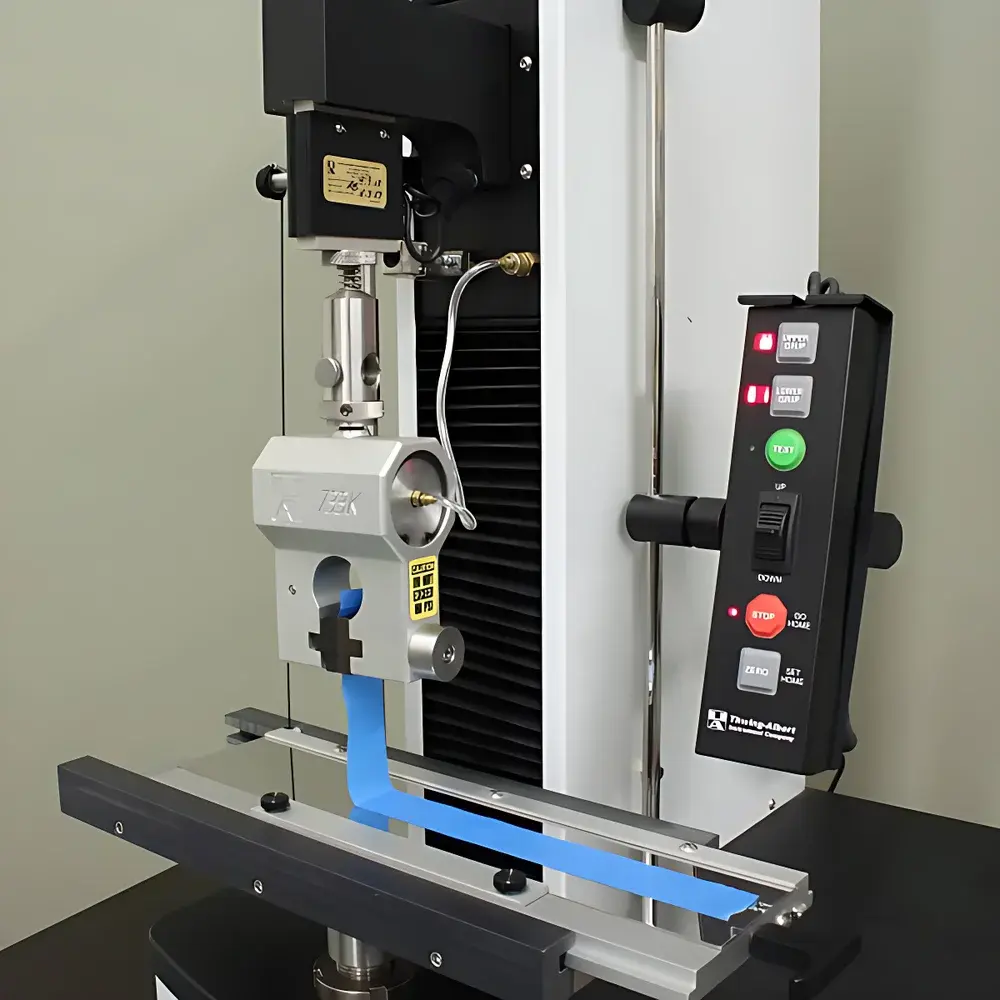
Thwing-Albert Vantage 90° Peel Test System
| Origin | USA |
|---|---|
| Manufacturer Type | Authorized Distributor |
| Origin Category | Imported |
| Model | Thwing-Albert Vantage |
| Price Range | USD 14,000 – 70,000 |
| Load Capacity | 1 kN (225 lbf) |
| Peel Angle | Fixed 90° |
| Standard Compliance | ASTM D6862, ASTM D6252, PSTC-1A |
| Fixture Part No. | 1750–3005 |
| Sample Type | Flexible Adhered Substrates (e.g., pressure-sensitive tapes, laminates, labels, medical adhesives) |
| Test Mode | Tensile Peel |
| Grip Configuration | Upper Movable Jaw + Lower Motorized Crosshead with Angularly Constrained Specimen Stage |
Overview
The Thwing-Albert Vantage 90° Peel Test System is a precision-engineered mechanical testing platform designed specifically for standardized quantitative evaluation of adhesive bond integrity under controlled 90-degree peel geometry. Built upon the modular Vantage electromechanical universal testing frame, this configuration integrates a purpose-built 90° peel fixture (Part No. 1750–3005) that mechanically constrains specimen alignment to maintain a constant 90° peel angle throughout the test cycle—eliminating angular deviation that compromises data comparability. The system operates on fundamental principles of tensile force transduction: the adhered substrate (e.g., tape bonded to stainless steel or polymer backing) is anchored at the fixed upper jaw, while the un-bonded end is clamped to a motor-driven lower crosshead. As the crosshead moves vertically at programmable rates (0.01–500 mm/min), the peel front propagates along the interface, and the resulting force is measured via a high-fidelity 1 kN load cell with <±0.5% full-scale accuracy per ASTM E4. This architecture ensures traceable, repeatable peel force profiles essential for QC release, formulation development, and regulatory documentation.
Key Features
- Fixed-geometry 90° peel fixture (P/N 1750–3005) with precision-machined angular guide rails and low-friction linear bearings to enforce consistent peel angle across all test speeds and substrate thicknesses.
- Vantage series base frame featuring dual-column rigid construction, brushless servo motor drive, and closed-loop position/force control compliant with ISO 7500-1 Class 0.5 accuracy requirements.
- Integrated digital load cell calibrated to NIST-traceable standards; supports real-time force sampling at up to 1,000 Hz for capturing transient peel events such as stick-slip or cohesive failure onset.
- Modular grip system accommodating standard specimen widths (25 mm, 50 mm) and thicknesses up to 3 mm; optional pneumatic or wedge-action grips available for high-volume lab throughput.
- Pre-loaded test methods for ASTM D6862 (peel adhesion of pressure-sensitive tapes), ASTM D6252 (peel strength of flexible barrier laminates), and PSTC-1A (standard test for tape adhesion) within the VantageTouch software suite.
Sample Compatibility & Compliance
The system is validated for testing flexible adhered assemblies including pressure-sensitive adhesives (PSAs), medical transdermal patches, label stocks, flexible packaging laminates (e.g., PET/Alu/PE), and die-cut foam tapes. Substrate combinations must meet minimum stiffness and dimensional stability criteria per ASTM D6862—specifically, the non-adhered arm must remain taut without buckling during peel initiation. All hardware and firmware comply with CE marking directives (2014/30/EU EMC, 2014/35/EU LVD), and mechanical calibration protocols align with ISO/IEC 17025 requirements for accredited testing laboratories. Data acquisition meets FDA 21 CFR Part 11 audit trail and electronic signature readiness when configured with VantageTouch v4.2+ and networked user authentication.
Software & Data Management
VantageTouch software provides intuitive method setup, real-time curve visualization, and automated pass/fail evaluation against user-defined limits (e.g., average peel force ±15%, maximum peak force, elongation at break). Raw force-displacement data exports in CSV, XML, and ASTM E1318-compliant .tdf formats. Advanced analysis modules include statistical process control (SPC) charting, batch trending, and comparative overlay of up to eight curves. Audit logs record operator ID, timestamp, method version, calibration status, and any parameter overrides—fully exportable for GLP/GMP internal audits or regulatory submissions.
Applications
- Quality control of PSA manufacturing batches against specification limits per ISO 2922 or TL 8130.
- Comparative evaluation of adhesive formulations under accelerated aging (e.g., 40°C/75% RH for 7 days per ASTM D1000).
- Validation of liner release force consistency in label stock production.
- Peel performance mapping of medical device adhesives across skin simulants (e.g., polyurethane film per ISO 10993-10).
- Failure mode analysis—differentiating interfacial delamination from cohesive splitting or substrate yielding via force curve morphology.
FAQ
What substrates are recommended for ASTM D6862-compliant testing?
Stainless steel panels (ASTM D1000 Grade 2B finish) or specified polymer backings (e.g., PET, PP) conditioned per ASTM D618 for 40 hours at 23°C/50% RH.
Can this system perform 180° peel tests?
No—the 1750–3005 fixture is mechanically dedicated to 90° geometry; 180° testing requires separate fixture P/N 1750–3006 and modified test method configuration.
Is calibration certificate included with shipment?
Yes—a NIST-traceable Certificate of Calibration valid for 12 months is provided, covering load cell, displacement encoder, and speed accuracy per ISO 7500-1 Annex B.
How is specimen alignment verified before testing?
Via integrated optical alignment aid: a laser line projects the nominal peel plane onto the specimen stage, enabling visual verification of tape edge parallelism within ±0.2° prior to clamping.
Does the system support multi-specimen sequential testing?
Yes—VantageTouch supports programmable auto-reset sequences with configurable dwell times, allowing unattended testing of up to 99 specimens per batch with individual result logging.




