
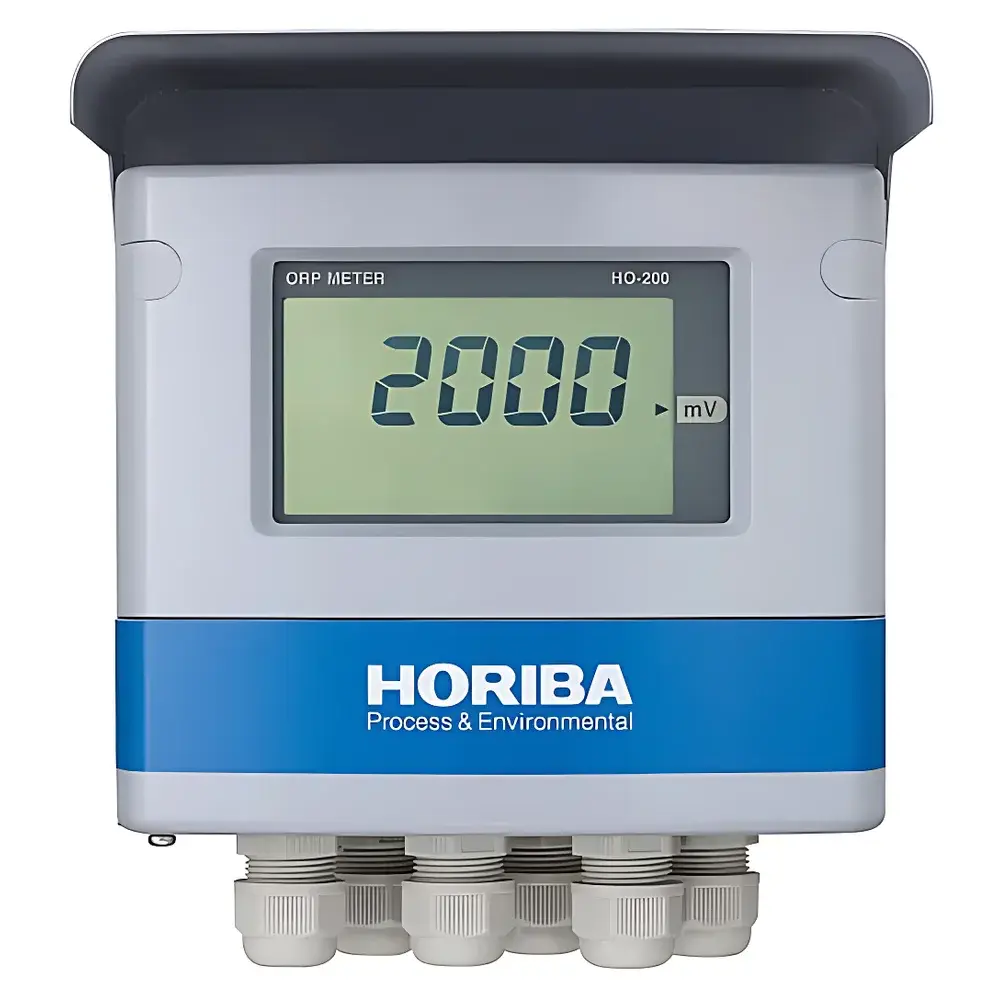
HORIBA HO-200 Industrial Online ORP Transmitter
| Brand | HORIBA |
|---|---|
| Origin | Japan |
| Model | HO-200 |
| Type | Industrial Online ORP Meter |
| ORP Range | −2000 to +2000 mV |
| Temperature Range | 0 to 100 °C |
| ORP Resolution | 1 mV |
| Temperature Resolution | 0.1 °C |
| ORP Repeatability | ±5 mV |
| Temperature Repeatability | ±0.3 °C (equivalent input) |
| Linearity | ±5 mV (ORP), ±0.3 °C (temperature) |
| Output | Two isolated 4–20 mA DC outputs (load ≤ 900 Ω) |
| Relay Outputs | Three SPDT dry-contact relays (R1, R2, FAIL) |
| Input | One opto-isolated contact input for external cleaning command |
| Communication | Isolated RS-485 (2-wire) |
| Power Supply | AC 100–240 V ±10%, 50/60 Hz |
| Power Consumption | ≤15 W |
| Enclosure | Aluminum, IP65-rated |
| Operating Ambient Temperature | −20 to +55 °C |
| Mounting | Wall or 50A pole mount |
| Weight | ~4.5 kg |
| Compliance | CE marking, FCC Rules, RoHS, WEEE |
Overview
The HORIBA HO-200 is an industrial-grade, panel-mountable ORP (Oxidation-Reduction Potential) transmitter engineered for continuous, real-time monitoring of redox status in aqueous process streams. It operates on the principle of potentiometric measurement using a noble-metal reference electrode (Pt or Au) paired with a stable reference system—typically Ag/AgCl or calomel—enabling direct voltage measurement (in millivolts) relative to the Standard Hydrogen Electrode (SHE). Unlike pH, which quantifies proton activity, ORP reflects the net tendency of a solution to gain electrons (be reduced) or lose electrons (be oxidized), making it indispensable for process control in biological treatment stages such as aerobic nitrification, anoxic denitrification, and chemical oxidation-reduction dosing. The HO-200 is specifically designed for fixed installation in wastewater treatment plants, chemical dosing skids, and industrial cooling water systems where robustness, long-term stability, and immunity to electromagnetic interference are critical. Its four-wire configuration ensures signal integrity over extended cable runs, while its wide operating ambient temperature range (−20 to +55 °C) and IP65-rated aluminum enclosure guarantee reliable performance in outdoor or semi-outdoor environments subject to dust, moisture, and thermal cycling.
Key Features
- Simultaneous dual-parameter measurement: ORP (−2000 to +2000 mV) and temperature (0 to 100 °C) with independent resolution (1 mV / 0.1 °C)
- High-stability analog outputs: Two fully isolated 4–20 mA DC current loops, each configurable for ORP, temperature, or derived control signals; maximum load impedance 900 Ω
- Three programmable SPDT relay outputs supporting upper/lower limit alarms, ON/OFF control, fault signaling (FAIL), and automated sensor cleaning commands
- Integrated self-diagnostic capability: Real-time detection of electrode open-circuit, short-circuit, drift beyond tolerance, and internal transmitter faults—reported via relay status and display
- RoHS- and WEEE-compliant lead-free electrode design; compatible with standard HORIBA ORP sensors (e.g., Pt-type 6805-50B, Au-type 6815-50B, and replaceable-chip 6870-60B)
- Large, high-contrast LCD display with backlight for clear visibility under varying ambient lighting; intuitive menu navigation via three tactile buttons
- Non-volatile memory stores calibration history, sensor ID, date/time stamps, and user-defined offset/gain corrections
- Secure terminal block with captive-thread screw terminals prevents accidental disconnection during vibration or maintenance
Sample Compatibility & Compliance
The HO-200 is optimized for conductive aqueous media with conductivity ≥100 µS/cm—typical of municipal wastewater, industrial effluents, recirculating cooling water, and electroplating rinse baths. It is not intended for non-aqueous solvents, highly viscous slurries, or low-conductivity deionized water without supplemental grounding. Sensor selection must match application chemistry: platinum electrodes suit oxidizing environments (e.g., chlorine residual monitoring), while gold variants offer superior resistance to sulfide poisoning in anaerobic digesters. The transmitter complies with CE marking requirements (EMC Directive 2014/30/EU and Low Voltage Directive 2014/35/EU), FCC Part 15 Subpart B (Class A), and environmental directives RoHS 2011/65/EU and WEEE 2012/19/EU. Its design supports audit-ready operation under GLP and GMP frameworks when paired with documented calibration procedures and electronic log retention.
Software & Data Management
While the HO-200 operates as a standalone analog transmitter without embedded Ethernet or cloud connectivity, its RS-485 interface (EIA-485, 2-wire, isolated) enables integration into SCADA, DCS, or PLC-based supervisory systems using Modbus RTU protocol. All configuration parameters—including measurement units, alarm thresholds, relay hysteresis, temperature compensation coefficients (Pt1000, 500 Ω, 6.8 kΩ, or 10 kΩ thermistors), and manual offset/gain correction factors—are accessible and modifiable via serial communication or front-panel keypad. Calibration data—including date, operator ID (if entered), raw mV reading, temperature, and applied correction—is retained in non-volatile memory and can be exported via host system polling. For regulatory compliance, users may implement external data historians that record timestamped 4–20 mA output values with traceable metadata, satisfying FDA 21 CFR Part 11 requirements when paired with appropriate access controls and electronic signature workflows.
Applications
- Wastewater treatment: Monitoring redox potential in activated sludge basins, anoxic zones, and disinfection contact tanks to optimize nitrogen removal and chlorine dosing
- Industrial process control: Managing chemical reduction (e.g., Cr⁶⁺ to Cr³⁺) or oxidation (e.g., cyanide destruction) in metal finishing and semiconductor fab effluent lines
- Cooling tower management: Detecting biocide efficacy and early-stage microbiologically influenced corrosion (MIC) through trending ORP shifts
- Food & beverage sanitation: Verifying sanitizer concentration (e.g., hypochlorite, peracetic acid) in CIP rinse cycles
- Pharmaceutical water systems: Supporting USP purified water and WFI redox stability assessments when used with validated sensors and procedures
FAQ
What sensor types are compatible with the HO-200?
The HO-200 supports HORIBA’s standardized ORP sensors with M12 or PG13.5 connectors, including Pt-based (6805-50B), Au-based (6815-50B), and chip-replaceable models (6870-60B). Custom sensor interfaces require verification of output impedance and reference junction compatibility.
Does the HO-200 support automatic temperature compensation (ATC)?
Yes—it accepts input from integrated Pt1000, 500 Ω, 6.8 kΩ, or 10 kΩ temperature elements embedded in compatible ORP probes, applying Nernst-equation-based linear compensation to ORP readings across the full 0–100 °C range.
Can the relay outputs be configured for proportional-integral (PI) control?
No—the relays operate in on/off (hysteresis) mode only. For continuous control, users must route the 4–20 mA output to an external PID controller or DCS analog input module.
Is firmware upgrade supported in the field?
Firmware updates are performed exclusively by authorized HORIBA service centers using proprietary diagnostic tools; no user-accessible bootloader or over-the-air update mechanism is provided.
What is the recommended calibration frequency for routine operation?
Calibration interval depends on application severity: weekly for critical disinfection control, monthly for general wastewater monitoring, and quarterly for stable cooling water systems—always preceded by thorough sensor cleaning and verification against certified redox buffer solutions (e.g., Zobell’s or Light’s solution).




