
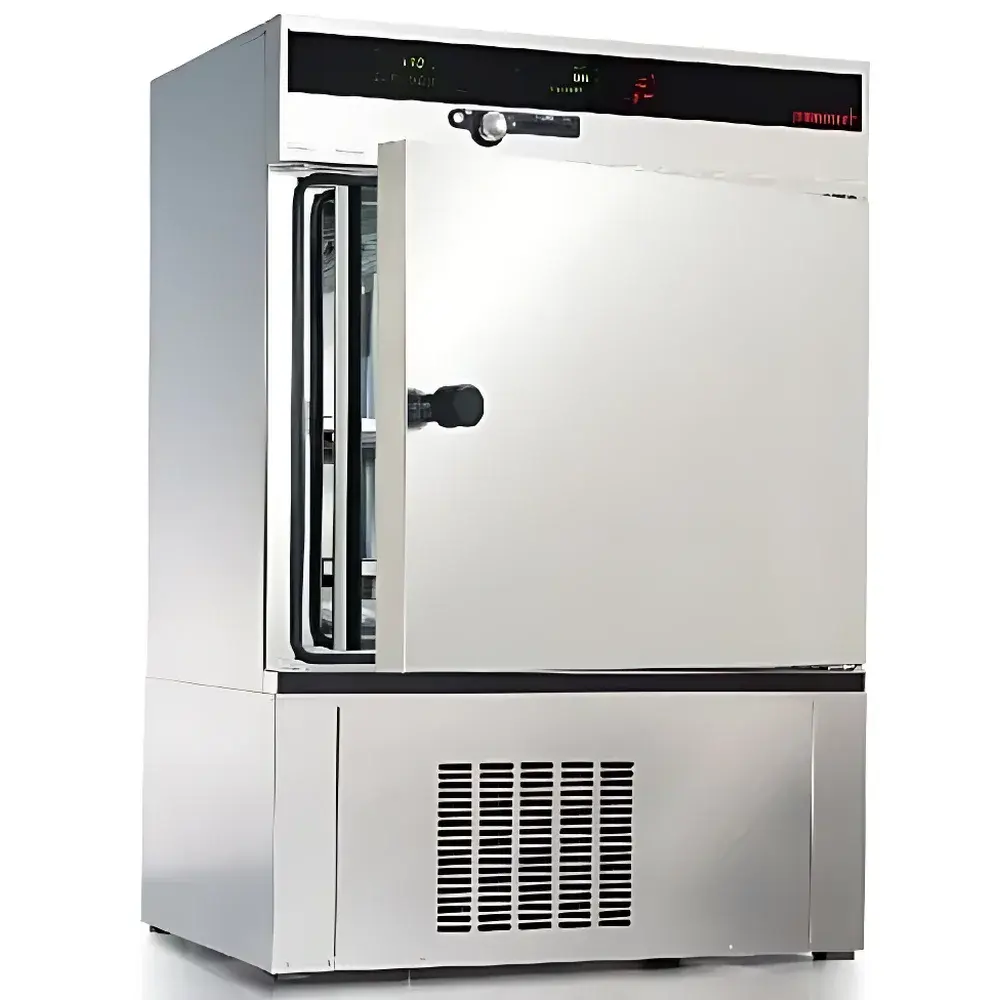
MEMMERT ICP500 Biochemical Incubator with Integrated Process Controller
| Brand | MEMMERT |
|---|---|
| Origin | Germany |
| Model | ICP500 |
| Capacity | 108 L |
| Temperature Range | 0–60 °C |
| Heating/Cooling System | Fully Enclosed Air-Jacket (Heating Top / Cooling Bottom) |
| Refrigerant | R134a (CFC-free) |
| Control | Microprocessor-Based Fuzzy Logic Controller |
| Programmability | Up to 9-Stage Temperature & Fan Profiles |
| Interface | RS232 (standard), optional RS485 |
| Data Storage | MEMoryCardXL removable memory card |
| Safety | Dual Independent Overtemperature Protection (TWW Class 3.1 + TB Class 1) |
| Construction | Interior & Exterior Stainless Steel (AISI 304) |
| Automatic Defrost | Full-cycle, non-interruptive |
Overview
The MEMMERT ICP500 is a precision-engineered biochemical incubator designed for uninterrupted, low-temperature cell and microbial cultivation under tightly regulated thermal conditions. Built upon MEMMERT’s decades-long heritage in laboratory climate control, the ICP500 integrates an advanced air-jacketed heating and cooling architecture—where heating elements are positioned exclusively in the top chamber wall and refrigeration components in the base—to eliminate simultaneous heating/cooling conflict. This segregated thermal design enables true integral temperature control, minimizing overshoot (“overshoot” or “temperature surge”) and ensuring stable setpoint convergence across the entire 108 L stainless steel chamber (560 × 480 × 400 mm internal dimensions). The unit operates within a validated range of 0 °C to +60 °C, making it suitable for psychrophilic culture, enzyme kinetics, long-term stability studies, and light-sensitive biological assays requiring circadian rhythm simulation via optional fluorescent lighting.
Key Features
- Fully enclosed air-jacket system ensures uniform temperature distribution (±0.3 °C at 37 °C, per DIN 12880) without desiccating samples—no humidity loss occurs during operation.
- Independent top-mounted heating and bottom-mounted refrigeration modules enable energy-efficient, mode-specific thermal actuation; each subsystem can be serviced or replaced without compromising the other.
- Dual redundant overtemperature protection: TWW (Class 3.1) provides active fuzzy logic correction when deviation exceeds user-defined limits, while TB (Class 1) serves as a passive mechanical cutoff at critical failure thresholds (>80 °C), compliant with EN 61010-1 safety standards.
- Microprocessor-based controller with fuzzy logic algorithm delivers high reproducibility across repeated cycles, supporting up to nine programmable segments—including ramp rates, hold durations, fan activation/deactivation timing, and variable fan speed profiles.
- Non-interruptive automatic defrost cycle operates during active incubation—eliminating manual shutdowns and preserving experimental continuity for multi-day or week-long cultures.
- Stainless steel construction (AISI 304 interior and exterior) guarantees corrosion resistance, ease of decontamination, and compliance with GLP/GMP cleanroom-compatible handling protocols.
Sample Compatibility & Compliance
The ICP500 accommodates standard microbiological and cell culture vessels—including Petri dishes, flasks (up to 2 L), multiwell plates, and roller bottles—within its uniformly conditioned chamber. Its 0–60 °C operating envelope supports ISO 8573-1-compliant ambient-air-based cultivation, USP stability testing parameters, and ASTM E1980-22 thermal validation requirements. The unit conforms to IEC 61000-6-3 (EMC emission), IEC 61000-6-2 (immunity), and carries CE marking per EU Directive 2014/30/EU (EMC) and 2014/35/EU (LVD). Optional fluorescent lighting modules meet ISO 8573-7 Annex B illumination specifications for photoperiod-controlled phyto- and mycological studies.
Software & Data Management
The ICP500 includes a built-in RS232 interface (upgradeable to RS485 at no cost), enabling centralized monitoring and control of up to six ICP-series incubators from a single PC workstation using MEMMERT’s free LabWorldSoft® software. All program sequences—including temperature ramps, fan schedules, delay/hold commands, and loop iterations—can be configured, archived, and deployed via the removable MEMoryCardXL storage device. Each card functions as a secure, tamper-resistant protocol key: identical cultivation conditions are guaranteed across shifts, operators, or laboratories without reliance on manual re-entry. Audit trails, parameter change logs, and real-time temperature export (CSV/TXT) support FDA 21 CFR Part 11–compliant electronic recordkeeping when paired with validated software configurations.
Applications
The ICP500 serves core workflows in academic research, pharmaceutical QC, clinical diagnostics, and industrial biotechnology. Typical use cases include low-temperature bacterial preservation (e.g., E. coli glycerol stocks at 4 °C), fungal sporulation studies under diurnal lighting cycles, cold-adapted enzyme activity profiling, shelf-life assessment of biologics per ICH Q5C guidelines, and aerobic/anaerobic culture of environmental isolates. Its precise thermal inertia management also supports ISO 15197:2013 glucose oxidase assay calibration and ASTM D6400 compostability incubation protocols.
FAQ
What refrigerant does the ICP500 use, and is it environmentally compliant?
The ICP500 employs R134a—a zero-ozone-depletion-potential (ODP = 0), low-global-warming-potential (GWP = 1430) hydrofluorocarbon refrigerant—fully compliant with EU F-Gas Regulation (EU) No 517/2014 and U.S. EPA SNAP Program requirements.
Can the ICP500 maintain humidity without external humidification?
While not a dedicated humidified incubator, the fully sealed air-jacket design prevents convective moisture loss; relative humidity remains stable at ambient levels (typically 40–60% RH at 20–37 °C) without condensation or drying artifacts.
Is validation documentation available for IQ/OQ/PQ protocols?
Yes—MEMMERT supplies factory-verified temperature mapping reports, calibration certificates traceable to DKD/DAkkS-accredited standards, and customizable IQ/OQ templates aligned with ISO/IEC 17025 and GAMP 5 frameworks.
How does the dual overtemperature protection function during power recovery?
Upon power restoration, the controller defaults to last-saved settings; TWW resumes active regulation immediately, while TB remains continuously energized—ensuring fail-safe thermal containment even during brownout or reboot scenarios.
What is the maximum load capacity for uniform temperature performance?
Uniformity specifications (±0.3 °C) are verified at 50% chamber loading (e.g., five stacked 1-L flasks); full-load uniformity remains within ±0.8 °C per DIN 12880-1 Annex A testing methodology.




