
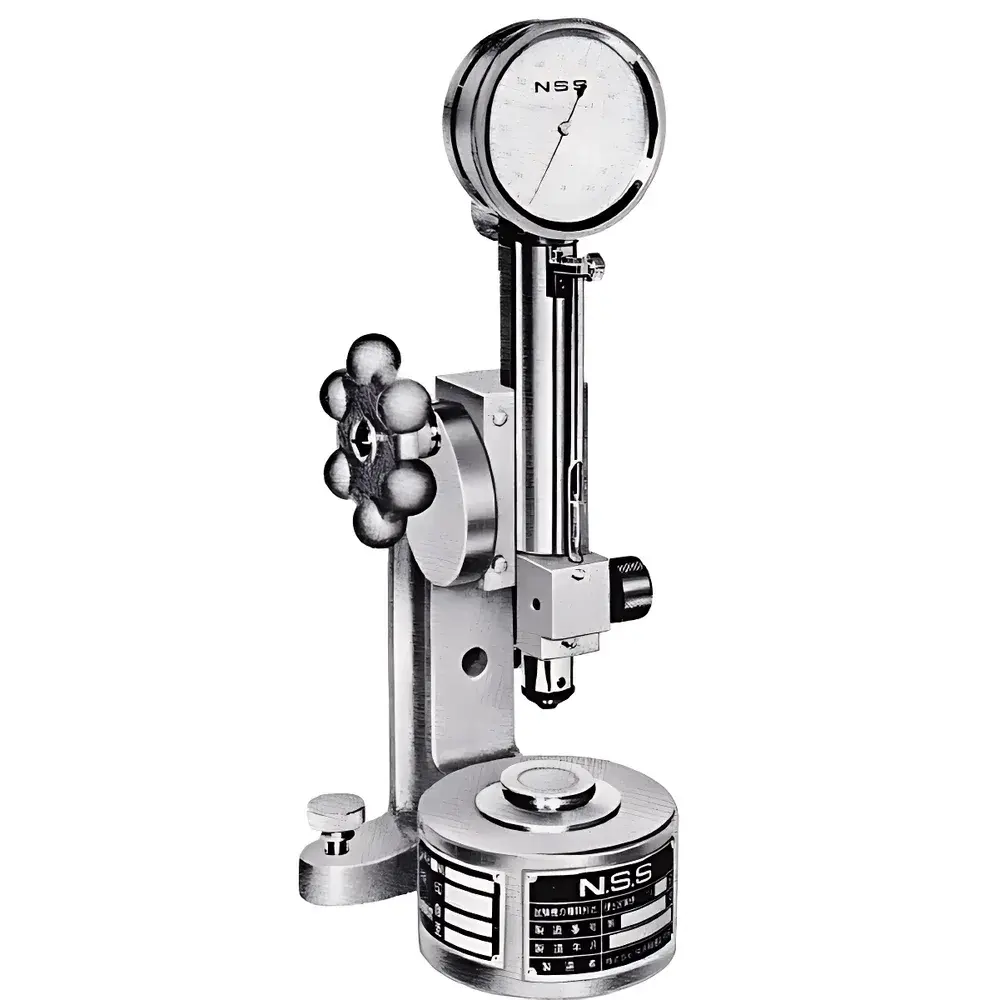
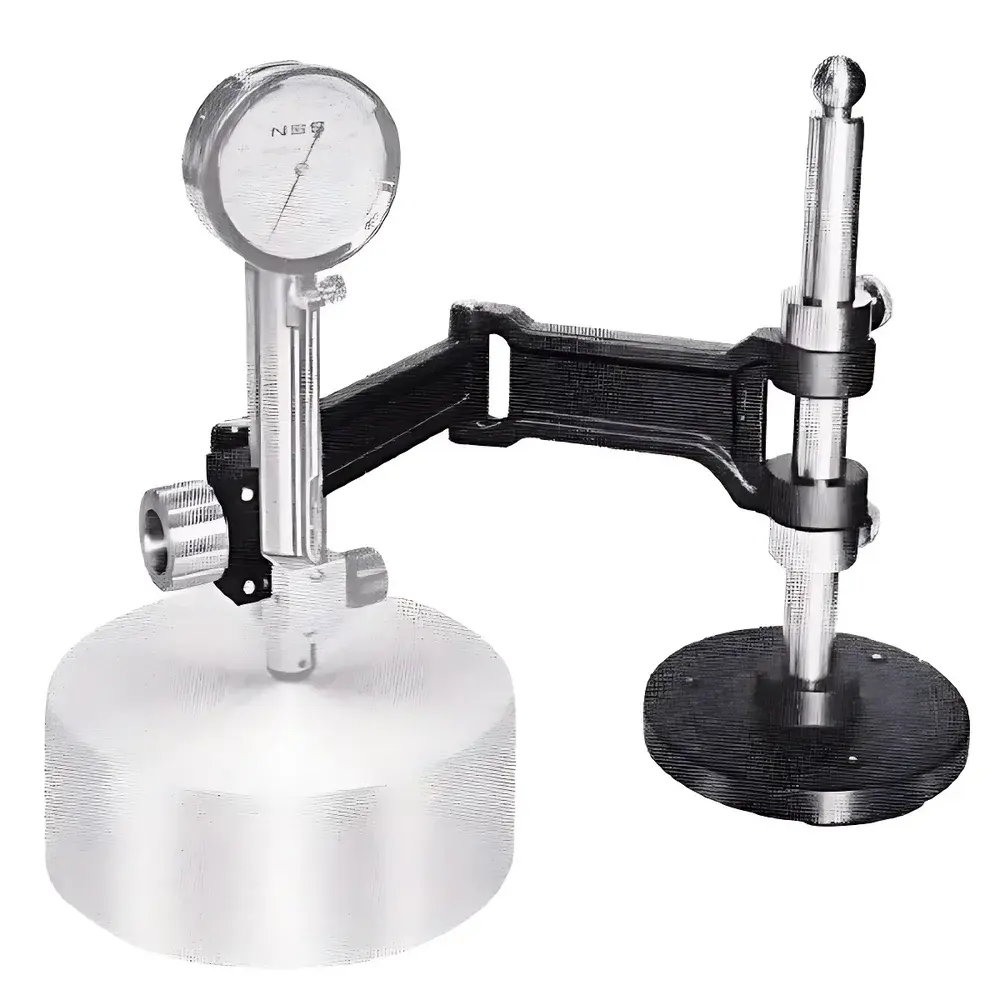
SOLY Model-D Dial-Type Shore Hardness Tester
| Brand | SOLY |
|---|---|
| Origin | Italy |
| Type | Shore Hardness Tester (Shore D) |
| Construction | C-frame with weighted diamond-tipped impact hammer |
| Drop height | 19 mm |
| Dimensions (H × W × D) | 360 mm × 150 mm × 162 mm |
| Vertical clearance | 70 mm |
| Base footprint | 60 mm × 150 mm |
| Weight | 16 kg |
| Standard accessories | Soft/hard calibration shims (1 each), V-groove anvil, interface gauge, weight extractor, hardness conversion chart (ISO 868 / ASTM D2240 compliant), carrying case, vinyl protective cover |
Overview
The SOLY Model-D Dial-Type Shore Hardness Tester is a precision mechanical instrument engineered for the non-destructive determination of Shore D hardness in rigid and semi-rigid polymeric materials, elastomers, thermoplastics, and vulcanized rubber. Based on the classical rebound principle defined in ISO 868 and ASTM D2240, the device measures the elastic recovery of a material surface following a standardized impact from a spring-loaded, diamond-tipped hammer. The Model-D employs a robust C-frame architecture with a fixed 19 mm drop height and a calibrated hammer mass, ensuring consistent kinetic energy delivery across repeated tests. Its dial-type analog readout provides immediate visual feedback without reliance on electronics or power sources—making it especially suitable for workshop environments, QC labs with limited infrastructure, and field applications where portability and operational simplicity are critical. Unlike digital variants, this mechanical design eliminates battery dependency, firmware updates, or sensor drift concerns, delivering long-term measurement stability when maintained per manufacturer guidelines.
Key Features
- C-frame mechanical design optimized for rigidity and minimal frame deflection during impact, preserving measurement integrity on large or heavy specimens.
- Weighted diamond-tipped hammer with precisely controlled mass and geometry, compliant with Shore D specifications (tip radius: 0.1 mm, included angle: 30°).
- Fixed 19 mm drop height ensures repeatable impact energy (0.049 J nominal), eliminating operator-induced variability associated with manual release techniques.
- Detachable measurement cylinder enables handheld operation for oversized or immobile samples—maintaining compliance with ASTM D2240 Annex A2 for portable use conditions.
- Analog dial scale with 0–100 Shore D graduation, offering direct reading resolution of 1 unit and parallax-reduced pointer design for accurate visual interpretation.
- Integrated V-groove anvil supports cylindrical specimens (e.g., hoses, tubing, rollers) while ensuring perpendicular impact alignment per ISO 868 Clause 6.2.
- Full accessory set includes traceable calibration shims (soft/hard), interface gauge for anvil parallelism verification, and weight extractor for routine maintenance.
Sample Compatibility & Compliance
The Model-D is validated for use on flat, convex, or cylindrical surfaces with minimum thickness ≥6 mm and surface roughness Ra ≤3.2 µm. It complies with international standards governing Shore hardness testing: ISO 868:2003 (Plastics — Determination of indentation hardness by means of a durometer), ASTM D2240-22 (Standard Test Method for Rubber Property—Durometer Hardness), and DIN 53505. The instrument meets GLP documentation requirements when used with the provided calibration shims and logbook-ready conversion chart. While not electronically audit-trail capable, its mechanical nature supports 21 CFR Part 11-aligned procedural controls when integrated into validated test protocols (e.g., documented calibration frequency, shim verification logs, operator training records).
Software & Data Management
As a fully mechanical analog instrument, the Model-D does not incorporate embedded software, connectivity interfaces, or digital data output. All measurements are recorded manually into laboratory notebooks or LIMS-compatible spreadsheets. Users are advised to pair the tester with ISO/IEC 17025-compliant calibration services—at minimum annually or per internal SOPs—and retain calibration certificates alongside hardness shim verification records. The included conversion chart facilitates cross-referencing with Rockwell, Brinell, and IRHD scales per ISO 48-4; however, such conversions remain empirical approximations and shall not substitute direct method-specific measurements.
Applications
- Quality control of injection-molded plastic housings, automotive interior trim, and engineering thermoplastics (e.g., ABS, PC, POM).
- In-process verification of vulcanization degree in rubber compounds during tire, belt, and gasket manufacturing.
- Supplier qualification testing for elastomeric seals, O-rings, and damping components per SAE J2236 or ISO 22867.
- Educational laboratories demonstrating fundamental polymer viscoelastic response under transient impact loading.
- Field inspection of construction-grade polyurethane coatings and flooring systems where electrical instrumentation is impractical or prohibited.
FAQ
Is the Model-D suitable for measuring soft silicone rubbers?
No—the Model-D is configured specifically for Shore D scale (20–90 range). Soft silicones typically fall within Shore A (10–90), requiring a Shore A durometer with lower spring force and blunter indenter geometry.
Can calibration shims be recalibrated or replaced?
Yes. SOLY-certified calibration shims are supplied with individual traceable certificates (NIST-traceable reference materials). Replacement shims must be sourced directly from authorized SOLY distributors to maintain metrological continuity.
Does the instrument require periodic adjustment beyond calibration?
Mechanical zero-point verification should be performed before each test session using the soft shim. Hammer spring tension and anvil flatness must be inspected quarterly per maintenance schedule; full recalibration is recommended after any impact damage or transportation shock.
What environmental conditions affect measurement accuracy?
Testing must occur at 23 ±2 °C and 50 ±5 % RH per ISO 291. Specimens require ≥16 h conditioning prior to testing. Surface temperature deviations >±1 °C from ambient will introduce measurable hysteresis in elastomeric responses.
Is the carrying case certified for air transport?
The vinyl-covered molded case meets IATA Packing Instruction 950 for non-hazardous laboratory equipment. No special declarations are required, though hammer assembly must remain secured during transit.



