
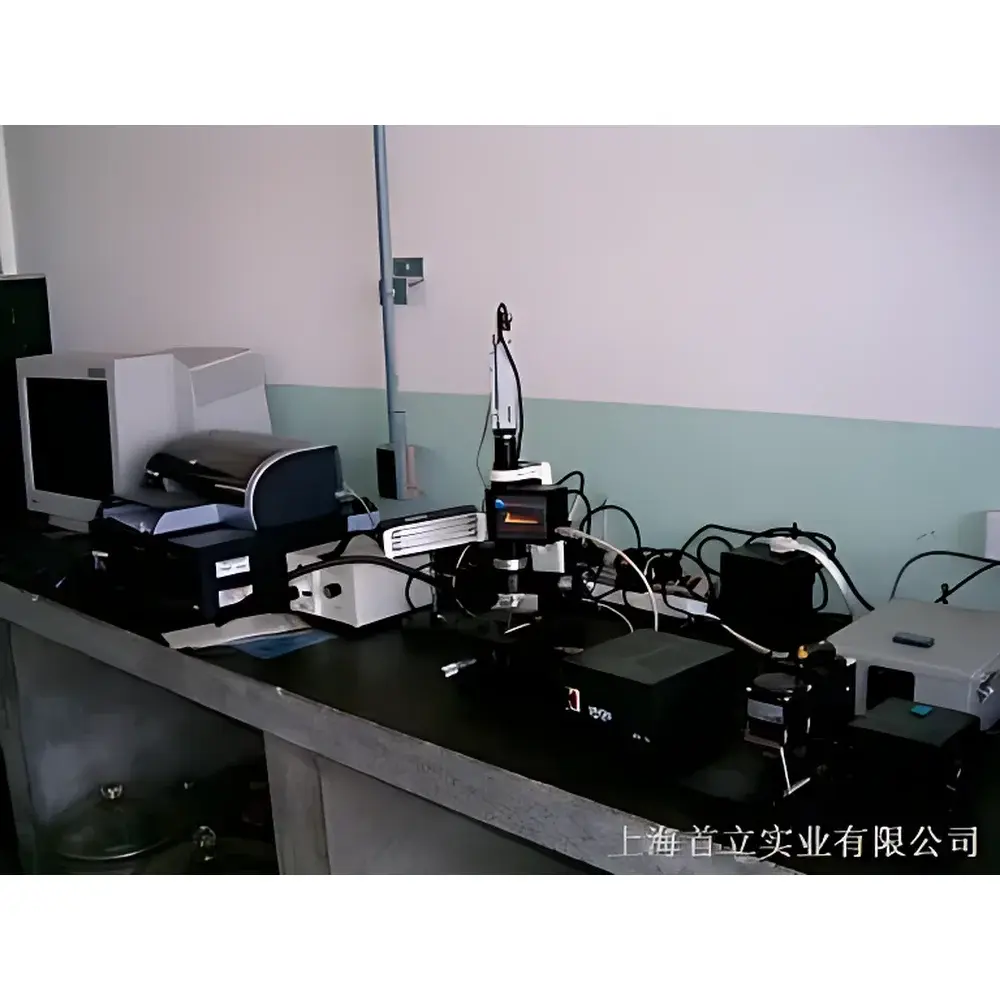
DJH Crater Dry Film Thickness Measurement System
| Origin | Canada |
|---|---|
| Manufacturer Type | Authorized Distributor |
| Origin Category | Imported |
| Model | DJH |
| Pricing | Available Upon Request |
Overview
The DJH Crater Dry Film Thickness Measurement System is a precision mechanical cross-sectioning instrument engineered for non-destructive (semi-destructive) quantitative thickness analysis of multi-layer organic and inorganic coatings on rigid substrates. Unlike X-ray fluorescence (XRF) or eddy current techniques, the DJH system employs a controlled micro-drilling methodology based on ASTM D5796—“Standard Test Method for Determination of Coating Thickness by Cross-Sectioning Using Optical Microscopy.” A precision-ground conical drill bit, with a fixed included angle of 30°, is used to create a tapered crater through successive layers until the substrate is cleanly exposed. The resulting crater geometry forms a right triangle where the measured horizontal width at the surface corresponds to ten times the actual perpendicular film thickness—enabling direct calculation via trigonometric scaling (tan θ = opposite/adjacent). This geometric amplification principle delivers sub-micron resolution without reliance on calibration standards, signal attenuation, or matrix effects common in spectroscopic methods.
Key Features
- Compliant with ASTM D5796—the only instrument formally referenced in this standard for crater-based coating thickness measurement
- Capable of resolving up to five discrete layers (e.g., conversion coating, primer, intermediate coat, topcoat, clearcoat) in a single crater
- No probe calibration required; measurement traceability is derived from drill geometry and optical magnification
- Integrated high-resolution digital imaging system with real-time video feed and adjustable illumination
- Drill depth control ensures consistent crater formation across varying hardness substrates (steel, aluminum, zinc-coated steel, plastics)
- Zero solvent use—eliminates VOC exposure, wipe residue, and operator safety hazards associated with chemical dissolution methods
- Optional extended-range drill bits available for coatings exceeding 50 µm (2 mil), maintaining geometric fidelity up to 125 µm
Sample Compatibility & Compliance
The DJH system accommodates flat or gently curved rigid substrates with surface roughness Ra ≤ 3.2 µm. Compatible coating systems include electrophoretic primers, powder coatings, liquid-applied automotive finishes, anodized layers, and PVD/CVD thin films. All measurements are fully compliant with ISO 2808 (Paints and varnishes—Determination of film thickness), ASTM B499 (Nonmagnetic coatings on magnetic basis metals), and support GLP/GMP documentation requirements. Audit trails—including operator ID, timestamp, image capture metadata, and layer annotation—are preserved in accordance with FDA 21 CFR Part 11 when paired with validated DJH View 32 software configurations.
Software & Data Management
DJH View 32 is a native 32-bit Windows application designed for deterministic image acquisition, layer boundary detection, and automated thickness computation. It supports multi-point averaging across up to 10 crater locations per sample, with statistical output (mean, SD, CV%) exported to CSV or PDF. Measurement images are tagged with EXIF metadata (magnification, objective lens, pixel scale), enabling retrospective validation. Report templates adhere to internal QA protocols and can be configured to include company logo, test method reference, and signature fields for authorized personnel. Data integrity is enforced via password-protected user roles and immutable log files.
Applications
This system is routinely deployed in automotive OEM paint labs, aerospace finishing facilities, coil coating quality control, and industrial maintenance departments where regulatory compliance and inter-laboratory reproducibility are critical. Typical use cases include verification of electrocoat uniformity prior to primer application, quantification of clearcoat build in refinish operations, thickness mapping of thermal barrier coatings on turbine blades, and failure analysis of delamination events. Its independence from elemental composition makes it uniquely suited for measuring transparent or low-Z coatings (e.g., UV-curable acrylates, silicone release layers) where XRF lacks sensitivity.
FAQ
Is the DJH system suitable for flexible or soft substrates such as rubber or thermoplastics?
No—substrate rigidity is essential to prevent plastic deformation during crater formation. Substrates must maintain dimensional stability under localized mechanical stress.
Can the system measure coatings on galvanized steel without interference from the zinc layer?
Yes—since measurement relies on optical edge detection rather than elemental emission, the underlying zinc intermetallic phase does not affect accuracy.
What is the minimum measurable thickness per layer?
With 100× objective magnification and calibrated pixel scaling, individual layers down to 2 µm can be resolved, subject to surface finish and contrast.
Does DJH View 32 support LIMS integration?
Yes—via configurable ODBC drivers and structured XML export, enabling bidirectional data exchange with laboratory information management systems.
How often does the drill bit require replacement?
Under normal use (≤50 craters/day), tungsten carbide bits retain dimensional accuracy for ≥500 craters; wear is monitored automatically via image sharpness metrics in DJH View 32.
Related Products



