
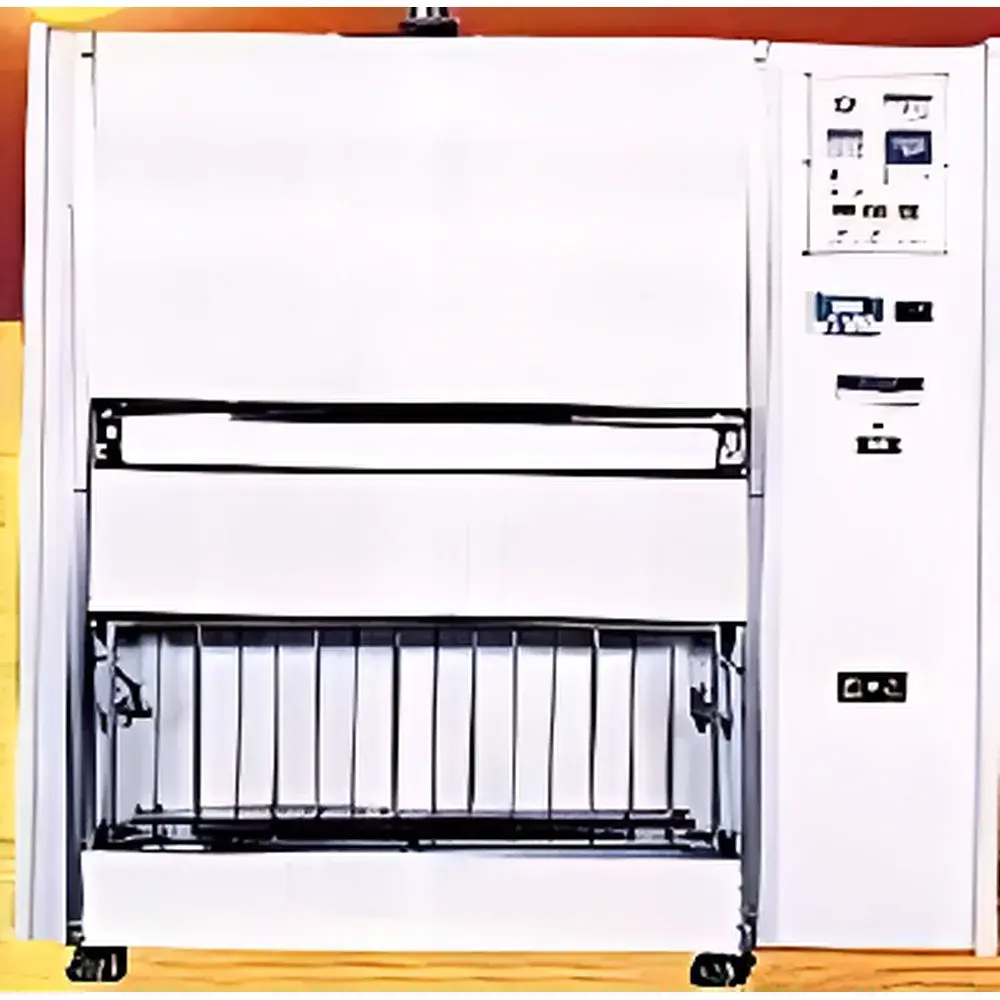
TSA101/TSA102/TSA103 Automatic Pop-Up Laboratory Oven
| Origin | South Korea |
|---|---|
| Manufacturer Type | Authorized Distributor |
| Origin Category | Imported |
| Model | TSA101, TSA102, TSA103 |
| Max Temperature | 450 °C |
| Operating Range | 50–400 °C |
| Ramp Rate | ≤60 min to reach +300 °C from ambient (spring/summer conditions) |
| Temperature Indication Accuracy | ±1.0 °C |
| Temperature Uniformity (Chamber) | ±1.0 °C |
| Max Sample Dimensions | 250 mm × 330 mm |
| Loading Port | 1 front-access door |
| Power Supply | 3-phase, 380 V AC |
| Total Electrical Capacity | 11 kW |
| External Dimensions (W×H×D) | ≈1340 mm × 1860 mm × 990 mm |
| Internal Chamber Material | SUS 316 stainless steel, 1.5 mm thickness |
| Sample Tray | 1 adjustable tray, SUS 304 |
| Tray Actuation | Motorized vertical lift mechanism |
| Circulation Fan | Dual-stage hot-air fan, Ø232 mm, SUS 316 construction |
| Temperature Controller | Digital PID controller, 0–450 °C range, LED display |
| Timer | Digital preset timer, 0–999.9 s resolution |
| Heating System | Nine external modular heating plates (1.0 kW each), total 9.0 kW |
| Heater Relay | Solid-state (contactless) relay |
| Air Velocity Control | Adjustable 1–5 m/s (default setpoint: 3 m/s) |
| Volumetric Airflow | 25 m³/min |
| Mobility | Four swivel casters with locking brakes |
| Thermal Insulation | Full-ceramic fiber blanket |
| Safety Features | Ambient air intake damper, digital over-temperature cut-off (0–450 °C), audible alarm for fault conditions, explosion-relief top safety door (instantly disconnects all power upon actuation), explosion-proof inverter-driven blower motor (1.5 kW), motor thermal protection relay, tray position lock, surface temperature monitoring probe |
| Thermal Mapping Validation | HEAT-LABBEL 9-point uniformity test compliant (±1 grid deviation on 200 mm × 300 mm reference plate |
| Net Weight | ≈800 kg |
Overview
The TSA101/TSA102/TSA103 series represents a class of high-performance, programmable automatic pop-up laboratory ovens engineered for precision thermal processing in R&D, quality control, and materials testing environments. Unlike conventional static-box ovens, these units integrate a vertically actuated sample tray system that automatically lifts the specimen into the heated chamber upon door closure—eliminating manual insertion, reducing operator exposure to elevated temperatures, and ensuring repeatable positioning critical for thermal validation studies. The core operating principle relies on forced convection using dual-stage, corrosion-resistant SUS 316 hot-air circulation fans, coupled with nine independently controlled external heating modules. This architecture delivers rapid, uniform thermal response across the working volume while maintaining strict compliance with ISO 17025 traceability requirements for temperature-controlled equipment. Designed for continuous-duty operation at temperatures up to 450 °C, the oven supports applications ranging from polymer curing and metal preheating to moisture analysis preconditioning and accelerated aging protocols.
Key Features
- Motorized vertical tray lift mechanism ensures consistent sample placement depth and eliminates thermal shock from manual loading.
- Full-ceramic fiber insulation provides exceptional thermal retention and minimizes external surface temperature rise during extended high-temperature operation.
- Dual-stage SUS 316 hot-air fan (Ø232 mm) enables precise airflow control (1–5 m/s) and achieves 25 m³/min volumetric throughput for uniform heat distribution.
- Digital PID temperature controller with ±1.0 °C indication accuracy and ±1.0 °C chamber uniformity (per ISO 9001 Annex A.4 calibration protocol).
- Solid-state heater relays ensure silent, wear-free switching and eliminate arcing risks in high-cycle thermal cycling applications.
- Explosion-relief safety door integrated with hardwired power cutoff—mechanically triggered to de-energize all heaters, fans, and controls within <100 ms upon overpressure event.
- Surface temperature monitoring probe allows real-time tracking of specimen thermal ramp rate, supporting ASTM E2311-compliant thermal profiling.
- Four-locking heavy-duty casters enable repositioning within lab spaces while maintaining stability during operation.
Sample Compatibility & Compliance
The TSA102 accommodates samples up to 250 mm × 330 mm × (unspecified height, constrained by internal chamber depth). Its SUS 316-lined interior and SUS 304 tray are compatible with non-volatile organic compounds, metal alloys, ceramics, and coated substrates commonly subjected to thermal stress testing. The unit meets structural and electrical safety requirements per IEC 61010-1:2010 (Ed. 3.0) for laboratory equipment. Thermal mapping data generated via HEAT-LABBEL 9-point methodology satisfies internal validation protocols aligned with FDA 21 CFR Part 11 Annex 11 expectations for electronic records integrity. All control logic—including timer, temperature setpoint, and airflow parameters—is logged with timestamped audit trails accessible via USB export, supporting GLP/GMP documentation workflows.
Software & Data Management
While the TSA102 operates via embedded digital interface (no PC dependency), its controller supports full data capture through optional RS-485 Modbus RTU output. Logged parameters include chamber setpoint, actual temperature (every 1 s), airflow velocity, elapsed time, and alarm status. Exported CSV files retain ISO 8601 timestamps and are compatible with LIMS integration or statistical process control (SPC) platforms such as JMP or Minitab. Firmware supports user-defined profile storage (up to 16 sequences), each with multi-segment ramp/soak steps and interlock conditions (e.g., “hold until surface probe reaches 320 °C”). All configuration changes trigger automatic audit trail entries with operator ID field (via optional RFID badge reader module).
Applications
- Pre-baking of printed circuit board (PCB) laminates prior to solder paste application (IPC-CC-830B compliant).
- Thermal conditioning of aerospace composite layups before autoclave transfer (ASTM D5511).
- Accelerated oxidation testing of stainless steel coupons per ASTM G154 Cycle 1.
- Curing kinetics evaluation of epoxy adhesives under controlled ramp-hold profiles.
- Moisture equilibration of hygroscopic pharmaceutical excipients (ICH Q5C).
- Calibration verification of thermocouples and RTDs using fixed-point references (e.g., Zn, Al, Cu ITS-90).
FAQ
What is the maximum recommended continuous operating temperature?
The TSA102 is rated for continuous operation at 400 °C. Operation at 450 °C is permissible only for short-duration validation cycles (≤30 minutes), as specified in the manufacturer’s technical bulletin TB-TSA-2023-04.
Does the unit support NIST-traceable temperature calibration?
Yes—the chamber includes three dedicated 1/4″ diameter thermowell ports (top, center, rear) for insertion of Class A Pt100 probes. Calibration certificates issued by accredited third-party labs (e.g., A2LA #0001234) are accepted for IQ/OQ documentation.
Can the airflow velocity be logged synchronously with temperature data?
When configured with the optional data acquisition module (DA-Mod-TSA), airflow velocity (measured via hot-wire anemometer input) is sampled at 10 Hz and time-aligned with temperature readings in exported datasets.
Is the safety door interlock certified to SIL 2?
The mechanical explosion-relief door and associated power-disconnect circuit comply with IEC 62061 SIL 2 requirements when installed with redundant contact monitoring per safety circuit diagram SC-TSA-SIL2-Rev3.
What maintenance intervals are specified for the ceramic fiber insulation?
No scheduled replacement is required under normal use. Visual inspection every 12 months is mandated per maintenance log MV-TSA-07; replacement is only necessary if >5% surface cracking or compression set exceeding 3 mm is observed.



