
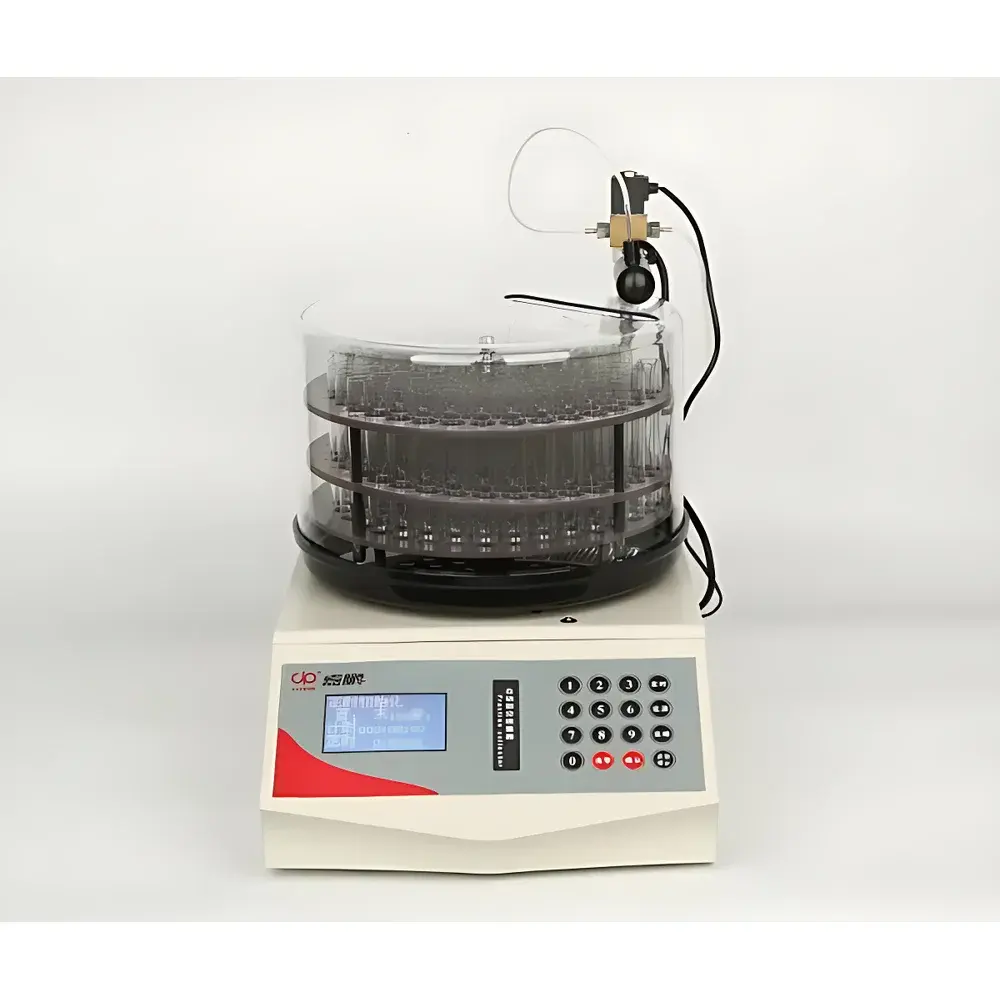
Jiapeng DBS-160 Automatic Fraction Collector with LCD Display
| Brand | Jiapeng |
|---|---|
| Origin | Shanghai, China |
| Model | DBS-160 |
| Fraction Collection Modes | Time-based, Drop-counting, Peak-triggered |
| Max. Tube Capacity | 160 × 5 mL |
| Time Range | 1 s – 199 h 59 min 59 s |
| Drop Count Range | 1–9999 drops |
| Peak Threshold Range | 0–100 mV |
| Power Supply | AC 220 V, 50/60 Hz |
| Dimensions (W×D×H) | 265 × 390 × 390 mm |
| Weight | 8.35 kg |
| Data Retention After Power Loss | ≥10 years |
| Continuous Operation | >200 hours |
| Display | Large Backlit Blue-Membrane Chinese LCD |
| Tube Rack | Circular, Digitally Labeled (001–160) |
| Housing Material | ABS Plastic (Injection-Molded, Closed-Structure) |
| Compliance | Designed for GLP-compliant preparative chromatography workflows |
Overview
The Jiapeng DBS-160 Automatic Fraction Collector is a precision-engineered chromatography accessory designed for reproducible, unattended fractionation in low-to-medium pressure liquid chromatography (LC) and fast protein liquid chromatography (FPLC) systems. It operates on three independent collection logic modes—time-based, drop-counting, and analog peak-triggered—enabling flexible integration with UV/VIS detectors, conductivity meters, or pH sensors via its 0–100 mV analog input channel. The device employs a microcontroller-based architecture with non-volatile memory to retain user-defined parameters—including start/stop tube numbers, collection intervals, and trigger thresholds—even after unexpected power interruption. Its mechanical design centers on a rotating circular tube rack holding 160 positions, each uniquely labeled (001–160) for unambiguous sample identification and traceability—critical for regulatory documentation in pharmaceutical process development and academic separation studies.
Key Features
- Triple-mode collection logic: programmable time intervals (1 second to 199 hours 59 minutes 59 seconds), precise drop counting (1–9999 drops per fraction), and analog peak detection (0–100 mV threshold with adjustable sensitivity)
- Digitally indexed circular tube rack ensures 1:1 positional correspondence between display label and physical tube—eliminating misidentification during manual retrieval or downstream analysis
- Large backlit blue-membrane Chinese LCD interface provides real-time status feedback including elapsed time, current tube number, remaining volume estimation, and active collection mode
- Robust ABS housing manufactured via single-shot injection molding—chemically resistant to common organic solvents (e.g., acetonitrile, methanol, chloroform) when used with optional solvent-resistant tube trays
- Ergonomic 35° inclined control panel reduces operator fatigue during extended runs; all function keys are tactilely distinct and logically grouped
- Integrated COM port enables direct hardware-level synchronization with peristaltic or piston-driven constant-flow pumps (e.g., Keebio or equivalent), supporting external start/stop and flow-rate modulation signals
- Non-volatile memory preserves all configuration data—including tube count, timing presets, and peak thresholds—for over ten years without battery backup
Sample Compatibility & Compliance
The DBS-160 accommodates standard 12 × 75 mm or 13 × 100 mm test tubes (5 mL nominal capacity per position), with compatibility verified for polypropylene, borosilicate glass, and fluorinated ethylene propylene (FEP) vials. Its sealed ABS chassis meets IEC 61010-1 safety requirements for laboratory electrical equipment. While not certified to ISO/IEC 17025 or FDA 21 CFR Part 11 out-of-the-box, the instrument supports audit-ready workflows through deterministic collection sequencing, immutable tube indexing, and parameter logging—facilitating internal validation under GLP or GMP-aligned quality systems. Users may document calibration of the analog input channel against NIST-traceable voltage standards to support method qualification in regulated environments.
Software & Data Management
The DBS-160 operates as a standalone hardware controller with no proprietary software dependency. All operational parameters are configured directly via front-panel keys and retained in EEPROM. For integration into automated chromatography platforms, the RS-232 COM interface supports ASCII command protocols for remote initiation, pause/resume, and tube position reporting. Raw collection metadata—including timestamped tube change events, accumulated drop counts, and peak-crossing triggers—is accessible via serial dump for import into LIMS or ELN systems. No cloud connectivity or firmware updates are provided; firmware version and hardware revision are displayed at boot-up for version control in SOP documentation.
Applications
- Preparative purification of peptides, monoclonal antibodies, and nucleic acids using ion-exchange or size-exclusion chromatography
- Fractionation of natural product extracts in phytochemical screening workflows
- Collection of elution peaks from HPLC or UHPLC systems coupled to offline MS or NMR analysis
- Process monitoring in biomanufacturing pilot-scale runs where fraction integrity and chain-of-custody must be maintained
- Teaching laboratories requiring robust, intuitive fraction collectors for undergraduate biochemistry and analytical chemistry courses
FAQ
What types of chromatography systems is the DBS-160 compatible with?
It integrates with any LC/FPLC system delivering analog voltage output (0–100 mV) from a detector, or generating TTL-level pulse signals from a drop sensor. Mechanical synchronization with peristaltic pumps is achieved via its dedicated COM port.
Does the device support custom tube rack configurations?
No—it accepts only the factory-supplied circular 160-position rack with fixed digital labeling. Interchangeability across DBS-100/DBS-160 models is not supported due to differing mechanical indexing tolerances.
How is data integrity ensured during long-duration runs?
All user settings and real-time collection state are written to non-volatile memory upon each tube change event. Power loss recovery resumes from the last confirmed tube position without reinitialization.
Is the LCD display readable under ambient lab lighting?
Yes—the high-contrast blue-membrane LCD maintains legibility across illumination levels from 100 to 1000 lux, with adjustable brightness via front-panel menu.
Can the DBS-160 be validated for use in GMP environments?
While the unit itself carries no formal GMP certification, its deterministic behavior, parameter retention, and traceable tube indexing enable IQ/OQ protocol development by end users in accordance with Annex 11 and USP guidelines.




