
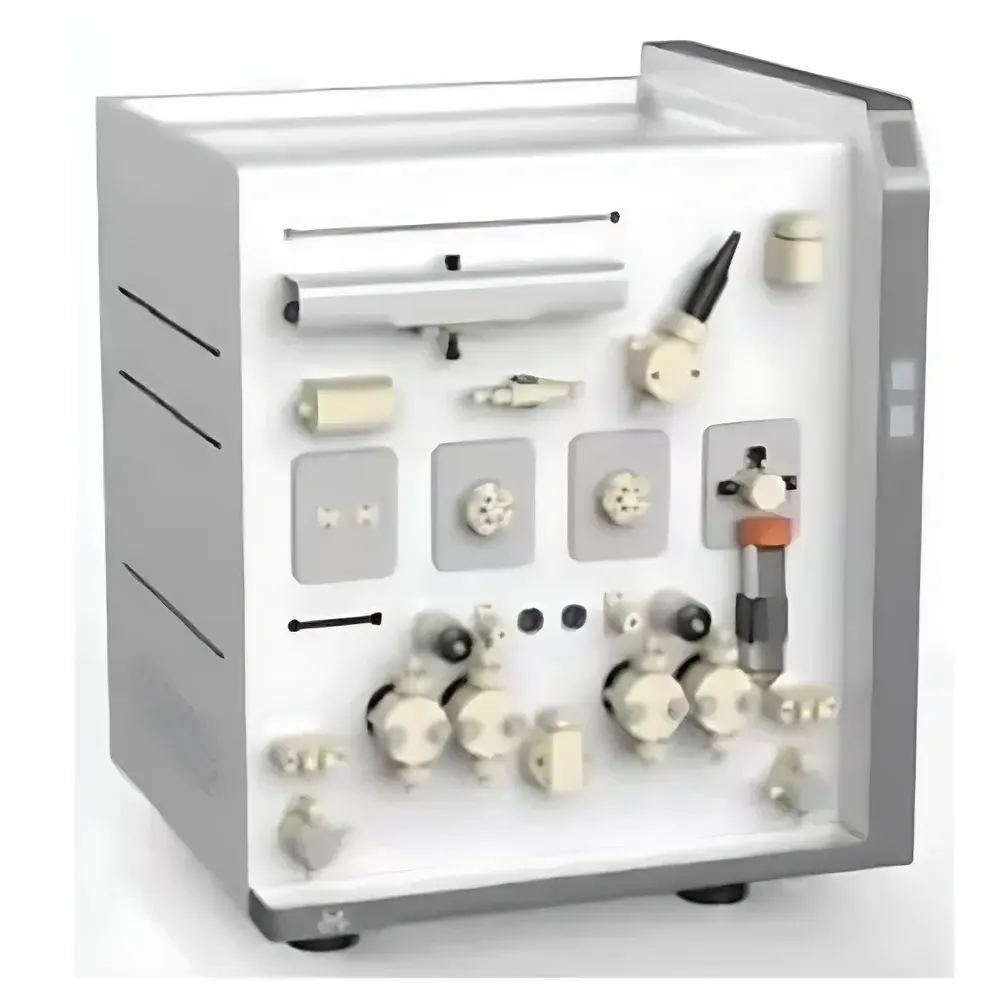
JP-KeebioGO Protein Purification System
| Brand | JiaPeng |
|---|---|
| Origin | Shanghai, China |
| Manufacturer Type | Authorized Distributor |
| Country of Origin | China |
| Model | JP-KeebioGO |
| Purification Principle | Ion Exchange Chromatography (IEX) |
| Gradient Types | Isocratic, Linear, and Step Gradients |
| Flow Rate Range | 0.001–25 mL/min |
| Flow Rate Accuracy | ±1.2% |
| UV Detection Range | –6 to +6 AU |
| Linearity | ±1.5% (0–2 AU) |
| Maximum System Pressure | 0–10 MPa (1500 psi) |
| Conductivity Range | 0.001–400.00 mS/cm |
| Accuracy | ±2% with temperature compensation |
| pH Range | 0–14 (measurable range 2–12) |
| Accuracy | ±0.1 with temperature compensation |
| Temperature Sensor Range | 0–100 °C |
| Accuracy | ±1 °C |
| Detector Wavelengths | 260 nm, 280 nm, 295 nm, 310 nm |
| Wavelength Accuracy | ±1 nm |
| Repeatability | ±0.1 nm |
| Sample Cell Volume | 10 µL |
| Bubble Sensors | Installed at A/B inlets and sample inlet |
| Injection Valve | 3-position, 7-port, software-controllable, supporting Load/Inject/Waste modes |
| Fraction Collection Compatibility | JP-KeebioFC with configurable rack support |
| Data Export Format | Native Excel (.xlsx) |
| Operating Temperature | 4–40 °C |
| Dimensions (W×D×H) | 360 × 380 × 470 mm |
| Weight | 20 kg |
Overview
The JP-KeebioGO Protein Purification System is an integrated, benchtop liquid chromatography platform engineered for precision, reproducibility, and operational flexibility in biomolecule isolation workflows. Based on classical column chromatography principles—including ion exchange (IEX), affinity, size exclusion (SEC), hydrophobic interaction (HIC), and desalting/buffer exchange—the system delivers scalable purification from microgram to gram quantities of proteins, peptides, nucleic acids, and polysaccharides. Its dual-pump architecture enables stable, low-pulsation flow delivery across a wide dynamic range (0.001–25 mL/min), while real-time multi-parameter monitoring—UV absorbance at four user-selectable wavelengths (260 nm, 280 nm, 295 nm, 310 nm), conductivity, pH, pressure, temperature, and bubble detection—ensures rigorous process control and method robustness. Designed for compliance-conscious laboratories, the JP-KeebioGO supports audit-ready data integrity through automatic timestamped acquisition, electronic signature-capable method storage, and full traceability of all hardware events.
Key Features
- Industrial-grade 12-inch capacitive touchscreen interface with intuitive, bilingual (English/Chinese) navigation—no warm-up required; baseline stabilization achieved within seconds of startup.
- Modular dual-syringe or dual-piston pump system delivering continuous, pulse-free flow with ±1.2% accuracy across the full 0.001–25 mL/min range and maximum backpressure tolerance of 10 MPa (1500 psi).
- Dynamic mixing chamber (2 mL volume) enabling precise gradient formation with real-time online adjustment of isocratic, linear, or step profiles during runtime.
- Dual-wavelength UV-Vis detector featuring LED cold-light source, 10 µL flow cell, and calibrated linearity (±1.5% over 0–2 AU) across –6 to +6 AU range—optimized for protein (A280), nucleic acid (A260), and aromatic residue detection.
- Integrated electrochemical sensors: conductivity module (0.001–400.00 mS/cm, ±2% accuracy with automatic temperature compensation) and pH probe (range 2–12, ±0.1 accuracy with NIST-traceable calibration support).
- Intelligent fraction collection via JP-KeebioFC interface—supports time-based, peak-triggered, UV-threshold, or conductivity-gated collection, with compatibility for standard microtiter plates, test tubes, and custom racks.
- Comprehensive system diagnostics: optical bubble sensors at A/B solvent inlets and sample injection port; real-time column inlet pressure monitoring; and thermal stability verification across 0–100 °C.
Sample Compatibility & Compliance
The JP-KeebioGO accommodates standard aqueous and organic-aqueous mobile phases used in preparative and analytical bioseparations—including Tris-HCl, phosphate, acetate, imidazole, NaCl, glycerol, and ethanol/water mixtures—compatible with PEEK, PTFE, and stainless-steel fluidic pathways. All wetted materials meet USP Class VI biocompatibility standards. The system supports method development and validation under GLP and GMP frameworks: raw data files are immutable upon acquisition, include embedded metadata (operator ID, instrument serial number, timestamp, method version), and retain full audit trail for FDA 21 CFR Part 11 compliance when deployed with validated electronic signature modules. Instrument qualification documentation—including IQ/OQ protocols—is available upon request.
Software & Data Management
The embedded chromatography workstation provides synchronized, multi-channel visualization: UV trace, gradient profile, conductivity curve, pH trend, temperature log, and fraction index—all rendered in real time on a single unified screen. Methods are stored as encrypted XML files with version control and user-access permissions. All chromatograms and sensor logs are automatically saved in proprietary .jpk format (lossless compression) and exportable to industry-standard Excel (.xlsx) without third-party conversion. Data integrity safeguards include automatic recovery after power interruption, cyclic buffer logging, and checksum-verified backups. Optional network integration allows remote monitoring via secure HTTPS and centralized data archiving using LIMS-compatible APIs.
Applications
- Purification of recombinant proteins (e.g., His-tagged, GST-fused, antibody fragments) via immobilized metal affinity chromatography (IMAC) or protein A/G ligands.
- Ionic strength–guided separation of post-translationally modified isoforms (e.g., phosphorylated or glycosylated variants) using strong/weak cation or anion exchangers.
- Desalting and rapid buffer exchange prior to mass spectrometry, crystallization trials, or functional assays.
- Size-based fractionation of oligomeric states or degradation products via high-resolution SEC columns (e.g., Superdex, TSK-GEL).
- Process development and small-scale manufacturing support for preclinical biologics, including purity assessment per ICH Q5A and host cell protein clearance verification.
FAQ
What chromatographic techniques does the JP-KeebioGO support?
It supports ion exchange (IEX), affinity, size exclusion (SEC), hydrophobic interaction (HIC), and desalting/buffer exchange—configured via interchangeable column hardware and method parameters.
Is the system compliant with regulatory data integrity requirements?
Yes—when operated with enabled audit trail and electronic signature features, it meets core expectations of FDA 21 CFR Part 11, EU Annex 11, and WHO TRS 996 for electronic records and signatures.
Can I integrate third-party fraction collectors or detectors?
The system offers TTL and RS-232 interfaces for hardware synchronization; however, only JP-KeebioFC collectors are fully validated for trigger-based collection logic and tube mapping.
What is the minimum detectable protein concentration under standard conditions?
With a 10 µL flow cell and A280 detection, the theoretical limit of quantitation is ~20 µg/mL for typical globular proteins—subject to pathlength, column efficiency, and signal-to-noise optimization.
Does the software support method transfer between instruments?
Yes—method files (.jpk) are portable across JP-KeebioGO units of the same firmware generation and retain all gradient, detection, and collection settings without recalibration.
Related Products




