
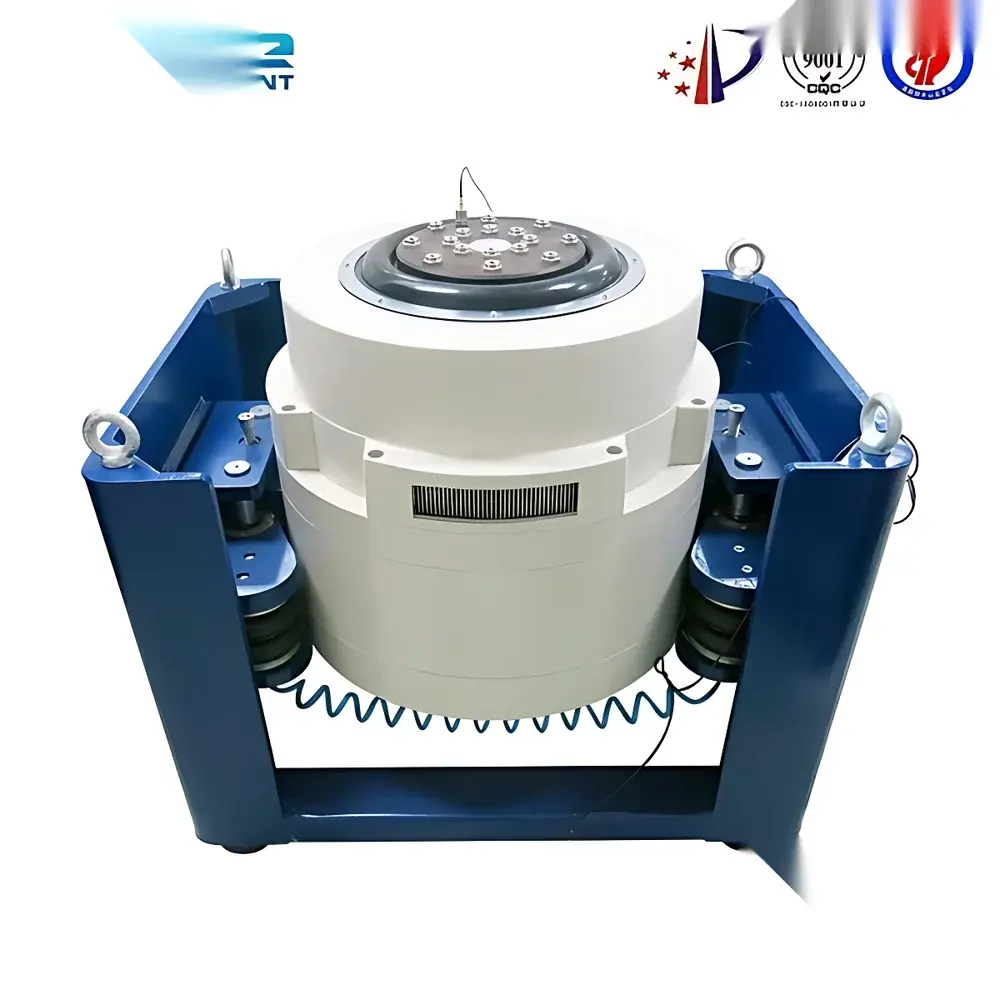
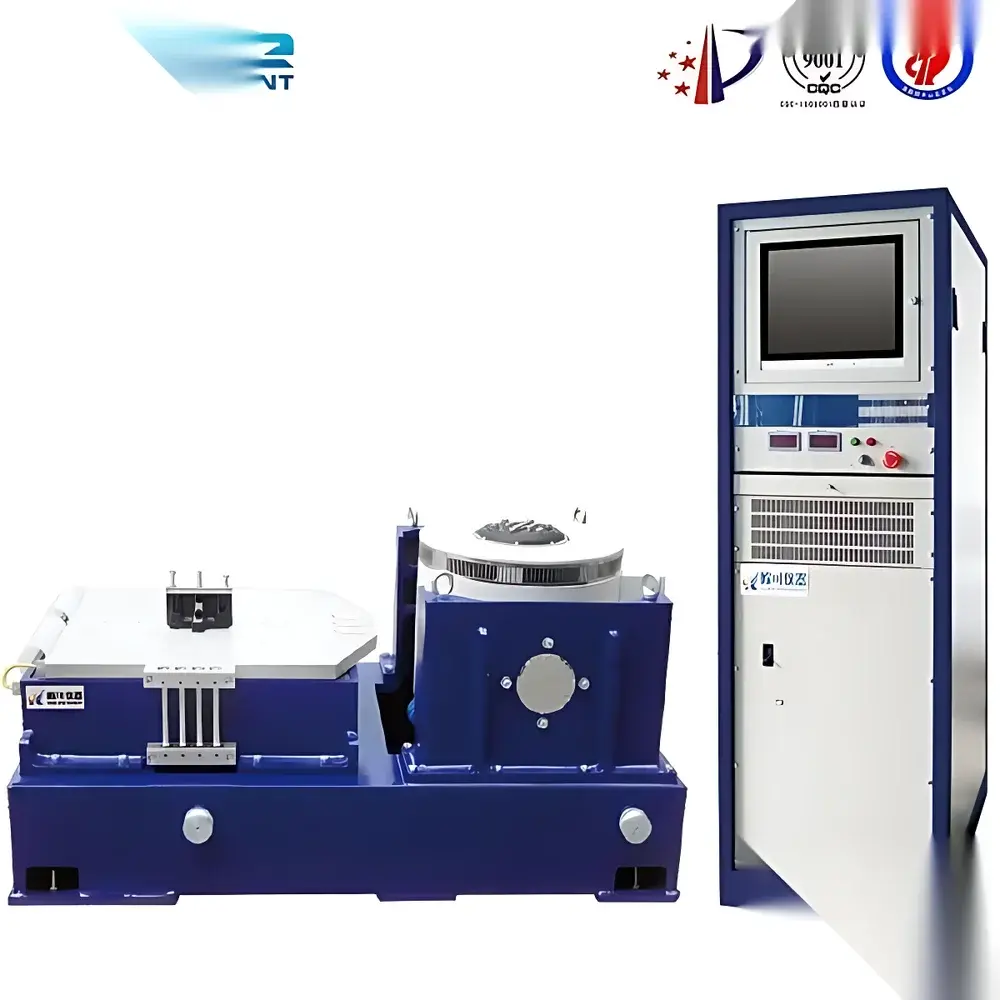
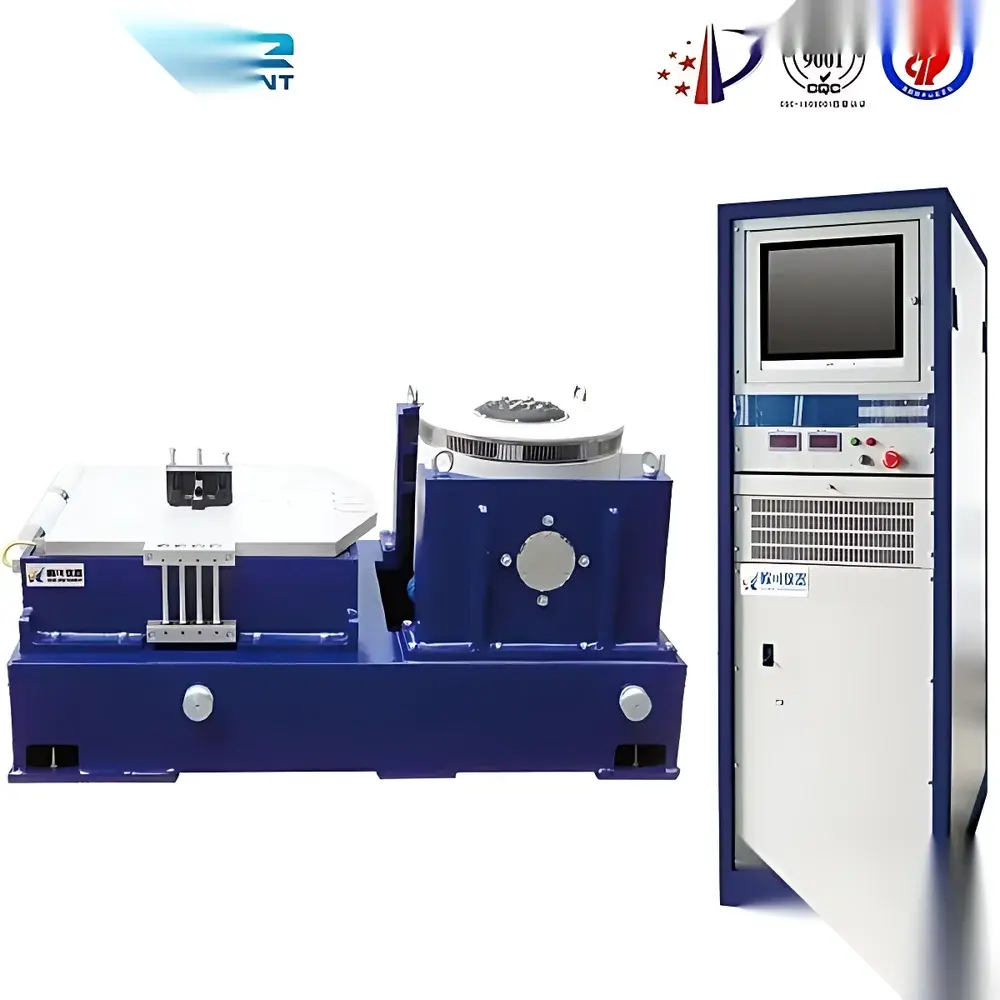
Electric Random Vibration Testing System
| Key | Load Capacity: 100 kg |
|---|---|
| Table Dimensions (Vertical) | 50×20×50 cm (L×H×W) |
| Table Dimensions (Horizontal) | 50×26.5×50 cm (L×H×W) |
| 台面尺寸 (Table Top) | 50×50 cm (L×W) |
| Vibration Axes | Vertical (Z-axis) and Horizontal (X/Y-axes) |
| Frequency Range | 1–600 Hz (standard), up to 5000 Hz (customizable) |
| Sweep Mode | Linear/logarithmic bidirectional sweep with user-defined start/stop frequencies and dwell time |
| Programmable Mode | 15-segment profile, each segment configurable for frequency and duration, repeatable |
| Tuning Mode | Frequency tuning within range under acceleration ≤20 g and displacement ≤5 mm p-p |
| Octave Mode | 15-step octave-up, octave-down, or up-down-up sequences |
| Logarithmic Mode | Three-directional log-sweep (low→high, high→low, low→high→low), repeatable |
| Motor Power | 2.2 kW |
| Peak Displacement | 0–5 mm p-p (adjustable) |
| Peak Acceleration | 20 g (max) |
| Waveform | Sinusoidal |
| Time Resolution | 1 s (programmable) |
| Frequency Display Resolution | 0.01 Hz |
| Frequency Accuracy | ±0.1 Hz |
| Power Supply | 220 V ±20%, 5 A max |
| Acceleration–Displacement Relationship | aₚₑₐₖ = 0.002 × f² × D (with aₚₑₐₖ in g, f in Hz, D in mm p-p) |
Overview
The Electric Random Vibration Testing System is a high-fidelity electrodynamic shaker platform engineered for controlled mechanical excitation of test specimens under sinusoidal, swept-sine, and programmable vibration profiles. Unlike hydraulic or pneumatic exciters, this system employs a voice-coil electromagnetic actuator driven by a high-efficiency 2.2 kW amplifier—delivering precise, repeatable force output across a broad frequency spectrum (1–600 Hz standard; optionally extended to 5000 Hz). Its core measurement principle relies on closed-loop control of acceleration and displacement via real-time feedback from integrated or externally connected transducers. Designed for compliance with international vibration testing standards—including ISO 10816 (mechanical vibration evaluation), ASTM D999 (shipping container vibration simulation), and MIL-STD-810H Method 514.8 (vibration testing for military equipment)—this system enables rigorous assessment of structural integrity, fatigue life, and early failure detection during product development, qualification, and quality assurance phases.
Key Features
- Bi-axial excitation capability: independent vertical (Z-axis) and horizontal (X/Y-plane) vibration modes, supporting multi-degree-of-freedom test configurations.
- Full programmability: 15-segment vibration profiles with user-defined frequency, dwell time, and sweep direction per segment—repeatable over unlimited cycles.
- Three standardized sweep methodologies: linear sweep, logarithmic sweep (with three directional options), and octave-based frequency progression—each supporting both forward and reverse traversal.
- High-resolution control interface: frequency resolution down to 0.01 Hz, accuracy maintained within ±0.1 Hz across the operational bandwidth.
- Dual mechanical configuration: compact table dimensions (50×50 cm top surface) accommodate diverse fixture designs; vertical unit height is 20 cm; horizontal unit height is 26.5 cm—optimized for lab integration and modal testing setups.
- Dynamic envelope constraints: real-time enforcement of physical limits—peak acceleration capped at 20 g, peak-to-peak displacement limited to 5 mm—ensuring safe operation while preserving waveform fidelity.
- Standard RS-485 communication port for integration into automated test systems; optional interface card and PC software enable remote control, data logging, report generation, and traceable audit trails.
Sample Compatibility & Compliance
This system accommodates rigidly mounted samples up to 100 kg, including electronic assemblies, automotive ECUs, aerospace avionics modules, consumer appliance subassemblies, and defense-grade enclosures. Fixture design must ensure rigid coupling and minimal modal interference below 100 Hz. The system meets mechanical safety requirements per IEC 61000-4-27 (electromagnetic compatibility for vibration test equipment) and supports test execution in accordance with ISO 2041 (vibration and shock—vocabulary), ISO 5344 (vibration test fixtures), and US DoD standards for environmental stress screening (ESS). When paired with calibrated accelerometers and third-party DAQ hardware, it satisfies GLP and GMP documentation requirements—including full audit trail generation for FDA 21 CFR Part 11–compliant validation protocols.
Software & Data Management
While the base unit operates via front-panel controls, full functionality is unlocked through optional PC-based control software accessible via RS-485. This software provides real-time waveform visualization, profile editing with drag-and-drop sequencing, automatic limit checking against acceleration/displacement envelopes, and timestamped binary data export in CSV or TDMS formats. All test sessions generate immutable metadata logs—including operator ID, calibration status, environmental conditions (if sensor-integrated), and system health diagnostics—supporting ISO/IEC 17025-compliant laboratory accreditation. Optional add-ons include FFT-based spectral analysis tools, SRS (Shock Response Spectrum) calculation modules, and PDF report templating with embedded pass/fail criteria per test specification.
Applications
- Early-life failure screening (burn-in vibration) for PCBs and solder joint reliability assessment.
- Structural resonance mapping and modal analysis of lightweight chassis and composite housings.
- Transportation simulation per ISTA 3A and ASTM D4169—replicating road, rail, and air cargo vibration environments.
- Qualification testing of inertial sensors, MEMS devices, and navigation-grade IMUs under controlled harmonic excitation.
- Environmental stress screening (ESS) per Telcordia GR-63-CORE for telecom infrastructure hardware.
- Design verification of vibration-damping mounts, isolation platforms, and shock-absorbing packaging systems.
FAQ
What is the maximum payload capacity without compromising performance?
The system maintains specified acceleration and displacement linearity up to 100 kg when properly balanced and fixtured. Exceeding this mass requires derating per manufacturer’s load vs. frequency curves.
Can this system perform random vibration testing—or only sine-based profiles?
This model is optimized for deterministic (sine, swept-sine, programmable) vibration. For true Gaussian random vibration testing—including PSD synthesis and kurtosis control—a dedicated random vibration controller and power amplifier upgrade are required.
Is calibration certification included with shipment?
Factory calibration data (acceleration sensitivity, displacement linearity, frequency response) is provided. NIST-traceable calibration certificates require separate scheduling with an accredited metrology lab.
How is thermal management handled during extended high-g operation?
The actuator incorporates forced-air cooling via integrated axial fans, with temperature monitoring and automatic power throttling if coil temperature exceeds 120 °C.
Does the system support third-party control software such as NI LabVIEW or MATLAB?
Yes—via the RS-485 interface and documented Modbus RTU register map. Driver libraries and example scripts are available upon request for LabVIEW, Python, and MATLAB environments.



