
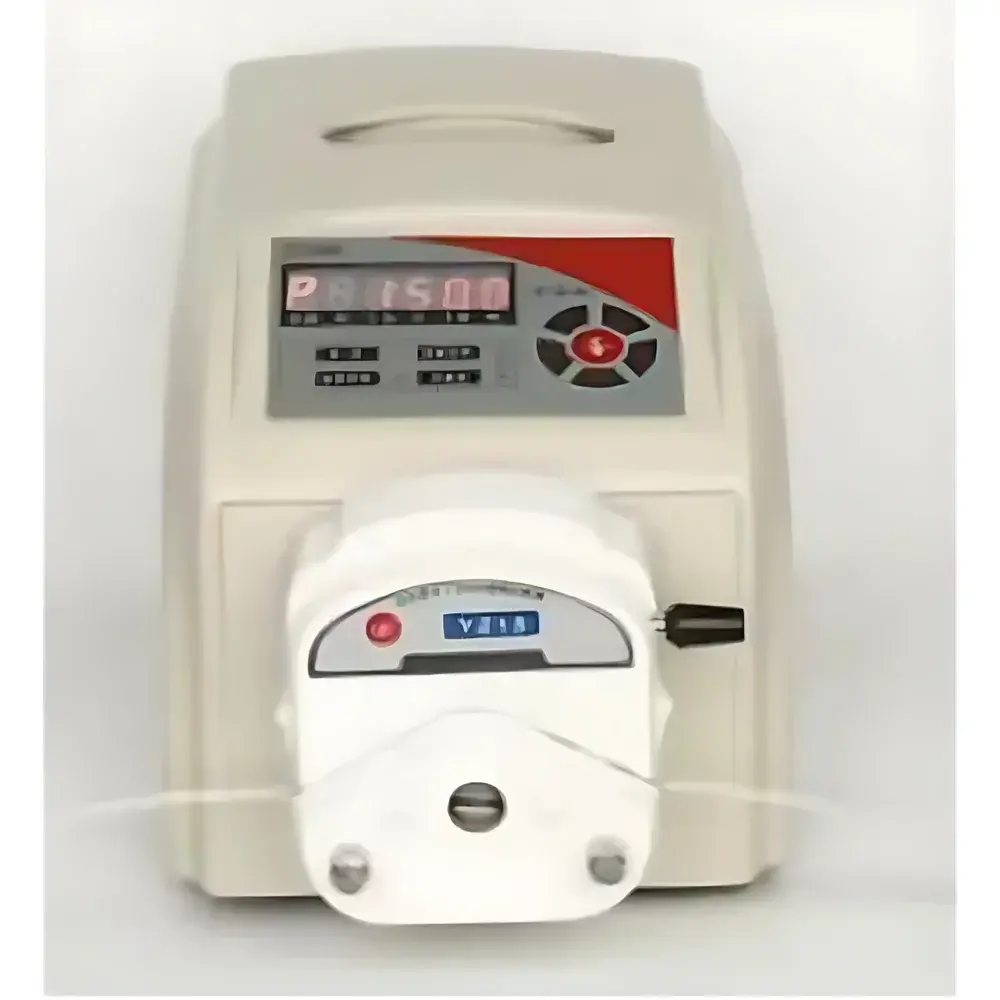
Jiapeng BT-200SD Digital Programmable Dual-Channel Peristaltic Pump
| Brand | Jiapeng |
|---|---|
| Origin | Shanghai, China |
| Model | BT-200SD |
| Flow Rate | 2 × (0.9–14,500 mL/h) |
| Pressure Rating | ≥3 kg/cm² |
| Flow Accuracy | ±0.5% |
| Speed Range | 0.1–150 rpm (bidirectional) |
| Display | 4-digit LED tachometer |
| Control | Microprocessor-based timer (run/standby), external trigger, memory retention |
| Pump Head | Dual YZ1515 |
| Tube Compatibility | #13, #14, #16, #17, #18, #19, #25 silicone or fluoropolymer tubing |
| Drive | 256-microstep stepper motor |
| Housing Materials | Titanium alloy chassis, 316 stainless steel rollers |
| Power Input | AC 220 V, 50/60 Hz |
| Dimensions | 250 × 170 × 170 mm |
| Weight | 3.5 kg |
Overview
The Jiapeng BT-200SD is a dual-channel digital programmable peristaltic pump engineered for precise, repeatable fluid delivery in analytical and preparative laboratory workflows. Operating on the principle of positive displacement via roller compression of flexible tubing, it delivers consistent flow without fluid contact with internal mechanical components—ensuring chemical compatibility, minimal cross-contamination, and compliance with Good Laboratory Practice (GLP) requirements. Designed as a core module in liquid chromatography systems, the BT-200SD synchronizes seamlessly with UV/Vis nucleic acid & protein detectors and fraction collectors to form complete low-to-medium pressure chromatographic separation and purification platforms. Its microstepping motor control and high-resolution speed regulation enable stable flow profiles essential for gradient elution, column equilibration, and time-resolved fraction collection.
Key Features
- Dual independent YZ1515 pump heads supporting simultaneous or asynchronous operation—ideal for buffer delivery, sample loading, or dual-stream mixing applications.
- 256-step microstepping stepper motor drive ensures smooth rotation, low pulsation (<2.5% peak-to-peak), and acoustic noise below 45 dB(A) at rated load—critical for vibration-sensitive detection setups.
- 4-digit LED tachometer displays real-time rotational speed (0.1–150 rpm) with bidirectional control; direction reversal facilitates backflushing and system priming.
- Non-volatile parameter memory retains last-used settings—including speed, run time, standby duration, and direction—after power cycle or emergency stop.
- Titanium alloy structural frame and 316 stainless steel rollers provide long-term dimensional stability and corrosion resistance against organic solvents, acids, and saline buffers.
- Programmable timing logic supports two distinct operational modes: “Run Timer” (1 second to 9 h 59 min 59 s) and “Standby Timer” (0–9 h 59 min 59 s), enabling unattended overnight operation.
- External TTL-compatible trigger input allows synchronization with fraction collectors or data acquisition systems for event-driven collection (e.g., peak detection output).
Sample Compatibility & Compliance
The BT-200SD accommodates a broad range of elastomeric tubing sizes (#13 through #25), including platinum-cured silicone, EPDM, and fluoropolymer-lined variants—supporting compatibility with aqueous, polar organic, and mildly aggressive reagents (pH 2–12). Its tube-based fluid path eliminates metal leaching and avoids seal degradation issues common in diaphragm or piston pumps. The device meets IEC 61010-1 safety standards for laboratory electrical equipment and supports traceable operation under ISO/IEC 17025-accredited environments when paired with validated tubing and calibration protocols. While not FDA 21 CFR Part 11–certified out-of-the-box, audit-ready operation is achievable via external electronic lab notebook (ELN) integration and manual logbook documentation of parameter changes.
Software & Data Management
The BT-200SD operates as a standalone instrument with no proprietary software dependency. All configuration is performed via tactile membrane keypad with immediate visual feedback on the LED display. For automated system integration, the pump accepts 5 V TTL-level start/stop signals and provides open-collector status outputs (RUN/STANDBY), compatible with LabVIEW, Python (via USB-to-TTL adapters), or PLC-based control architectures. Time-stamped operational logs must be maintained externally; however, the built-in timer resolution (1-second granularity) and memory retention support reproducible method execution across shifts and operators—facilitating alignment with GLP documentation requirements.
Applications
- Preparative and analytical liquid chromatography (e.g., gel filtration, ion exchange, affinity purification).
- Continuous sampling in environmental water analysis and bioreactor effluent monitoring.
- Controlled reagent addition in kinetic enzyme assays and titration systems.
- Automated dialysis and tangential flow filtration feed control.
- Calibration standard delivery in atomic absorption spectroscopy (AAS) and inductively coupled plasma (ICP) sample introduction systems.
- Cell culture media perfusion in microfluidic organ-on-chip platforms requiring low-shear, pulse-free flow.
FAQ
What tubing sizes are supported by the BT-200SD?
The pump accommodates standard peristaltic tubing sizes #13, #14, #16, #17, #18, #19, and #25—each optimized for specific flow ranges and chemical resistance profiles.
Can the BT-200SD operate in reverse mode during a run?
Yes—bidirectional rotation is fully programmable and can be initiated manually or triggered externally without interrupting the timer sequence.
Is flow rate calibration required before use?
While factory-calibrated for nominal accuracy (±0.5%), users should perform volumetric verification using gravimetric or timed-collection methods when working with new tubing batches or critical applications.
Does the pump support analog or digital communication protocols?
No native RS-232, USB, or Ethernet interface is included; control is limited to front-panel input and TTL-level external triggering.
How is maintenance performed on the pump head assembly?
Roller alignment and tubing compression force are factory-set and non-adjustable; routine maintenance consists solely of periodic roller cleaning and tubing replacement per manufacturer’s service interval recommendations.
Related Products



