
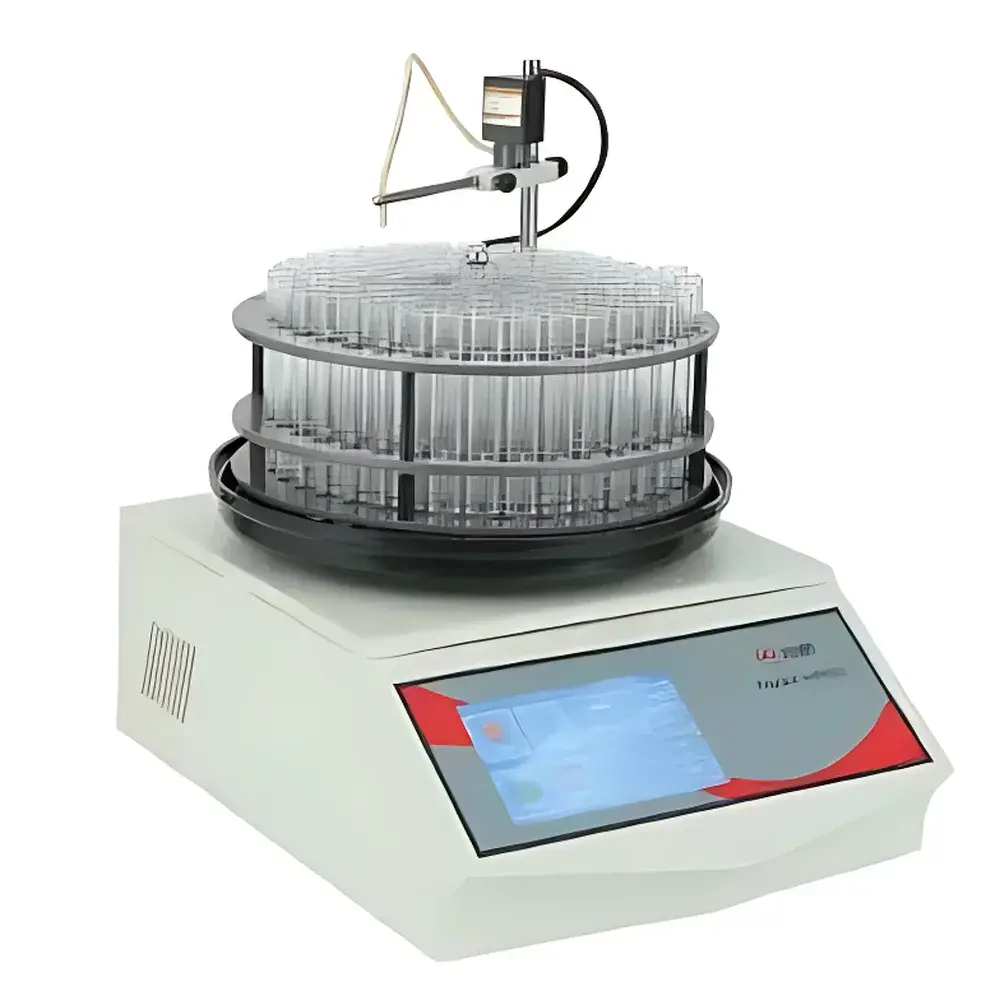
Jiapeng JP-FCD160 Automated Fraction Collector
| Brand | Jiapeng |
|---|---|
| Model | JP-FCD160 |
| Type | Liquid-phase Fraction Collector |
| Collection Modes | Time-based, Drop-counting, UV/absorbance threshold-triggered |
| Tube Capacity | 160 × 5 mL |
| Touchscreen Interface | 5.5-inch capacitive LCD |
| UV Input Range | 0–100 mV (analog) / –6 to +6 AU (digital, requires external UV detector) |
| Timer Range | 1 s – 199 h 59 min 59 s |
| Drop Count Range | 1–9999 drops |
| Delay Volume Compensation | Adjustable in software |
| Valve Type | PEEK solenoid valve (organic solvent compatible, drip-free switching) |
| Continuous Operation | >200 h |
| Power Supply | AC 220 V, 50/60 Hz |
| Dimensions (W×D×H) | 265 × 390 × 390 mm |
| Weight | 8.35 kg |
Overview
The Jiapeng JP-FCD160 Automated Fraction Collector is an engineered solution for precise, reproducible fractionation in medium- and low-pressure liquid chromatography (LC) and fast protein liquid chromatography (FPLC) workflows. Designed for integration with UV/VIS detectors, peristaltic or piston-driven pumps, and preparative columns, it operates on three primary collection triggers—time, drop count, and absorbance threshold—to ensure alignment between elution profile and physical sample recovery. Its core architecture implements a microprocessor-controlled PEEK fluid path with zero-dead-volume valve actuation, minimizing carryover and enabling high-fidelity fraction capture across diverse mobile phases—including aqueous buffers, acetonitrile, methanol, and isopropanol. The device complies with fundamental requirements for GLP-compliant preparative separations, supporting traceable, auditable collection logs when paired with compliant data acquisition software.
Key Features
- 160-position circular tube rack with engraved numeric labeling—each position uniquely identified for unambiguous tube assignment and post-collection traceability.
- 5.5-inch capacitive touchscreen interface with intuitive icon-driven workflow navigation; supports real-time parameter editing, program saving, and multi-step collection sequence definition.
- Three independent collection modes: time-programmed (1 s to 199 h 59 min 59 s), drop-counted (1–9999 drops per fraction), and UV/absorbance threshold-triggered (0–100 mV analog input or –6 to +6 AU digital signal, requiring external detector).
- Software-configurable delay volume compensation—critical for synchronizing fraction collection with detector signal peak maxima when system dwell volume introduces temporal offset.
- High-integrity PEEK solenoid valve assembly rated for continuous organic solvent exposure; engineered for <0.1 µL residual holdup and no-drip switching performance under variable flow rates (0.1–10 mL/min typical).
- RS-232/COM port for hardware-level external triggering—direct synchronization with peristaltic pumps (e.g., Jiapeng JP-1000B) or third-party controllers without intermediary software layers.
Sample Compatibility & Compliance
The JP-FCD160 accommodates standard 12 × 75 mm or 13 × 100 mm test tubes (5 mL capacity per position), with mechanical stability maintained across full rack loading. Its fluid-contact materials—PEEK valve body, PTFE tubing interfaces, and chemically inert tray housing—are compatible with pH 2–12 aqueous solutions and common LC-grade organic solvents. While not certified to IEC 61010-1 or ISO 13485 out-of-box, the unit meets baseline electrical safety and EMC criteria for laboratory instrumentation per GB 4793.1–2007 (equivalent to IEC 61010-1:2010). When operated within validated protocols and logged via compliant software, it supports adherence to USP , ASTM E2500, and basic GMP documentation requirements for fraction identity and integrity in early-stage biopurification.
Software & Data Management
The onboard firmware stores up to 20 user-defined collection methods with timestamped execution logs (date, start/stop time, trigger type, tube range). Optional PC-based control software (Jiapeng ChromaLink v3.x) provides real-time graphical display of active collection status, UV trace overlay, and CSV export of all run metadata—including tube index, elapsed time, cumulative drop count, and absorbance thresholds crossed. Audit trail functionality includes operator ID entry, method version tracking, and immutable log files suitable for internal review. Though not natively 21 CFR Part 11 compliant, the system supports integration into validated environments via external electronic lab notebook (ELN) or LIMS platforms using standardized data exchange formats (e.g., .csv, .txt).
Applications
- Purification of recombinant proteins and monoclonal antibodies via ion-exchange or size-exclusion chromatography.
- Isolation of natural product fractions from crude plant extracts using gradient RP-HPLC.
- Desalting and buffer exchange of oligonucleotides and peptides post-synthesis.
- Collection of metabolite fractions from LC-MS preparative runs for structural elucidation.
- Quality control sampling in small-molecule API purification campaigns where fraction homogeneity must be verified by parallel HPLC analysis.
FAQ
What types of detectors can be interfaced with the JP-FCD160 for threshold-based collection?
The unit accepts analog UV output (0–100 mV, ±1% FS linearity) from standalone UV-Vis detectors or digital absorbance signals (–6 to +6 AU, RS-232 or TTL-compatible) from integrated chromatography systems.
Is the delay volume setting adjustable per-run or globally?
Delay volume is defined at the method level and saved with each collection protocol—allowing different compensation values for distinct column/detector configurations.
Can the JP-FCD160 operate unattended for overnight purification runs?
Yes—rated for >200 hours of continuous operation with thermal management designed for stable ambient lab conditions (15–30°C, <80% RH non-condensing).
Does the tube rack support custom tube sizes beyond 5 mL?
The standard rack is optimized for 12 × 75 mm tubes; alternative racks (e.g., for 15 mL conical tubes) are available as optional accessories but require mechanical recalibration.
How is tube position accuracy ensured during high-speed collection cycles?
A precision stepper motor drives the carousel with optical encoder feedback, achieving ±0.1° positional repeatability—verified across 10,000+ indexing cycles in factory testing.





