
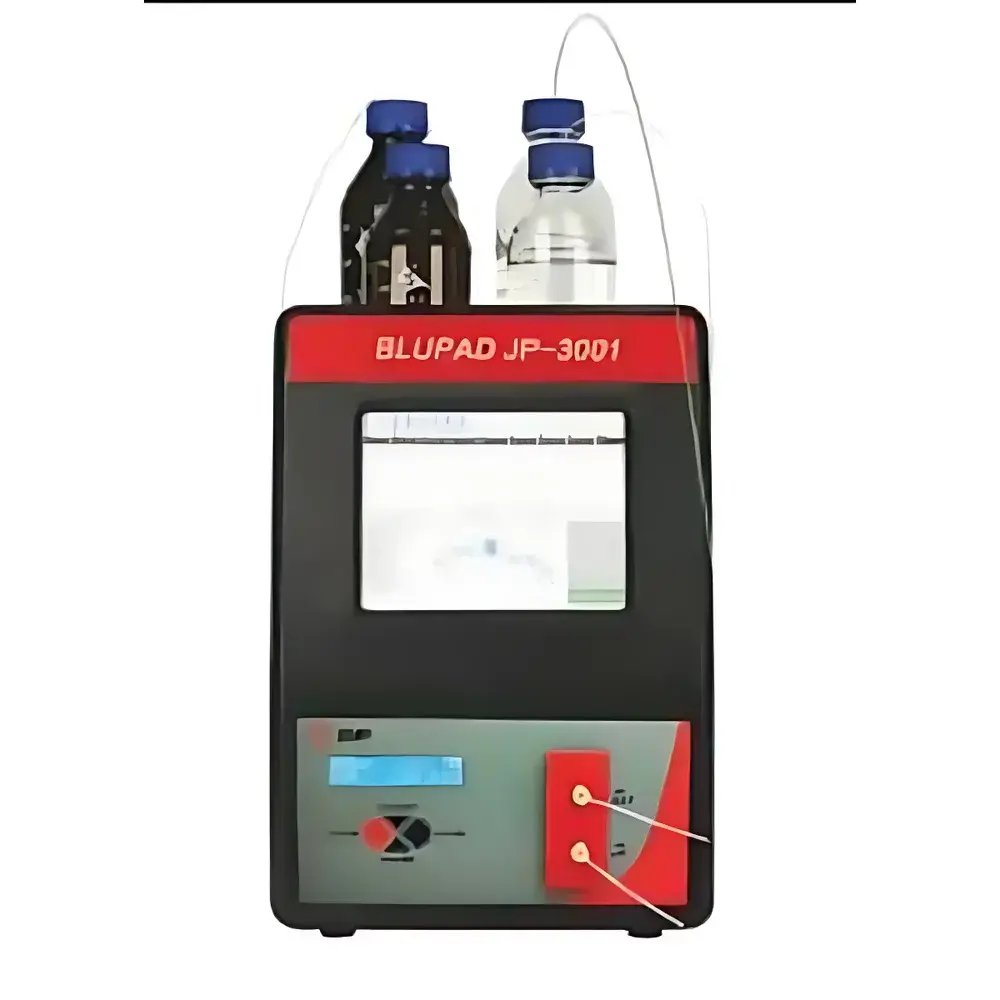
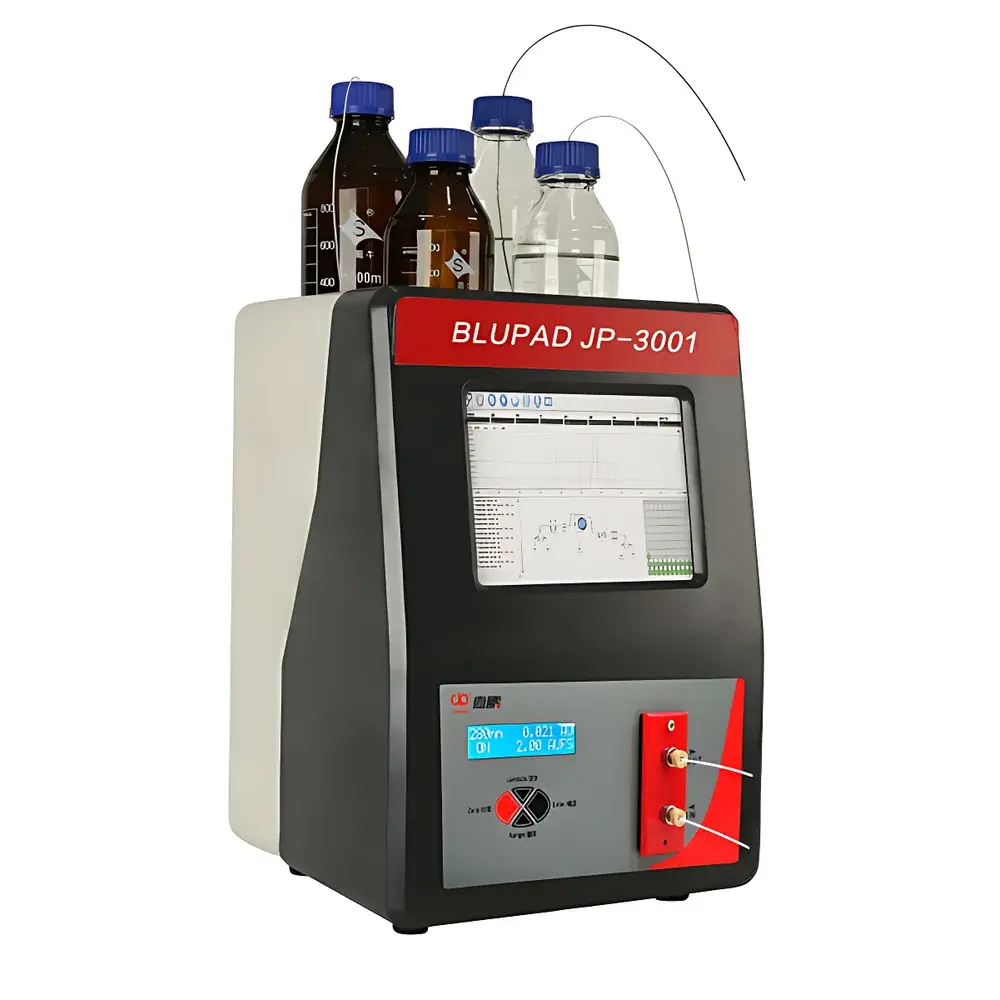
Jiapeng JP-3001 Dual-Beam UV-Vis Nucleic Acid & Protein Detector
| Brand | Jiapeng |
|---|---|
| Origin | Shanghai, China |
| Model | JP-3001 |
| Purification Principle | Gel Filtration Chromatography (GFC) |
| Gradient Type | Linear Gradient |
| Detector Type | Dual-Beam UV Absorbance Detector |
| Detection Wavelengths | 260 nm, 280 nm, 295 nm, 310 nm |
| Minimum Detectable Concentration | 20 µg/mL |
| Light Source | High-Stability LED (Lifespan > 50,000 h) |
| Optical Path Length | 2 mm |
| Flow Cell Volume | 10–120 µL |
| Baseline Noise | < 0.0001 AU |
| Drift | ≤ 0.002 AU/s |
| Absorbance Sensitivity Range | 0.05–2.0 AU (adjustable in 6 steps) |
| Zero Calibration | Real-time dual-beam auto-zero |
| Display | 10.1-inch capacitive touchscreen LCD |
| Power Supply | AC 220 V, 50/60 Hz |
| Dimensions (W×D×H) | 290 × 330 × 470 mm |
| Weight | 9 kg |
| Max Operating Pressure | 3 MPa |
Overview
The Jiapeng JP-3001 Dual-Beam UV-Vis Nucleic Acid & Protein Detector is an integrated analytical instrument engineered for real-time, high-stability absorbance monitoring during liquid chromatography-based purification of biomolecules. It operates on the principle of dual-beam UV-Vis spectrophotometry, where one beam passes through a reference flow cell and the other through the sample flow cell—enabling continuous background compensation and eliminating baseline drift caused by lamp intensity fluctuation or solvent absorption changes. Designed specifically for gel filtration chromatography (GFC), the JP-3001 delivers precise quantification of nucleic acids (A260), proteins (A280), aromatic amino acids (A295), and tryptophan-rich domains (A310) across a fixed-wavelength array. Its LED-based optical architecture ensures long-term photometric stability (>50,000 h lifetime), low thermal load, and immunity to warm-up delays—critical for reproducible method transfer between labs and compliance with GLP/GMP-aligned workflows.
Key Features
- Dual-beam optical path design with real-time reference subtraction, eliminating manual zeroing and ensuring stable baselines from power-on
- Programmable wavelength selection via stepper-motor-driven filter wheel (260 nm, 280 nm, 295 nm, 310 nm) — optimized for nucleic acid/protein ratio (A260/A280) analysis and conformational assessment
- High-sensitivity detection down to 20 µg/mL (BSA equivalent) with six-step adjustable absorbance gain (0.05–2.0 AU), supporting both dilute eluates and concentrated fractions
- Integrated 10.1-inch capacitive touchscreen running Blupad Chromatography Workstation v3.x — enabling on-device chromatogram acquisition, peak integration, retention time annotation, and export in JPG, CSV, and native .blu formats
- Standardized 1/16″ PEEK tubing interface and GE-compatible column fittings, facilitating seamless integration with AKTA systems, ÄKTA avant, or home-built FPLC setups for pre-purification scouting runs
- Robust mechanical architecture with 2-mm optical path quartz flow cell (10–120 µL volume range) rated for sustained operation up to 3 MPa, suitable for high-resolution size-exclusion separations on rigid media such as Superdex or Sephacryl
Sample Compatibility & Compliance
The JP-3001 supports aqueous and low-organic mobile phases commonly used in GFC—including phosphate-buffered saline (PBS), Tris-HCl, and sodium acetate buffers—without interference from solvent cutoff effects below 220 nm. Its LED source emits no UV-C radiation, eliminating ozone generation and enabling safe benchtop use without ventilation requirements. The system complies with IEC 61010-1 for laboratory electrical safety and meets EMC Class B emission limits per CISPR 11. While not certified for FDA 21 CFR Part 11 out-of-the-box, the Blupad software supports audit-trail-enabled user accounts, electronic signatures (via external authentication), and immutable data logging—providing a foundation for validation under ISO/IEC 17025 or pharmaceutical QC environments when configured with appropriate SOPs and change control documentation.
Software & Data Management
Blupad Chromatography Workstation (v3.x, Software Copyright No. 2019SR0680657) provides full local control of detection parameters, gradient programming synchronization (when interfaced with compatible pumps), and real-time overlay of multi-wavelength traces. All chromatograms are timestamped and stored with metadata including date/time, operator ID, method name, and instrument serial number. Export options include lossless JPG for publication-ready figures, CSV for third-party statistical analysis (e.g., R, Python pandas), and proprietary .blu files retaining raw detector voltage vs. time data at 10 Hz sampling rate. Data integrity is reinforced via cyclic redundancy check (CRC) on file write operations and optional network backup to SMB/CIFS shares.
Applications
- Monitoring elution profiles during size-exclusion purification of monoclonal antibodies, recombinant enzymes, and viral vectors
- Quantitative assessment of DNA/RNA purity (A260/A280 and A260/A230 ratios) post-extraction or after desalting columns
- Method development for GFC separation of protein aggregates, fragments, or degradation products in stability studies
- Supporting academic research in structural biology, where consistent A280 tracking enables rapid fraction pooling prior to SEC-MALS or cryo-EM grid preparation
- Quality control testing in nutraceutical and fermented food production, verifying peptide content and absence of contaminating nucleic material
FAQ
Does the JP-3001 support wavelength scanning or only fixed-wavelength detection?
No — the JP-3001 uses discrete, motor-driven bandpass filters at four fixed wavelengths (260, 280, 295, 310 nm). It does not perform continuous spectral scanning.
Can the flow cell be replaced with a custom pathlength or material?
Yes — the standard 2-mm quartz flow cell is field-replaceable; optional 1-mm and 10-mm pathlength cells are available as accessories for high- or low-absorbance applications.
Is remote control possible via Ethernet or USB?
The device supports USB 2.0 host connection for firmware updates and mass storage mode; however, live remote control requires direct serial (RS-232) or analog voltage output integration with external PLC or DAQ systems.
What validation documentation is provided with the instrument?
Each unit ships with a Factory Acceptance Test (FAT) report including wavelength accuracy verification (NIST-traceable holmium oxide filter), baseline noise measurement, and zero stability test — compliant with ASTM E275 and ISO 17025 clause 5.9 requirements.
How often must the LED light source be calibrated?
LED intensity is inherently stable; no routine photometric calibration is required. Annual verification using a neutral density filter set is recommended for ISO 17025 accreditation maintenance.




