
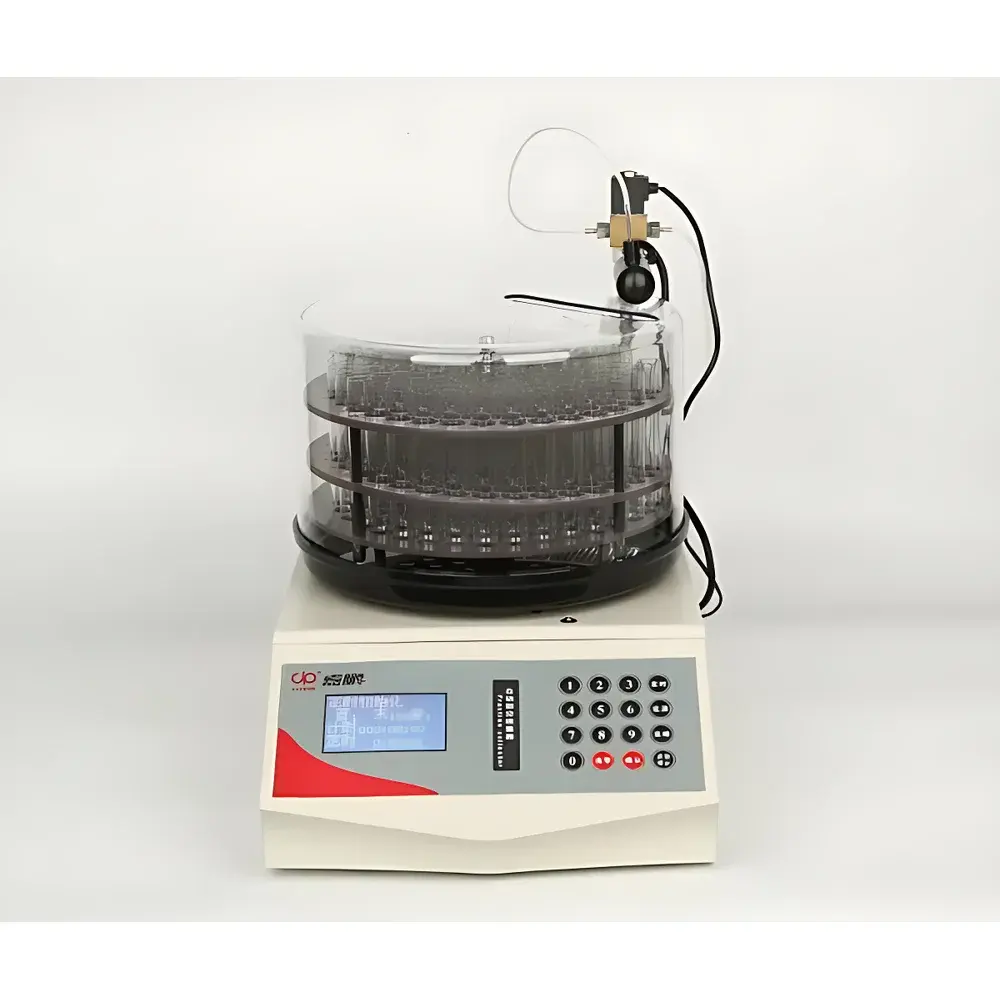
Jiapeng DBS-100 Automatic Fraction Collector with LCD Display
| Brand | Jiapeng |
|---|---|
| Origin | Shanghai, China |
| Model | DBS-100 |
| Fraction Collection Type | Liquid-phase |
| Collection Modes | Time-based, Drop-counting, Peak-triggered |
| Tube Capacity | 100 × 12 mL |
| Time Range | 1 s – 199 h 59 min 59 s |
| Drop Range | 1–9999 drops |
| Peak Threshold Range | 0–100 mV |
| Power Supply | AC 220 V, 50/60 Hz |
| Dimensions (W×D×H) | 265 × 390 × 390 mm |
| Weight | 8.35 kg |
| Data Retention After Power Loss | 10 years |
| Display | Large Blue-backlit Chinese LCD |
| Tube Tray | Circular, Digitally Labeled (00–99) |
| Continuous Operation Time | >200 h |
| Housing Material | ABS Plastic (Injection-molded, Closed-loop Design) |
| Compliance | Designed for GLP-aligned chromatographic workflows |
Overview
The Jiapeng DBS-100 Automatic Fraction Collector is a precision-engineered liquid-phase fraction collection system designed for integration into medium- and low-pressure preparative chromatography workflows. It operates on three deterministic collection triggers—time, drop count, and analog peak signal—enabling reproducible, protocol-driven fractionation of eluent streams from HPLC, FPLC, gravity-fed, or peristaltic pump-based separation systems. The device implements a robust microcontroller architecture with non-volatile memory, ensuring parameter retention for up to ten years following power interruption—a critical requirement for unattended overnight or multi-day purification runs in academic, biotech, and pharmaceutical development labs. Its circular, digitally labeled tube tray (00–99) supports 100 × 12 mL collection tubes, with mechanical indexing optimized to eliminate positional drift during tube exchange. The unit is not a standalone analytical instrument but a regulated auxiliary module intended for use under defined SOPs in environments where traceability, repeatability, and hardware-level reliability are prerequisites for downstream analysis or formulation.
Key Features
- Triple-mode collection logic: programmable time intervals (1 second to 199 hours, 59 minutes, 59 seconds), precise drop counting (1–9999 drops per fraction), and analog peak threshold triggering (0–100 mV input range)
- Large blue-backlit Chinese-character LCD display with high-contrast readability under standard laboratory lighting conditions
- Digitally indexed circular tube tray—each position labeled 00 through 99—ensuring unambiguous tube identification and eliminating misalignment during manual retrieval
- 35° ergonomic control panel angle, reducing operator fatigue during extended setup or monitoring sessions
- ABS polymer housing manufactured via single-stage injection molding—chemically resistant, structurally rigid, and compliant with ISO 14644-1 Class 8 cleanroom-compatible handling protocols
- Integrated COM port for direct TTL-level external triggering; compatible with standard peristaltic pumps and UV/VIS detectors equipped with analog output (0–100 mV full scale)
- Non-volatile memory retains all user-defined parameters—including start tube, end tube, delay offsets, and collection mode—without battery backup
Sample Compatibility & Compliance
The DBS-100 is intended for aqueous and moderately polar organic solvent systems commonly employed in protein purification (e.g., ammonium sulfate gradients), natural product isolation (methanol/water, acetonitrile/water), and oligonucleotide desalting. While the standard tube tray is compatible with common borosilicate or polypropylene 12 mL round-bottom tubes, optional Keebio fluid cutoff valves (sold separately) provide enhanced chemical resistance for aggressive solvents including chloroform, THF, and DMSO. The device does not perform analytical measurements and therefore carries no ISO/IEC 17025 accreditation; however, its deterministic actuation, fixed mechanical indexing, and persistent configuration storage support audit-ready documentation under GLP and GMP frameworks. It meets electromagnetic compatibility requirements per CISPR 11 Group 1, Class B and operates safely within ambient lab conditions (15–30 °C, 30–80% RH, non-condensing).
Software & Data Management
The DBS-100 operates without proprietary software—configuration is performed entirely via front-panel controls and validated through real-time LCD feedback. All settings are stored in EEPROM and survive power cycling without degradation. While no native PC interface is included, the COM port enables integration with third-party acquisition platforms (e.g., LabVIEW, Python-based control scripts) via RS-232 or USB-to-serial adapters. For regulated environments, users may log collection events manually or embed timestamps and tube indices into external chromatography data systems (CDS) using detector analog outputs. The absence of embedded operating systems or network interfaces eliminates cybersecurity exposure vectors and simplifies 21 CFR Part 11 compliance when used as a peripheral in validated chromatographic methods.
Applications
- Preparative gel filtration and ion-exchange chromatography of recombinant proteins and antibodies
- Desalting and buffer exchange of synthetic peptides prior to mass spectrometry analysis
- Fractionation of plant extracts during phytochemical profiling workflows
- Collection of discrete peaks from size-exclusion or reversed-phase HPLC runs for stability or solubility testing
- Automated pooling of fractions in process development for biosimilar manufacturing
- Teaching laboratories requiring reliable, low-maintenance fraction collection for undergraduate biochemistry courses
FAQ
Does the DBS-100 support USB or Ethernet connectivity?
No. Communication is limited to the RS-232-compatible COM port for external hardware triggering only.
Can I use non-standard tube sizes or shapes?
The tray is dimensionally optimized for 12 mL round-bottom tubes (16 mm OD). Deviations may cause misalignment or incomplete sealing.
Is calibration required before use?
No calibration is needed—the device relies on mechanical indexing and digital timing; however, users should verify drop-count accuracy against a calibrated flowmeter for quantitative applications.
What happens if power fails mid-run?
All active parameters and current tube index are preserved in non-volatile memory; operation resumes from the last valid position upon power restoration.
Is the unit suitable for use in cold rooms or fume hoods?
It is rated for 15–30 °C ambient operation. Prolonged exposure below 15 °C may affect LCD response time and ABS dimensional stability; enclosure ventilation must remain unobstructed.
Related Products




