
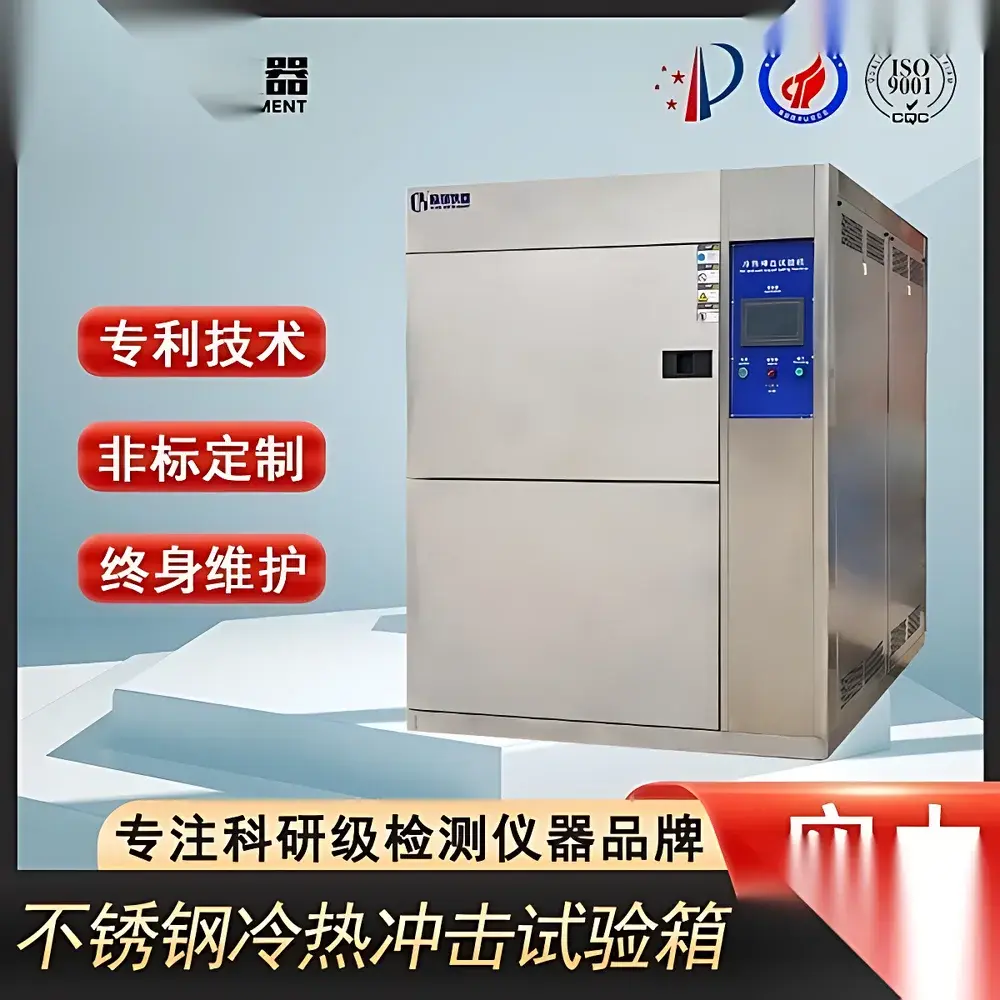
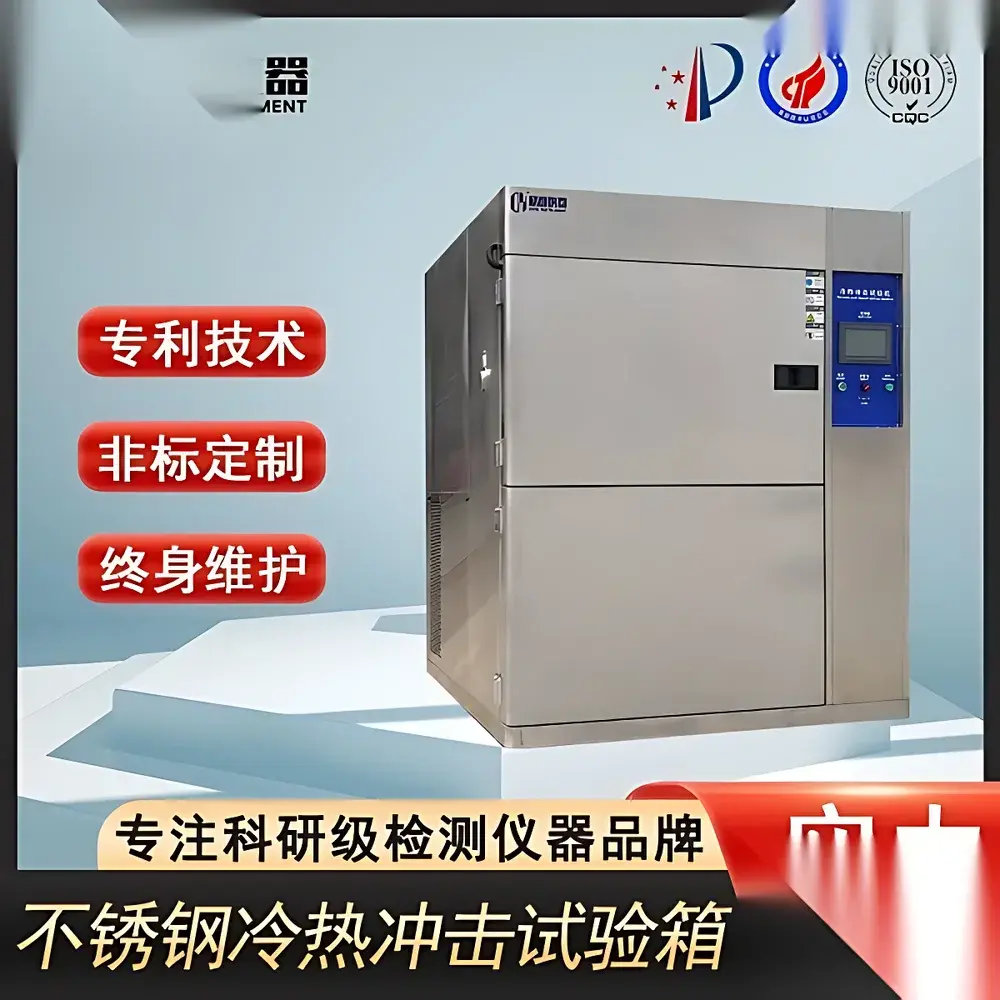
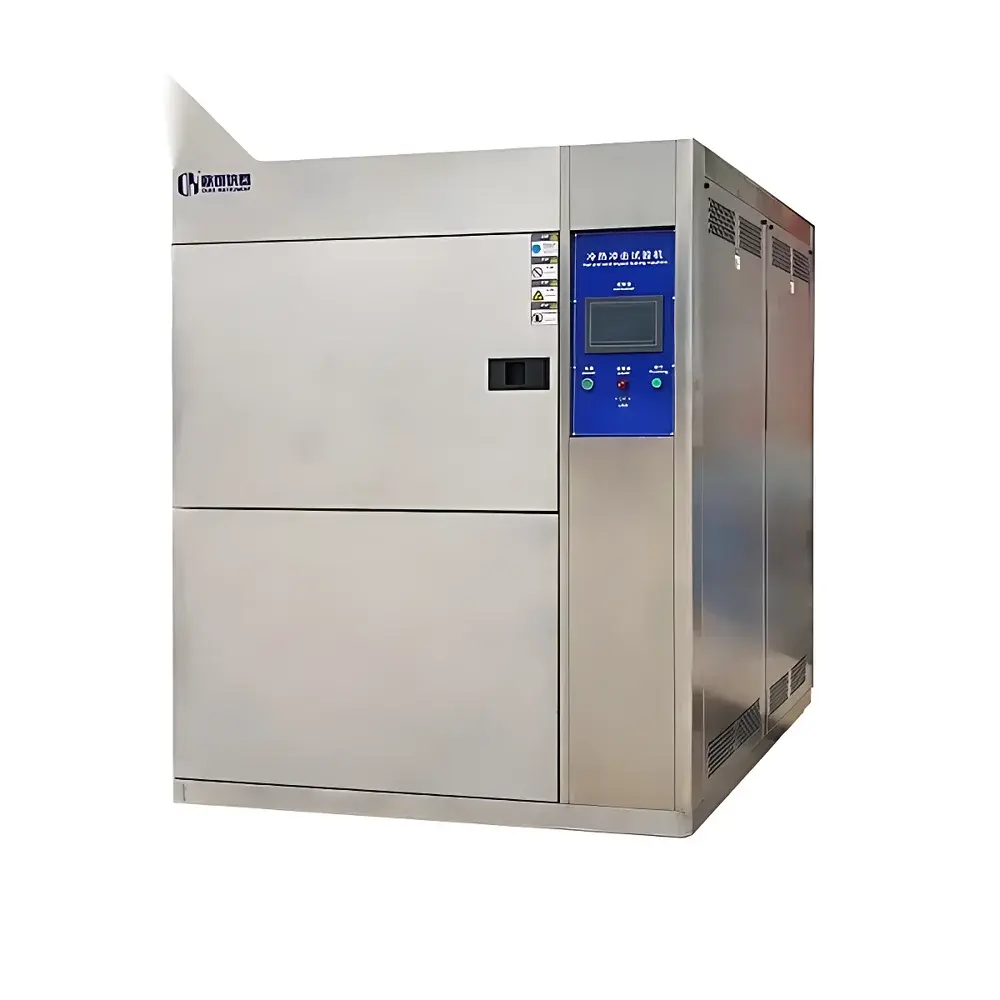
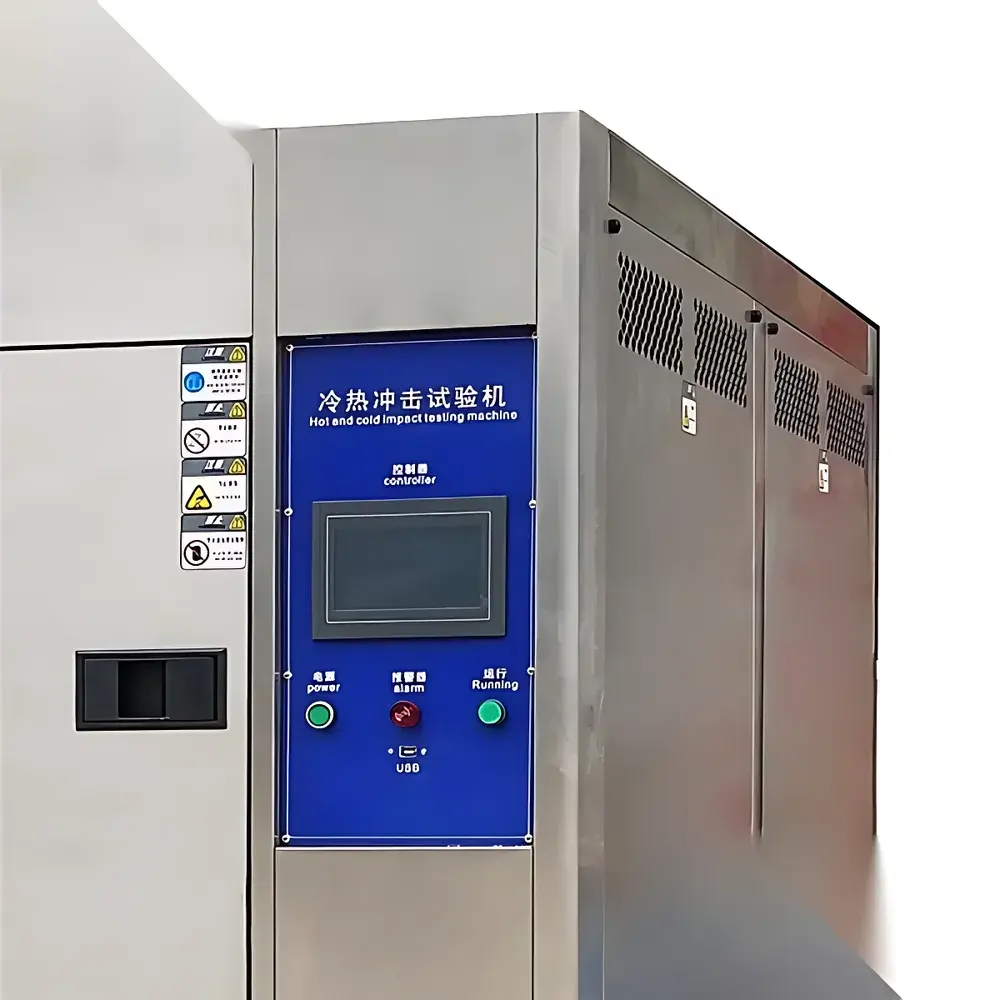
OK-TS-80 Three-Zone Thermal Shock Test Chamber (Imported Grade, PLC-Controlled, Dual-Compressor Cascade Refrigeration System)
| Brand | OK |
|---|---|
| Model | TS-80 |
| Chamber Configuration | Three-zone (High-Temp Zone / Low-Temp Zone / Test Zone) |
| Temperature Range | -65°C to +150°C |
| Shock Transition Time | ≤10 s (doorless air-path switching) |
| Temperature Recovery Time | ≤5 min (to ±0.5°C of target) |
| Control Accuracy | ±0.1°C (setpoint resolution) |
| Programmable Cycles | 1–999 |
| Soak Time per Zone | 1–999 min |
| Total Programs | 100 |
| Interface | 7-inch color LCD touchscreen with English/Chinese GUI |
| Compliance | GB/T 2423.22, GJB 150.5, IEC 60068-2-14, MIL-STD-810H |
| Refrigerant | R507A / R23 (zero ODP, low GWP) |
| Cooling Method | Water-cooled cascade system |
| Construction | Interior – SUS304 stainless steel |
| Port | One Ø50 mm test port (left side) |
| Safety Protections | Over-temperature, over-current, phase failure, compressor high-pressure/low-pressure, refrigerant leak detection, ground fault, emergency stop |
| Data Logging | RS485 interface with PC-compatible software (real-time curve plotting, audit trail, export to CSV) |
Overview
The OK-TS-80 Three-Zone Thermal Shock Test Chamber is an engineered solution for accelerated reliability assessment of electronic components, aerospace assemblies, automotive ECUs, and polymer-based materials subjected to rapid thermal transients. Based on the principle of *air-path switching between isolated high- and low-temperature reservoirs*, the chamber eliminates mechanical movement of test specimens—ensuring mechanical stability during shock cycles while delivering precise, repeatable thermal transitions. Unlike single-chamber ramp-and-soak systems, the TS-80’s tri-compartment architecture enables true thermal shock profiles per IEC 60068-2-14 and MIL-STD-810H Method 503, where specimens remain stationary in a thermally neutral test zone while conditioned airstreams are pneumatically routed from dedicated hot (up to +150°C) and cold (down to −65°C) reservoirs. This design minimizes thermal inertia, eliminates specimen handling-induced stress, and ensures compliance with qualification-level environmental screening requirements under GLP and GMP-aligned test protocols.
Key Features
- Three-zone architecture with independent temperature control of high-temp, low-temp, and test chambers—enabling simultaneous conditioning and shock execution
- Cascade refrigeration system with dual Copeland semi-hermetic scroll compressors (R507A/R23), optimized for deep-cold capability and energy modulation across dynamic load conditions
- ALCO oil separators and Alfa Laval brazed plate heat exchangers ensure long-term refrigerant circuit integrity and reduced fouling risk in critical evaporator-condenser interfaces
- PLC-based PID control with auto-tuning functionality, achieving ±0.1°C setpoint resolution and <±0.5°C recovery accuracy within 5 minutes post-transition
- 7-inch full-color LCD HMI with bilingual (English/Chinese) interface, real-time curve visualization, multi-step program editing, and alarm event logging with timestamped root-cause diagnostics
- Integrated safety architecture: triple-stage over-temperature cutoff, refrigerant pressure monitoring, phase-loss protection, emergency power-off, and audible/visual fault indication
- Water-cooled condensing system with flow/temperature interlock, compatible with industrial chiller loops operating at 10–32°C inlet water temperature
- Stainless steel (SUS304) interior with polyurethane foam + ultra-fine glass wool composite insulation (K-value ≤0.028 W/m·K)
Sample Compatibility & Compliance
The TS-80 accommodates samples up to 400 mm × 400 mm × 400 mm (W×D×H) within its test zone, with optional custom internal fixtures available upon request. Its static-test-zone configuration supports PCBs, solder joints, MEMS devices, battery modules, and encapsulated optical sensors without vibration-induced artifacts. The chamber meets mandatory requirements for environmental stress screening (ESS) per GJB 1032-90 and qualification testing per GB/T 2423.22–2012 (equivalent to IEC 60068-2-14). It also satisfies military-grade thermal shock validation under GJB 150.5–2012 and aerospace component screening per RTCA DO-160 Section 4.22. All control firmware and data logging functions comply with ALCO-compliant audit trail structure, supporting 21 CFR Part 11 readiness when paired with validated PC software.
Software & Data Management
The embedded TEMP850 controller supports full-cycle programmability—including soak dwell, transition rate definition, cycle repetition count, and automatic defrost scheduling. Data acquisition is synchronized at 1-second intervals and stored internally for ≥30 days. Via RS485 serial interface, the chamber integrates with Windows-based supervision software that provides live parameter monitoring, historical trend replay, deviation reporting, and CSV export for traceability. The software enforces user role-based access control (operator/engineer/admin), maintains immutable run logs with digital signatures, and generates PDF test reports compliant with ISO/IEC 17025 documentation standards. Optional OPC UA gateway support enables integration into MES or LabVantage environments.
Applications
This chamber is routinely deployed in QC laboratories for solder joint fatigue analysis (IPC-J-STD-020), wafer-level packaging qualification, EV battery module thermal cycling validation, and polymer coefficient-of-thermal-expansion (CTE) mismatch evaluation. Its stable thermal gradients and sub-5-minute recovery performance make it suitable for HALT/HASS pre-screening phases, while its programmable 100-profile memory supports standardized test sequences across multiple product families. Automotive suppliers use it for AEC-Q200 stress verification; medical device manufacturers apply it to ISO 13485-compliant aging studies of implantable electronics housings.
FAQ
What is the difference between two-zone and three-zone thermal shock configurations?
A three-zone system (like the TS-80) physically isolates hot, cold, and test zones—eliminating thermal cross-contamination and enabling faster, more repeatable transitions. Two-zone units share one chamber for both extremes, resulting in longer recovery times and greater thermal overshoot.
Does the chamber support automated data export for regulatory audits?
Yes—the RS485 interface and bundled software provide time-stamped, tamper-evident logs with operator ID, parameter settings, and anomaly alerts, fully traceable for FDA, ISO 13485, or AS9100 audits.
Can the unit operate as a standalone high-temperature or low-temperature chamber?
Absolutely. Independent zone control allows operation in constant-temperature mode (−65°C to +150°C), making it functionally equivalent to two separate environmental chambers.
Is water cooling mandatory, or can air-cooling be configured?
Water cooling is required for rated performance at −65°C. Air-cooled variants are available for milder ranges (e.g., −40°C to +150°C) but incur derated shock speed and increased ambient heat rejection load.
What refrigerant service intervals are recommended?
Under normal operation (≤8 hrs/day, 5 days/week), the R507A/R23 charge requires no replenishment for ≥8 years. Annual verification of oil level, filter-drier saturation, and pressure differentials is advised per OEM maintenance protocol.



