
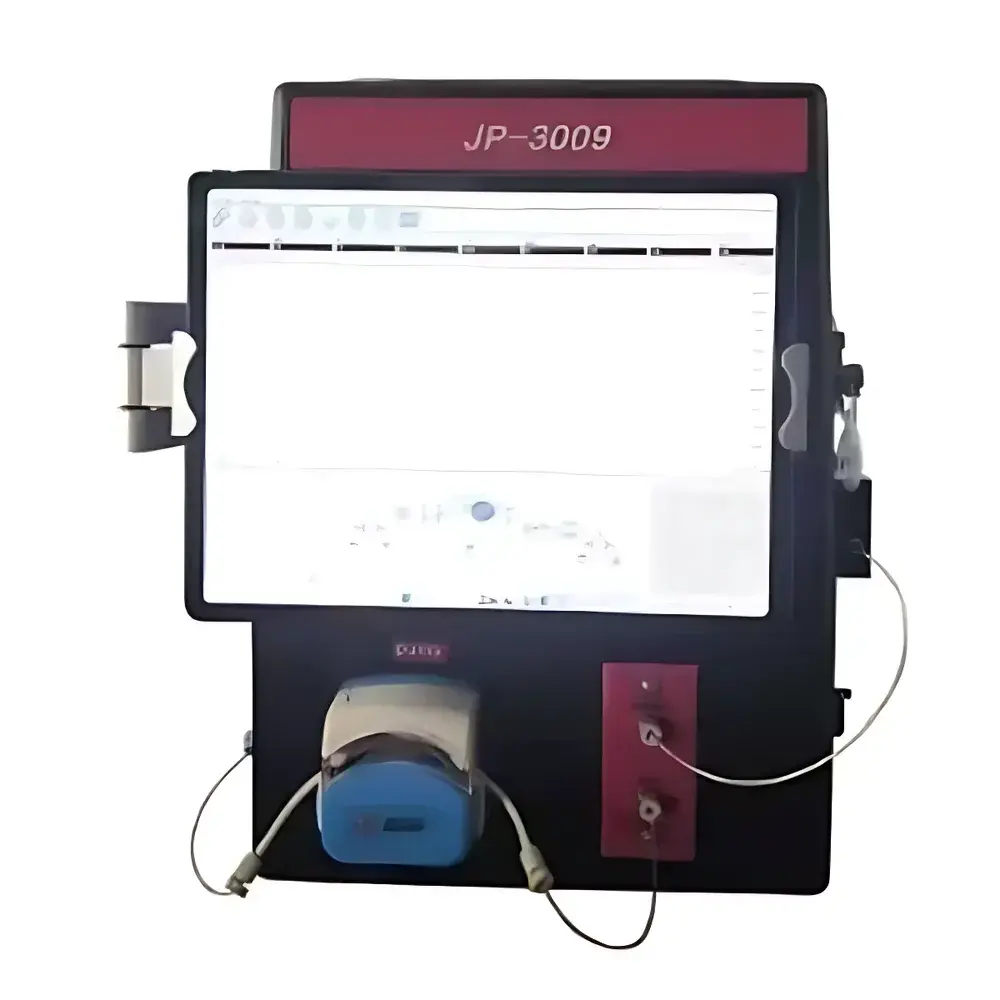
JP-Keebio3009 Protein Purification System
| Brand | JiaPeng |
|---|---|
| Origin | Shanghai, China |
| Model | JP-Keebio3009 |
| Purification Principle | Ion Exchange Chromatography (IEX) |
| Gradient Type | Isocratic & Step Gradient |
| UV Detector Wavelengths | 260 nm, 280 nm, 295 nm, 310 nm |
| Flow Rate Range | 0.1–10 mL/min |
| Flow Accuracy | ±1.2% |
| UV Detection Range | –6 to +6 AU |
| Linearity | ±1.5% (0–2 AU) |
| Maximum System Pressure | 3 bar |
| Conductivity Range | 0.001–400.00 mS/cm |
| Accuracy | ±2% (with temperature compensation) |
| Solvent Compatibility | Aqueous buffers, common chromatographic mobile phases, and biocompatible solutions used in protein purification |
Overview
The JP-Keebio3009 Protein Purification System is an integrated, benchtop-scale liquid chromatography platform engineered for reproducible, scalable purification of recombinant proteins, antibodies, enzymes, and other biomolecules under laboratory and early-process development conditions. It operates on the fundamental principles of high-performance liquid chromatography (HPLC), supporting multiple orthogonal separation modes—including ion exchange chromatography (IEX), affinity chromatography, size-exclusion chromatography (SEC), desalting, and buffer exchange—within a single, compact architecture. The system employs a dual-pump, low-dead-volume flow path with PEEK/PTFE fluidic components to ensure chemical resistance, minimal carryover, and compatibility with standard biological buffers (e.g., Tris-HCl, phosphate, sodium acetate, imidazole, and guanidine hydrochloride). Its modular design allows seamless integration with optional accessories such as fraction collectors, pH monitors, and external fraction refrigeration units—enabling full method development workflows from analytical screening to milligram-scale preparative runs.
Key Features
- High-precision dual-plunger constant-flow pump delivering stable, pulse-free flow across 0.1–10 mL/min with ±1.2% accuracy and ≤3 bar maximum pressure tolerance.
- Multi-wavelength fixed-wavelength UV detector with LED cold-light source at 260 nm, 280 nm, 295 nm, and 310 nm—optimized for simultaneous monitoring of nucleic acid contamination (A260), protein concentration (A280), tryptophan environment (A295), and disulfide bond integrity (A310).
- Dedicated inline conductivity detector (0.001–400.00 mS/cm, ±2% accuracy) with automatic temperature compensation, enabling real-time monitoring of salt gradients during IEX and SEC applications.
- 12-inch capacitive touchscreen interface with bilingual (English/Chinese) software, intuitive workflow navigation, and pre-configurable method templates for rapid protocol deployment.
- Integrated layer chromatography workstation displaying synchronized real-time plots of UV absorbance, conductivity, temperature, gradient profile, and fraction collection status on a single screen.
- Automated fraction collection via JP-blupadFC module with dual-channel valve (1 active collection port + 1 waste line), supporting peak-triggered, time-based, or threshold-based (AU or mS/cm) collection modes.
- Robust data integrity framework: all acquisition parameters, method settings, and chromatograms are timestamped and saved automatically in non-proprietary formats; supports export to CSV and Excel-compatible .xlsx files for downstream analysis and regulatory reporting.
Sample Compatibility & Compliance
The JP-Keebio3009 is validated for use with native and denatured proteins, monoclonal antibodies (mAbs), fusion tags (e.g., His-tag, GST, FLAG), peptides, and oligonucleotides. Its fluidic pathway—constructed from biocompatible PEEK, PTFE, and fused-silica capillaries—resists adsorption and degradation across pH 2–12 and temperatures from 4 °C to 40 °C. The system meets general requirements for Good Laboratory Practice (GLP) environments, including audit-trail-capable method logging, user-access control (role-based login), and electronic signature readiness. While not certified to FDA 21 CFR Part 11 out-of-the-box, its data export capabilities and deterministic method execution support validation protocols aligned with ISO 17025, USP , and ICH Q5E guidelines for analytical method transfer in biopharmaceutical development.
Software & Data Management
The embedded chromatography software provides full instrument control, real-time visualization, and post-run analysis without requiring third-party licenses. Method creation includes programmable gradient profiles (isocratic, linear, step), variable flow rate ramps, detector wavelength switching, and conditional fraction triggering. All raw data—including baseline-corrected absorbance traces, conductivity curves, and temperature logs—are stored in structured binary format with metadata headers (instrument ID, operator, date/time, method version). Export functions generate standardized spreadsheet files compatible with statistical packages (e.g., GraphPad Prism, JMP) and LIMS integration via API-ready file structures. Backup and restore functionality ensures continuity during power failure or unexpected shutdown.
Applications
- Purification of His-tagged proteins using immobilized metal affinity chromatography (IMAC) with Ni-NTA resins.
- Ion exchange purification of monoclonal antibodies (IgG) under pH- and conductivity-controlled elution conditions.
- Desalting and buffer exchange of enzyme preparations prior to crystallization or activity assays.
- Size-exclusion chromatography for aggregate analysis and monomer recovery of therapeutic proteins.
- Process development support for column scouting, binding capacity estimation, and gradient optimization in early-stage bioprocess characterization.
FAQ
What chromatographic modes does the JP-Keebio3009 support?
It supports ion exchange chromatography (IEX), affinity chromatography (e.g., IMAC, Protein A/G), size-exclusion chromatography (SEC), desalting, and buffer exchange—all using standard 1–10 mm ID analytical and semi-preparative columns.
Is the system compatible with regulatory-compliant documentation workflows?
Yes—the software records full audit trails, supports user authentication, and exports raw and processed data in open formats suitable for inclusion in regulatory submissions (e.g., IND, BLA) when validated per internal SOPs.
Can UV wavelengths be changed during a run?
Yes, wavelength selection is fully programmable within methods and can be switched dynamically between 260 nm, 280 nm, 295 nm, and 310 nm at user-defined time points or retention volumes.
Does the system include temperature control for the column compartment?
No built-in column oven is included; however, the system supports external column heaters or chillers via analog I/O interfaces, and temperature is monitored in-line upstream of the detector.
What is the minimum detectable protein concentration at 280 nm?
With a 10 µL flow cell and standard pathlength, the system achieves a practical detection limit of ~20 µg/mL for typical globular proteins under optimized flow and injection conditions.




