
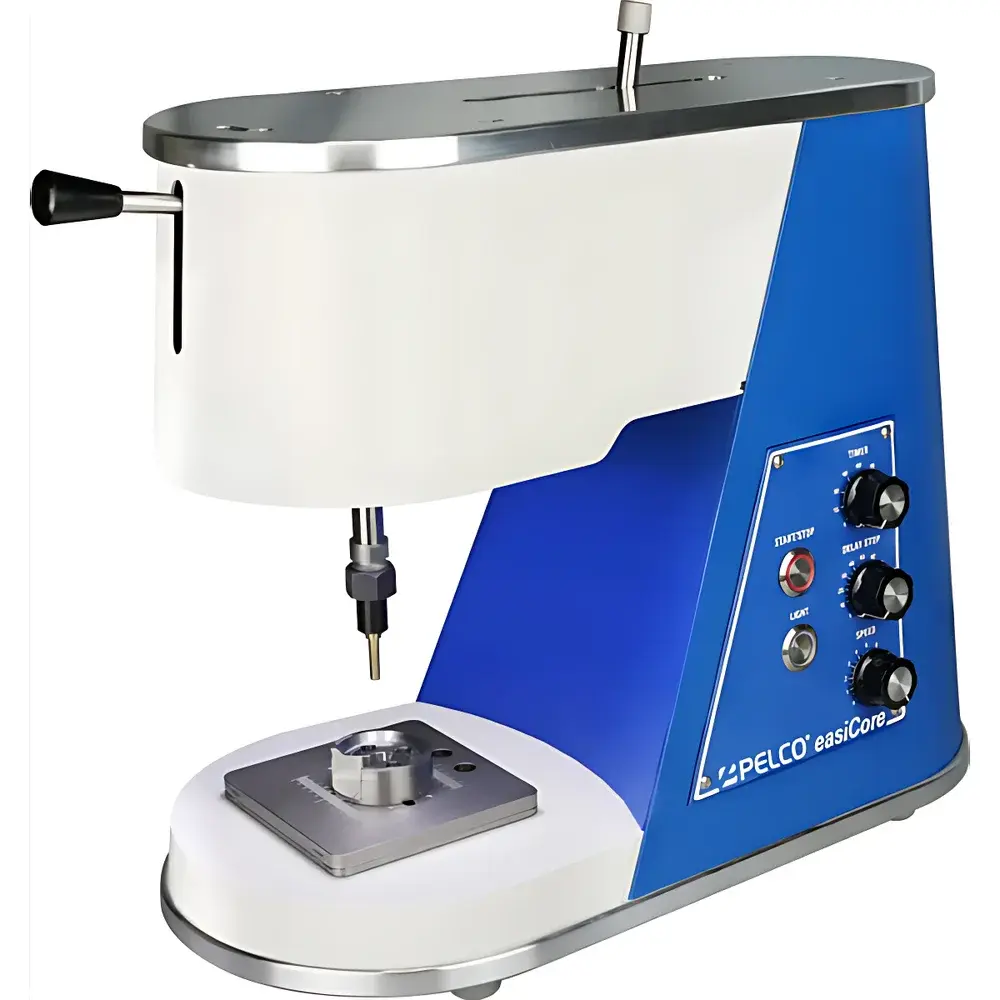
Ted Pella PELCO easiCore Low-Speed TEM Disc Cutter
| Brand | Ted Pella |
|---|---|
| Origin | USA |
| Manufacturer Type | Authorized Distributor |
| Product Origin | Imported |
| Model | PELCO easiCore |
| Price | Upon Request |
| Max Rotational Speed | 100–1500 rpm |
| Maximum Applied Load | 1 kg |
| Disc Diameter Range | 2.3–25 mm |
| Positioning Accuracy | X-Y Stage with 1 mm Graduated Scale |
| Compatible Mounting Fixtures | PELCO Precision Wire Saw, PELCO Precision Low-Speed Saw, PELCO Dimpler |
| Optional Accessory | PELCO Abrasive Dispenser (timed abrasive slurry delivery) |
Overview
The Ted Pella PELCO easiCore Low-Speed TEM Disc Cutter is an engineered solution for precision disc sectioning of bulk specimens prior to focused ion beam (FIB) lift-out or conventional thinning for transmission electron microscopy (TEM) analysis. Unlike ultrasonic or high-speed diamond sawing techniques—which induce thermal stress, microcracking, or phase transformation—the easiCore employs controlled low-speed rotational grinding using brass-tipped tooling and suspended abrasive slurries (e.g., alumina or silicon carbide in water or ethanol). This mechanical abrading mechanism operates under quasi-static loading conditions, minimizing subsurface damage and preserving crystallographic integrity—critical for high-resolution TEM, electron backscatter diffraction (EBSD), and atom probe tomography (APT) sample preparation. Designed specifically for the preparation of 3.0 mm diameter TEM discs from brittle ceramics, ductile metals, battery electrode composites, and delicate single crystals, the easiCore bridges a critical gap between macro-scale sectioning and nano-scale final polishing.
Key Features
- Adjustable rotational speed range (100–1500 rpm) enables optimization for material hardness, toughness, and thermal sensitivity—slower speeds for soft metals (e.g., Cu, Al), higher speeds for dense ceramics (e.g., SiC, YSZ).
- Programmable load application up to 1 kg-force with fine manual control, ensuring consistent material removal rate without chipping or delamination.
- X-Y precision translation stage with engraved 1 mm graduations allows repeatable positioning of the specimen relative to the rotating tool, supporting multi-disc cutting from a single wafer or block.
- Interchangeable mounting interfaces ensure seamless integration with Ted Pella’s ecosystem of sample preparation tools—including the PELCO Precision Wire Saw, PELCO Precision Low-Speed Saw, and PELCO Dimpler—enabling standardized workflow handoffs across thinning stages.
- Optional PELCO Abrasive Dispenser provides timed, metered delivery of abrasive suspension during extended cuts (>30 min), maintaining slurry concentration and reducing operator intervention.
- Tooling compatibility with standard brass-core drill bits (2.3–25 mm diameters) and replaceable abrasive media ensures adaptability across diverse material classes without hardware modification.
Sample Compatibility & Compliance
The easiCore accommodates a broad spectrum of conductive and non-conductive materials, including but not limited to lithium-ion battery cathodes (NMC, LFP), semiconductor wafers (Si, GaAs), oxide superconductors (YBCO), geological minerals (quartz, olivine), and biomedical alloys (Ti-6Al-4V, CoCr). Its non-thermal, low-stress abrading action avoids recast layers, amorphous zones, or preferential etching commonly observed with plasma or laser-based sectioning. The system conforms to laboratory safety standards for enclosed abrasive handling (OSHA 29 CFR 1910.1000) and supports GLP-compliant documentation when paired with validated SOPs. While not a regulated medical device, its output discs meet ASTM E1245–22 guidelines for metallographic specimen preparation reproducibility and are routinely accepted by TEM facility managers requiring traceable, artifact-minimized input samples.
Software & Data Management
The easiCore is a manually operated, analog-controlled instrument with no embedded firmware or digital interface. All operational parameters—speed, load, cut duration, and slurry feed intervals—are set via calibrated dials and mechanical timers. This architecture eliminates software validation requirements under FDA 21 CFR Part 11 while ensuring long-term reliability, electromagnetic immunity, and zero firmware obsolescence. Process logs (operator name, date, material ID, tooling batch, slurry composition, RPM/load/time settings) are maintained externally in laboratory notebooks or LIMS-integrated electronic records. For labs implementing ISO/IEC 17025 quality systems, the easiCore’s mechanical repeatability (±0.1 mm positional accuracy, ±5% load consistency over 8-hr operation) supports documented method verification per clause 7.2.2.
Applications
- Preparation of 3.0 mm TEM discs from cross-sectioned battery electrodes for SEI layer characterization and interfacial degradation analysis.
- Sectioning of single-crystal piezoelectric materials (e.g., LiNbO₃, PMN-PT) where lattice continuity must be preserved across the disc perimeter.
- Routine generation of site-specific discs from polished metallographic mounts for subsequent ion milling—reducing FIB time by >40% versus full-thickness milling.
- Cutting of fragile thermoelectric compounds (Bi₂Te₃, SnSe) that fracture under ultrasonic energy or rapid thermal cycling.
- Production of calibration standards for electron channeling contrast imaging (ECCI) and precession electron diffraction (PED) due to minimal surface strain.
FAQ
What types of abrasive slurries are compatible with the easiCore?
Standard aqueous or alcoholic suspensions of alumina (0.3–3.0 µm), silicon carbide (1–10 µm), or colloidal silica (20–50 nm) are routinely used; slurry viscosity and particle concentration must be adjusted to match material hardness and desired MRR.
Can the easiCore cut non-circular geometries?
No—it is optimized exclusively for coaxial disc sectioning; irregular shapes require post-cut trimming on a precision low-speed saw or FIB.
Is vacuum chucking supported?
The standard stage uses mechanical clamping; vacuum-compatible fixtures are not offered, but custom adapters may be fabricated per ISO 9001-certified machine shops.
What maintenance intervals are recommended?
Bearing lubrication every 500 operating hours; brass bit replacement after ~200 cuts on hard ceramics or ~500 cuts on soft metals; stage recalibration annually or after impact events.
Does Ted Pella provide method development support?
Yes—application scientists offer protocol optimization services including slurry selection, RPM/load mapping, and disc edge quality assessment via SEM cross-section imaging.





