
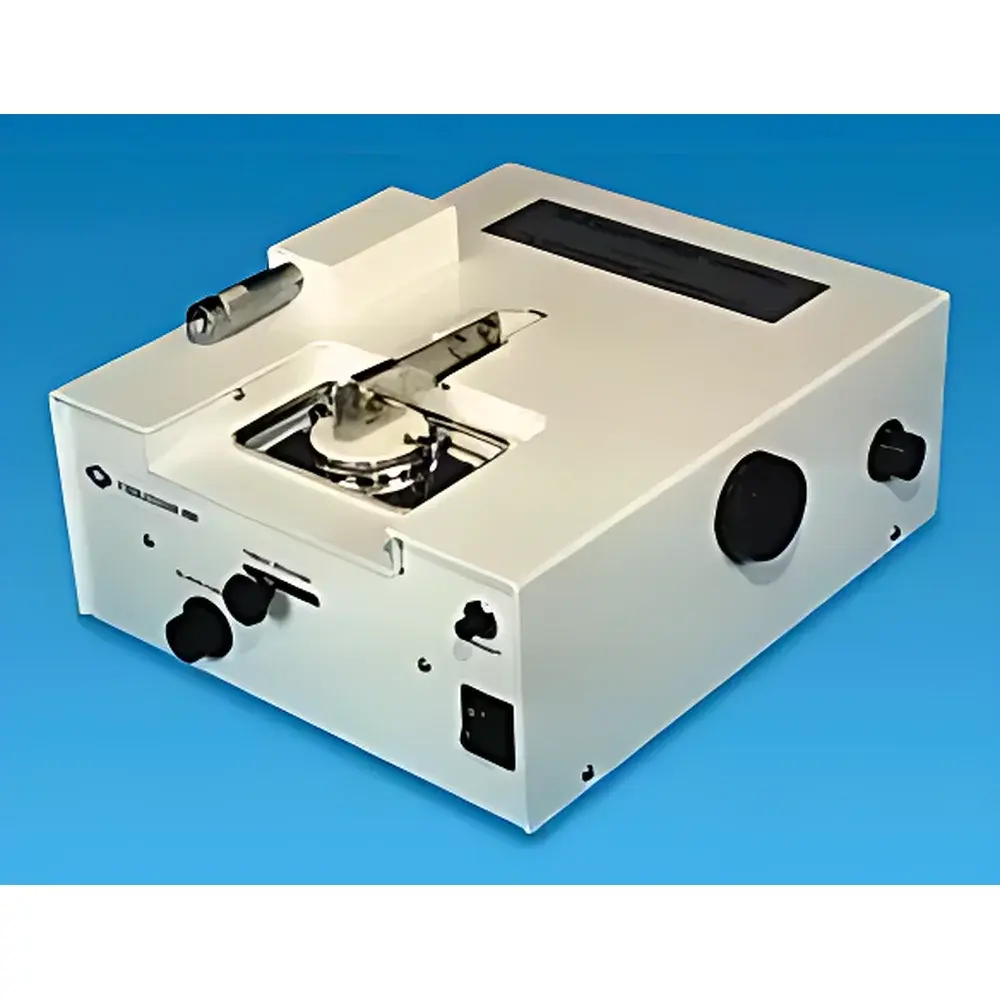
Ted Pella McIlwain Tissue Chopper Model 10180-220
| Brand | Ted Pella |
|---|---|
| Origin | USA |
| Manufacturer Type | Authorized Distributor |
| Origin Category | Imported |
| Model | 10180-220 |
| Max Sample Size | Adjustable |
| Section Thickness Range | 0–1 mm |
| Sectioning Step Resolution | 1 µm |
| Sectioning Frequency | 0–200+ cycles/min |
| Blade Force | Adjustable |
| Blade Trajectory | Adjustable |
| Cutting Direction | Left-to-right |
| Sample Stage | Interchangeable, Sterilizable, Compatible with 60 mm × 13.7 mm Petri Dishes |
| Safety | Integrated Limit Switch & Overload Protection |
| Power Supply | 220 VAC, 0.5 A / 115 W @ 230 V |
| Dimensions | 31 × 28.5 × 15 cm |
| Weight | 8 kg |
Overview
The Ted Pella McIlwain Tissue Chopper Model 10180-220 is a precision mechanical tissue sectioning instrument engineered for reproducible, low-damage preparation of fresh or fixed biological specimens—particularly suited for metabolic studies, ex vivo electrophysiology, and biochemical assays requiring intact cellular architecture. Unlike homogenizers or blenders that induce shear-induced lysis, the McIlwain chopper employs a controlled oscillating blade mechanism operating in a defined plane, minimizing mechanical disruption to subcellular structures and preserving functional viability in neural, hepatic, and renal tissues. Its design follows the original principles established by Dr. Thomas McIlwain in the 1960s, optimized for rapid generation of uniform thick sections (up to 1 mm) and geometrically defined tissue blocks (cubes or rhombic prisms), enabling standardized downstream processing including enzyme kinetics, mitochondrial respiration assays, and slice-based pharmacological screening.
Key Features
- Calibrated micrometer-driven thickness adjustment with 1 µm resolution across a continuous 0–1 mm range, enabled by a precision vernier scale and detented clutch mechanism.
- Programmable sectioning frequency from 0 to over 200 cycles per minute, allowing optimization for tissue elasticity and desired structural integrity.
- Adjustable blade force and trajectory to accommodate variations in tissue density, fixation state, and embedding medium.
- Interchangeable stainless-steel sample stages—including a sterilizable circular platform for bulk tissue and a dedicated Petri dish adapter supporting standard 60 mm × 13.7 mm culture dishes—enabling direct sectioning of adherent cell monolayers or organotypic cultures.
- Motorized left-to-right lateral translation with angular repositioning capability (±45° and ±90°) to generate rhombic prisms or cubic tissue blocks through sequential orthogonal cuts.
- Integrated safety architecture featuring mechanical limit switches and electronic overload protection to prevent motor stall or blade jam under variable load conditions.
Sample Compatibility & Compliance
The McIlwain 10180-220 accommodates a broad spectrum of specimen types without cryosectioning or paraffin embedding: unfixed brain slices (e.g., hippocampal or cortical explants), perfusion-fixed liver lobules, decapsulated kidney cortex, and even soft embryonic tissues when supported by agarose embedding. Its non-thermal, non-vibrational cutting action complies with GLP-aligned tissue preparation workflows where preservation of native enzyme activity, receptor conformation, and membrane potential is critical. While not certified as medical device hardware, its construction (304 stainless steel stage, chemical-resistant housing) meets ISO 13485-informed cleanliness requirements for research-grade instrumentation used in preclinical laboratories subject to internal audit protocols.
Software & Data Management
This is a standalone electromechanical instrument with no embedded microprocessor or digital interface; all operational parameters are set manually via calibrated dials and mechanical stops. This analog architecture ensures electromagnetic compatibility (EMC) in shielded electrophysiology rigs and eliminates firmware-related validation burdens in regulated environments. For traceability, users may document settings (thickness, frequency, blade angle) in laboratory notebooks or LIMS-integrated SOPs. The absence of proprietary software aligns with FDA 21 CFR Part 11 expectations for manual instruments where operator-recorded parameters constitute the primary audit trail—no electronic signatures or system-generated logs are required or provided.
Applications
- Preparation of viable brain slices for patch-clamp recording and field potential measurements.
- Routine generation of 200–1000 µm thick liver or kidney sections for oxygen consumption rate (OCR) assays using Seahorse XF analyzers.
- Production of cubic tissue biopsies (e.g., 1 mm³) for high-content histomorphometric analysis or spatial transcriptomics library prep.
- Sectioning of organotypic hippocampal slice cultures grown in Petri dishes, maintaining monolayer integrity during harvest.
- Metabolic tracer studies requiring rapid, consistent tissue segmentation prior to scintillation counting or LC-MS/MS quantification.
FAQ
Is the McIlwain chopper compatible with frozen tissue?
No—this instrument is designed exclusively for fresh, lightly fixed, or agarose-supported tissues. Frozen specimens require cryomicrotomy due to brittleness and thermal fracture risk.
Can blade alignment be recalibrated by the user?
Yes—mechanical zero-point calibration of the micrometer head and blade clearance is detailed in the operation manual and requires only standard hex keys and feeler gauges.
What maintenance is required for long-term reliability?
Routine cleaning of the stage and blade carrier with 70% ethanol; annual inspection of clutch engagement and motor brush wear by qualified service personnel.
Does Ted Pella supply replacement blades and custom stages?
Yes—original equipment manufacturer (OEM) blades (stainless steel, disposable or reusable variants), Petri dish adapters, and agarose-mold inserts are available under part numbers 10180-BLADE and 10180-PD-ADAPT.
Is the unit suitable for use in biosafety cabinets?
Yes—the compact footprint (31 × 28.5 cm), low acoustic emission (<55 dB), and absence of aerosol-generating mechanisms permit safe operation within Class II A2 cabinets during BSL-2 procedures.



