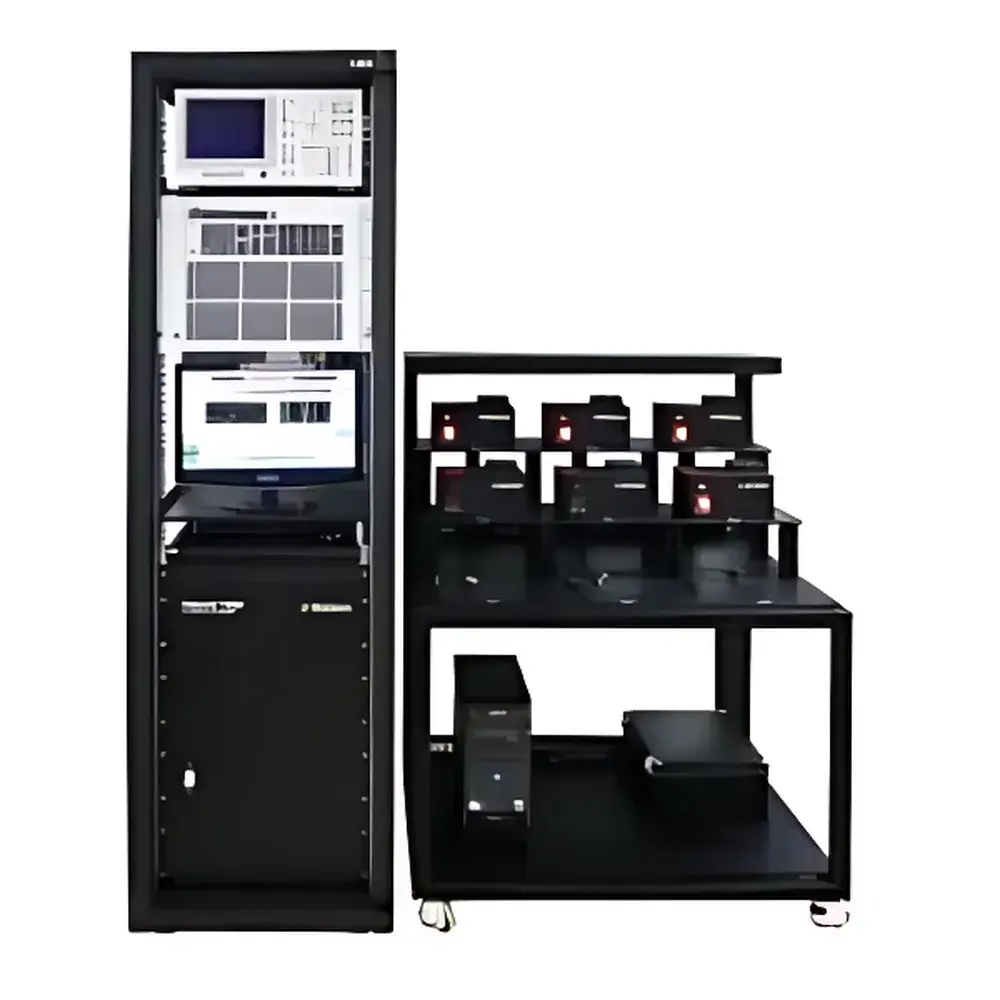
McScience T5000 TFT Parameter Characterization System
| Brand | McScience |
|---|---|
| Origin | South Korea |
| Model | T5000 |
| Channel Configuration | Single-Channel & Multi-Channel |
| Test Modes | Standard, Thermal Stress, Photo-Stress |
| Measurement Capabilities | Field-Effect Mobility (µFE), Saturation Mobility (µSAT), On/Off Current Ratio (Ion/Ioff), Threshold Voltage (Vth), Subthreshold Swing (SS) |
| Compliance | Designed for semiconductor device characterization per JEDEC JESD22-A108 (reliability), ISO/IEC 17025-compliant test environments |
| Software | McTestSuite v4.2 with GLP/GMP audit trail support |
Overview
The McScience T5000 TFT Parameter Characterization System is a dedicated semiconductor parameter analyzer engineered for high-precision electrical evaluation of thin-film transistor (TFT) devices across multiple material platforms—including amorphous silicon (a-Si), low-temperature polycrystalline silicon (LTPS), organic semiconductors (OTFTs), and metal-oxide systems (e.g., IGZO, ZnO, InGaZnO). Based on four-quadrant source-measure unit (SMU) architecture, the system implements programmable voltage/current sourcing and simultaneous nanoscale current/voltage sensing to extract fundamental device physics parameters under controlled bias, temperature, and illumination conditions. Its modular design supports both static DC characterization and dynamic stress-induced degradation analysis—enabling quantitative assessment of operational stability, interface trap generation, and bias temperature instability (BTI) in research, process development, and reliability qualification workflows.
Key Features
- Multi-mode stress testing: Integrated thermal chamber (−40 °C to +150 °C) and calibrated LED-based optical stress module (365–650 nm, adjustable irradiance up to 100 mW/cm²) for concurrent or sequential BTI, NBTI, and photo-bias stress experiments.
- Configurable channel topology: Supports single-channel (1-device-per-test) and multi-channel (up to 16-device parallel probing) configurations via interchangeable probe card interfaces compliant with standard 150 mm and 200 mm wafer handling protocols.
- High-resolution parameter extraction: Automated derivation of field-effect mobility (µFE) from transfer curves (Id vs. Vg at fixed Vd), saturation mobility (µSAT) using the transconductance-to-current ratio method, subthreshold swing (SS) calculated over 1–2 decades of Id, and threshold voltage (Vth) via linear extrapolation or constant-current (e.g., 1 nA/µm) definitions.
- Real-time data synchronization: Hardware-timed acquisition (100 kS/s max sampling rate) ensures phase-coherent capture of transient drain current responses during stress/recovery cycles, critical for time-dependent dielectric breakdown (TDDB) and trap kinetics modeling.
- Modular compliance architecture: Built-in support for ASTM F2624-20 (TFT electrical characterization), IEC 62439-3 (industrial redundancy), and configurable electronic signatures aligned with FDA 21 CFR Part 11 requirements for regulated laboratories.
Sample Compatibility & Compliance
The T5000 accommodates bare dies, patterned wafers (150 mm and 200 mm), and packaged discrete TFT elements mounted on standard probe stations or automated handler interfaces. Device contact is established via tungsten carbide or beryllium copper microprobes rated for ≤10⁶ touchdown cycles. All measurement routines adhere to ISO/IEC 17025:2017 general requirements for competence of testing and calibration laboratories. Traceable calibration certificates (NIST-traceable SMU modules) are provided with each system shipment. The platform satisfies pre-qualification criteria for JEDEC JESD22-A108 (high-temperature operating life), JESD22-A110 (electrostatic discharge), and IEC 61215-2 (for photovoltaic-integrated TFT applications).
Software & Data Management
McTestSuite v4.2 provides an integrated environment for test sequence definition, real-time visualization, statistical post-processing, and report generation. The software features hierarchical user roles (Operator, Engineer, Administrator), full audit trail logging (timestamped parameter changes, test execution logs, and export events), and encrypted database storage compliant with GLP and GMP documentation standards. Raw data exports support HDF5, CSV, and MATLAB .mat formats; metadata embedding includes ambient conditions (temperature, humidity), probe contact resistance, and instrument calibration status. Optional API integration enables bidirectional communication with MES (Manufacturing Execution Systems) and LIMS platforms via RESTful web services.
Applications
- Process optimization of back-channel etch (BCE) and top-gate oxide deposition in oxide-TFT fabrication lines.
- Comparative analysis of hysteresis magnitude and recovery dynamics in OTFTs subjected to ambient O₂/H₂O exposure.
- Accelerated lifetime modeling of display driver TFTs under gate-bias stress at elevated temperatures (e.g., 85 °C, Vg = −20 V).
- Extraction of trap density of states (tDOS) profiles from temperature-dependent transfer curve shifts.
- Validation of compact model parameters (e.g., BSIM-IMG, PSP) for SPICE simulation libraries used in display pixel circuit design.
FAQ
What semiconductor materials are supported by the T5000?
The system is validated for a-Si:H, LTPS, pentacene, P3HT, C₈-BTBT, IGZO, IZO, SnO₂, and other solution-processed or sputtered TFT active layers.
Does the T5000 support pulsed IV measurements?
Yes—programmable pulse widths from 10 µs to 10 s with duty cycle control enable transient response analysis and hot-carrier injection studies.
Can test sequences be exported for regulatory submission?
All reports include embedded digital signatures, version-controlled test scripts, and raw data provenance metadata required for FDA or EU MDR submissions.
Is remote operation supported?
Full GUI mirroring and secure SSH-based CLI access are available; no cloud-hosted components—data remains on-premise per ITAR and export control guidelines.
What calibration intervals are recommended?
Annual full-system calibration is advised; daily self-check routines verify SMU linearity, offset drift, and timing synchronization prior to scheduled test runs.