
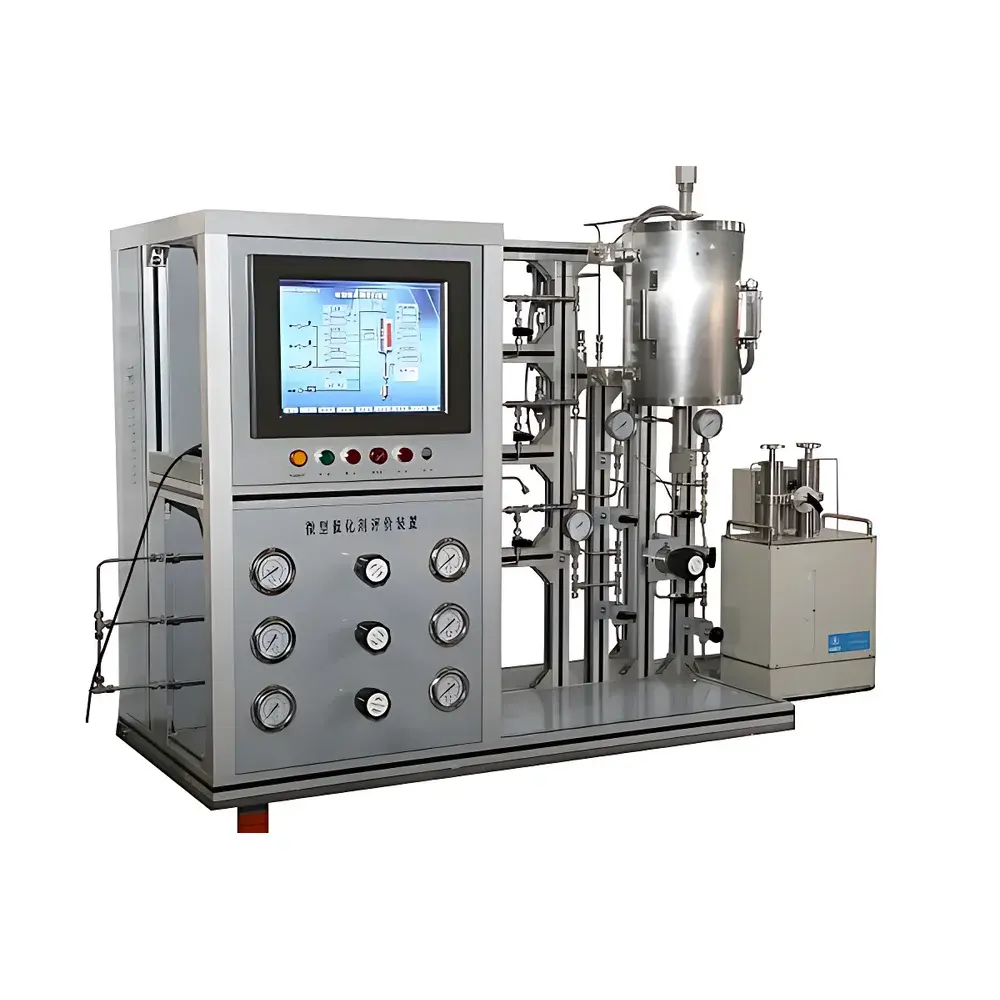
Henven HJW Miniature Catalyst Evaluation Unit
| Brand | Henven |
|---|---|
| Origin | Beijing, China |
| Manufacturer Type | Direct Manufacturer |
| Model | HJW |
| Temperature Range | Up to 550 °C |
| Maximum Pressure | 6 MPa |
| Catalyst Bed Volume | 5 mL |
| Construction Material | ASTM A240 S31603 (316 stainless steel) |
| Process Fluid Compatibility | H₂, N₂, H₂O, HF (anhydrous and aqueous) |
| Electrical Interface | 1/4″ FNPT |
| Control System | Integrated touchscreen HMI with Renmai fluidized-bed logic engine |
| Thermal Control | Zoned linear ramping & long-term isothermal stability |
| Safety Architecture | Independent dual-channel temperature/pressure monitoring with auto-shutdown and audible/visual alarm |
Overview
The Henven HJW Miniature Catalyst Evaluation Unit is a purpose-engineered bench-scale system for kinetic screening, deactivation studies, and process validation of heterogeneous catalysts under industrially relevant conditions. It operates on fixed-bed or fluidized-bed configurations—switchable via modular reactor insert—enabling direct comparison of catalyst performance across flow regimes. Core measurement principles rely on precision mass flow control (MFC), differential pressure transduction, and multi-point thermocouple arrays calibrated per IEC 60584-2 Class 1 tolerances. The reactor core employs a coaxial double-jacketed design with electric cartridge heaters and forced-air cooling channels, ensuring axial thermal uniformity ≤ ±1.5 °C over 100 mm active bed length. Unlike generic reaction stations, the HJW integrates corrosion-resistant wetted-path engineering: all HF-contact surfaces—including internal liner, valves, and sampling loops—are fabricated from passivated 316 stainless steel with Ra ≤ 0.4 µm surface finish, validated per ASTM B117 salt-spray testing for >1,000 hr resistance to anhydrous HF vapor at 200 °C.
Key Features
- Corrosion-resilient architecture: Full-wetted-path compatibility with hydrofluoric acid (HF), hydrogen, nitrogen, and steam—validated for continuous operation up to 550 °C and 6 MPa.
- Zoned thermal management: Three independently controlled heating zones enable precise axial temperature profiling and programmable linear ramps (0.1–10 °C/min) with <±0.5 °C setpoint stability during 72-hr isothermal holds.
- Renmai fluidized-bed control logic: Proprietary algorithm dynamically adjusts gas distributor velocity, bed expansion ratio, and entrainment suppression based on real-time differential pressure and capacitance probe signals—eliminating manual tuning.
- Dual-redundant safety layer: Independent temperature and pressure sensors feed into a SIL2-rated safety PLC; deviation beyond user-defined thresholds triggers immediate valve isolation, heater cutoff, and vent activation with audit-trail logging.
- Modular reactor interface: Quick-change reactor cartridges support 5 mL catalyst volumes in fixed-bed, tapered-fluidized, or trickle-bed configurations—interchangeable without tools or recalibration.
- Touchscreen HMI with embedded data historian: 10.1″ capacitive display running Linux-based RTOS; stores all sensor streams at 10 Hz with timestamped metadata (ISO 8601 format), exportable to CSV or HDF5.
Sample Compatibility & Compliance
The HJW accommodates powdered, extruded, or pelletized catalysts (particle size range: 20–500 µm) and supports co-feeding of corrosive reagents including anhydrous HF, HF/H₂O mixtures, and high-purity H₂ (≥99.999%). All fluidic components meet ASME B31.3 process piping standards for severe service. Pressure containment complies with PED 2014/68/EU Category IV requirements. The system is designed for GLP-compliant laboratories: full electronic audit trail (per FDA 21 CFR Part 11 Annex 11), role-based user access control, and password-protected parameter locking. Documentation includes Factory Acceptance Test (FAT) reports, material traceability certificates (EN 10204 3.1), and calibration records traceable to NIM (China National Institute of Metrology).
Software & Data Management
Control and data acquisition are managed by Henven’s proprietary CatalystStudio™ v3.2 software suite, installed on an onboard industrial PC. It provides synchronized visualization of up to 32 analog/digital channels—including MFC outputs, TC voltages, pressure differentials, and fluidized-bed void fraction—via configurable trend plots with zoom, overlay, and derivative analysis. Raw time-series data is stored in encrypted SQLite databases with SHA-256 integrity hashing. Export functions support ASTM E1382-compliant data packaging for third-party kinetic modeling tools (e.g., MATLAB, Aspen Custom Modeler). Remote monitoring is enabled via TLS 1.3-secured WebSocket API, compatible with LabArchives ELN and Siemens Desigo CCMS integration.
Applications
- Kinetic parameter estimation (TOF, Ea, adsorption constants) for acid-catalyzed alkylation, isomerization, and oligomerization using HF or solid Brønsted acids.
- Hydrothermal stability assessment of zeolites and metal-organic frameworks under cyclic steam/HF exposure.
- Deactivation mechanism studies: coke deposition profiling via online GC-TCD/FID coupling (optional interface kit available).
- Scale-down validation for FCC unit riser optimization and regenerator kinetics.
- Regulatory submission support: generation of repeatable, auditable datasets meeting ISO 17025 and USP method validation criteria.
FAQ
Does the HJW support integration with external gas chromatographs or mass spectrometers?
Yes—standard 1/8″ Swagelok ports are provided for effluent sampling lines; optional heated transfer lines (up to 250 °C) and split-flow modules ensure quantitative delivery to downstream analyzers.
Can the system operate under vacuum or sub-atmospheric conditions?
No—the HJW is rated for positive pressure only (0.1–6 MPa gauge); vacuum operation requires supplemental pumping hardware not included in base configuration.
What calibration services are included with purchase?
Factory calibration of all pressure transducers (valid per ISO/IEC 17025), thermocouples (NIST-traceable), and mass flow controllers is performed pre-shipment; full calibration certificates and uncertainty budgets are delivered digitally and in hard copy.
Is HF handling training provided with system commissioning?
Yes—Henven-certified field engineers conduct on-site installation, operational qualification (OQ), and safety protocol training aligned with NFPA 400 and OSHA 1910.1200 hazard communication standards.
How is firmware updated, and is version history maintained?
Updates are deployed via secure USB key with cryptographic signature verification; all firmware revisions, release notes, and patch logs are archived in the onboard historian and accessible through the HMI’s “System Maintenance” menu.



