
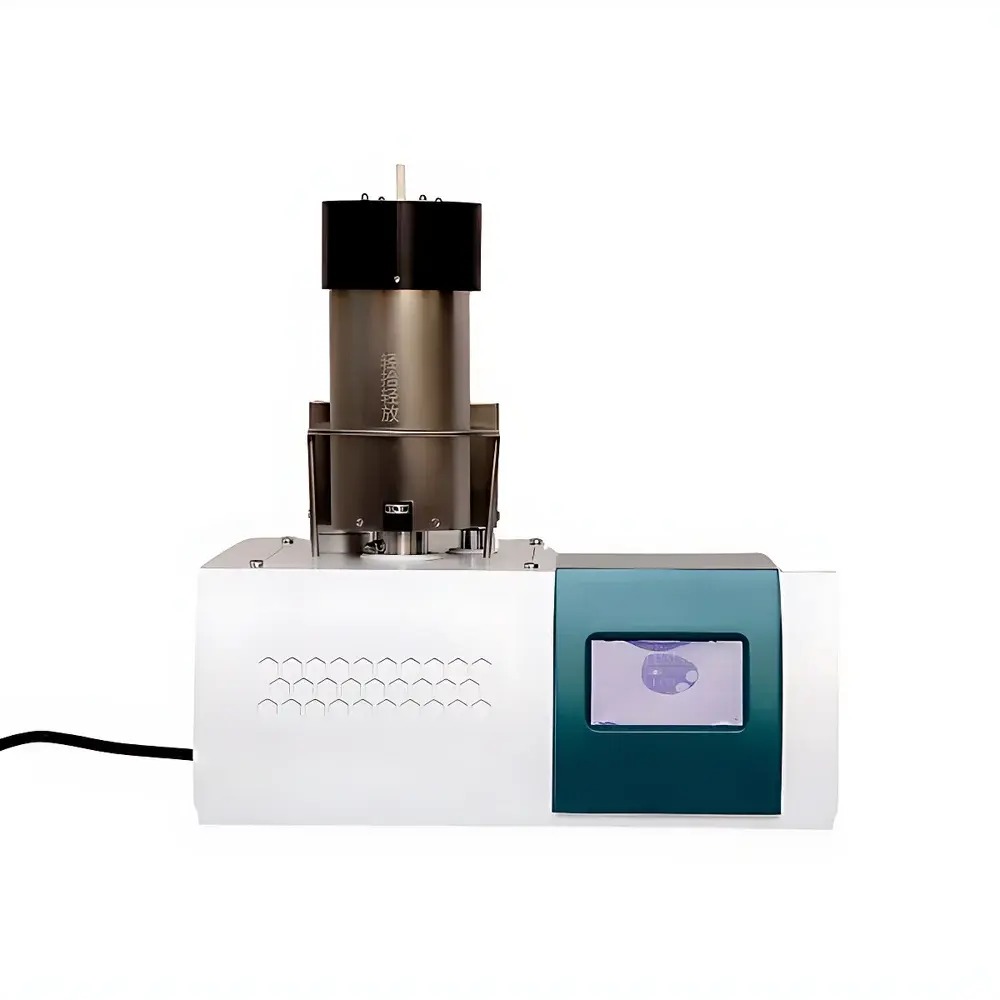
Henven HCR-4 Differential Thermal Analyzer
| Brand | Henven |
|---|---|
| Origin | Beijing, China |
| Manufacturer Type | Direct Manufacturer |
| Instrument Type | DTA (Differential Thermal Analysis) |
| Model | HCR-4 |
| Sample Capacity | Single-sample configuration |
| Temperature Range | Ambient to 1550 °C |
| Programmable Temperature Control | Heating and Isothermal hold |
| Temperature Accuracy | ±0.1 °C |
| Temperature Stability (Drift) | ≤0.1 °C over 24 h |
| Heating/Cooling Rate | 0.1–100 °C/min (user-definable) |
| DTA Signal Range | ±10 µV to ±2000 µV (auto-ranging) |
| DTA Resolution | 0.01 µV |
| DTA Noise Level | <0.01 µV (RMS) |
| DSC Measurement Range | ±1 mW to ±500 mW |
| DSC Sensitivity | ±0.1 µW |
| Atmosphere Control | Dual-channel mass flow controller (MFC), programmable gas switching, corrosion-resistant options available |
| Vacuum Capability (optional) | 2.5×10⁻² Pa |
| Isothermal Hold Duration | Up to 72 h at any temperature within range |
| Calibration Standards Supported | In, Sn, Pb, and user-defined reference materials |
| Optional Accessories | GC/MS transfer line (thermostatted to 200 °C), ceramic/alumina/graphite/quartz/platinum crucibles (0.06 mL & 0.12 mL standard) |
Overview
The Henven HCR-4 Differential Thermal Analyzer (DTA) is a precision benchtop thermal analysis system engineered for high-reproducibility measurement of temperature differentials between a sample and inert reference material under controlled thermal programs. Operating on the fundamental principle of differential thermometry—where two thermocouples simultaneously monitor sample and reference temperatures—the HCR-4 detects endothermic and exothermic events as deviations in ΔT (°C) versus temperature or time. Unlike DSC instruments that quantify heat flow (mW), the HCR-4 delivers high-fidelity DTA signals (µV) with sub-microvolt resolution, making it especially suitable for qualitative and semi-quantitative phase transition analysis, oxidation induction time (OIT) determination, crystallization kinetics modeling, and glass transition screening in inorganic, metallic, ceramic, and refractory materials. Its extended upper temperature limit of 1550 °C enables characterization of high-melting oxides, alloys, and advanced composites—applications common in metallurgical R&D, aerospace material qualification, and nuclear fuel development.
Key Features
- High-stability dual thermocouple architecture: One thermocouple continuously monitors furnace temperature (active or idle); the second measures real-time sample temperature during operation—enabling independent verification of thermal gradient integrity.
- Integrated atmosphere management system featuring two independently controlled mass flow controllers (MFCs), supporting automated gas switching (e.g., N₂ → O₂) during a single run with <1 s response time and ±0.5% full-scale repeatability.
- Programmable isothermal capability: Sustained temperature holds up to 72 hours at any point across the full 25–1550 °C range, critical for long-duration stability testing and oxidation induction period (OIP) analysis per ASTM D3895 and ISO 11357-6.
- Auto-ranging DTA signal acquisition (±10 µV to ±2000 µV) with 0.01 µV resolution and <0.01 µV RMS noise floor—optimized for detecting subtle thermal events in low-enthalpy transitions.
- Modular software suite supporting ASTM/ISO-compliant data processing: peak integration, baseline correction, kinetic modeling (Ozawa-Flynn-Wall, Kissinger), Tg determination via inflection/tangent methods, and comparative heat capacity estimation using the step-heating method.
- Expandable interface architecture: Optional thermostatted transfer line (ambient–200 °C) and vacuum-compatible flange enable direct coupling to GC, MS, or FTIR for evolved gas analysis (EGA), complying with ASTM E1131 and ISO 11357-8 requirements.
Sample Compatibility & Compliance
The HCR-4 accommodates a broad spectrum of solid-state samples—including powders, granules, sintered pellets, and thin foils—using interchangeable crucibles (standard 0.06 mL and 0.12 mL alumina; optional Pt, quartz, graphite, and SiC variants). Its robust furnace design and inert/corrosive gas compatibility (with optional MFC upgrade) support testing under air, N₂, Ar, He, CO₂, H₂, NH₃, and custom mixed atmospheres—meeting material safety and reactivity constraints outlined in GMP Annex 15 and USP . All thermal calibrations are traceable to NIST-certified standards (In, Sn, Pb), and the system supports full audit trail generation per FDA 21 CFR Part 11 when operated with validated software modules. Routine performance verification aligns with ISO 11357-1 (General Principles) and ISO 11357-2 (Temperature Calibration).
Software & Data Management
The proprietary HenvenTherm™ software provides a secure, role-based interface for instrument control, real-time visualization (dual-channel temperature curves, ΔT, d(ΔT)/dt), and post-run analysis. Raw data files are stored in vendor-neutral ASCII format with embedded metadata (operator ID, timestamp, calibration status, gas protocol). The software includes built-in tools for ASTM E537-compliant OIT calculation, Avrami exponent derivation for nucleation/growth modeling, and comparative DTA overlay with statistical deviation mapping. For regulated environments, optional 21 CFR Part 11 compliance packages deliver electronic signatures, change history logs, and locked audit trails. Custom algorithm integration is supported via documented Python API hooks—enabling client-specific kinetic models or proprietary enthalpy normalization routines.
Applications
- Determination of melting points, eutectic temperatures, and solidus/liquidus boundaries in metal alloys and ceramics.
- Oxidation induction time (OIT) assessment of polymers and lubricants per ASTM D3895 and ISO 11357-6.
- Crystallization and devitrification behavior in glasses and amorphous pharmaceuticals.
- Thermal stability evaluation of catalysts, battery cathode materials, and nuclear fuel matrices under inert or oxidative conditions.
- Phase transformation kinetics (e.g., martensitic, peritectic) via multi-rate heating experiments and isoconversional analysis.
- Compatibility screening of drug-excipient mixtures in preformulation studies using stepwise isothermal DTA.
FAQ
What is the difference between DTA and DSC functionality on the HCR-4?
While the HCR-4 is fundamentally a DTA instrument, its high-sensitivity microvolt-level signal detection and calibrated reference channel allow semi-quantitative heat flow estimation. True DSC quantification (mW) requires additional calibration with certified standards and is supported via optional software modules aligned with ISO 11357-4.
Can the HCR-4 perform simultaneous TG-DTA measurements?
No—the HCR-4 is a dedicated DTA platform. For combined thermogravimetric-differential thermal analysis, Henven offers the HTG-4 series, which shares identical furnace architecture and software ecosystem.
Is vacuum operation standard or optional?
Vacuum capability (2.5×10⁻² Pa) is an optional add-on requiring installation of a turbomolecular pumping station and vacuum-sealed furnace lid—configured during order specification.
How is temperature accuracy verified across the full 1550 °C range?
Calibration uses three NIST-traceable reference metals (In: 156.6 °C, Sn: 231.9 °C, Cu: 1084.6 °C) and optional high-temperature standards (e.g., Ni: 1455 °C). The system supports multi-point linear and polynomial correction algorithms within the software.
Are raw data files exportable for third-party analysis?
Yes—ASCII (.txt) and CSV formats are natively supported, including all metadata headers required for import into OriginLab, MATLAB, or Thermo-Calc. No proprietary binary locking is applied.



