
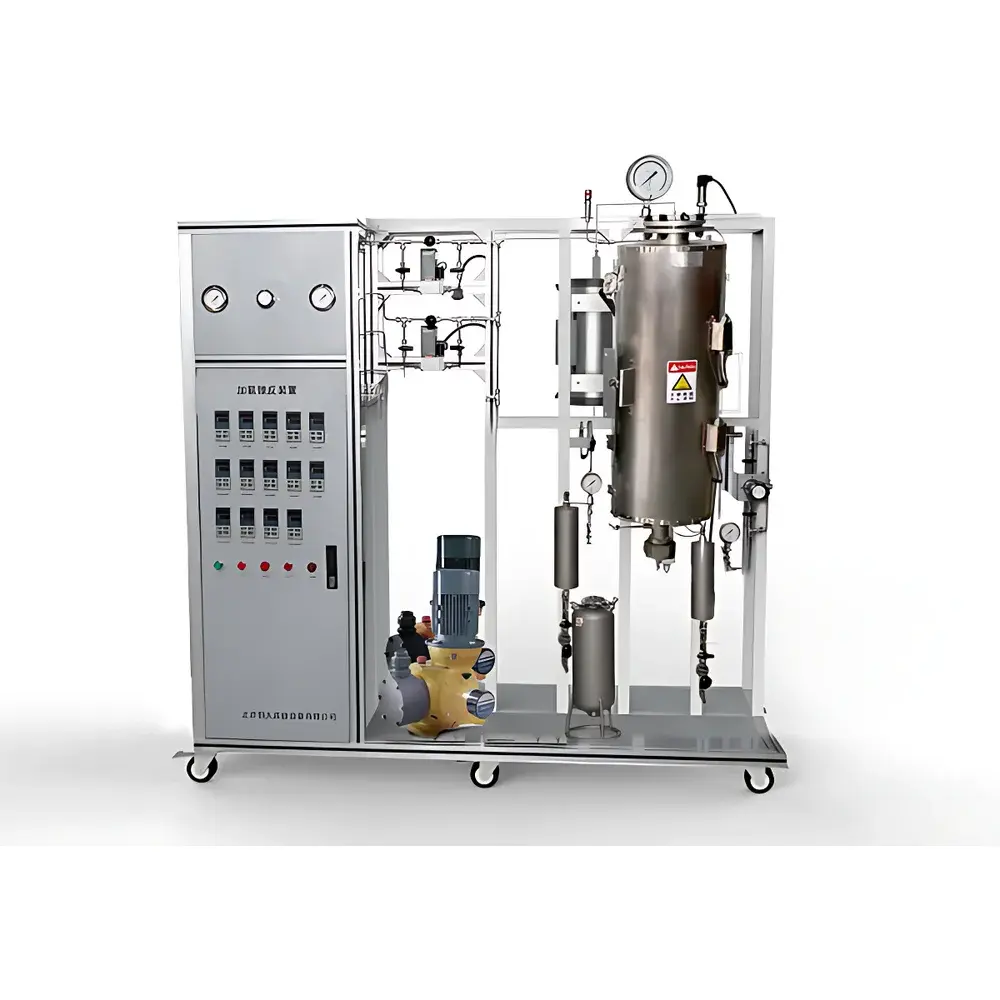
Henven HJQ Hydrogenation Microreactor System
| Brand | Henven |
|---|---|
| Origin | Beijing, China |
| Manufacturer Type | Manufacturer |
| Model | HJQ |
| Flow Rate | 0–10 L/h |
| Operating Pressure | 16.0 MPa |
| Pressure Drop | ≤0.3 MPa |
| Signal Output | 0–5 V |
| Catalyst Loading Volume | 100 mL |
| Maximum Design Temperature | 400 °C |
Overview
The Henven HJQ Hydrogenation Microreactor System is an integrated, fully automated bench-scale catalytic hydrogenation platform engineered for precise process development and kinetic studies under high-pressure, elevated-temperature conditions. Based on fixed-bed or fluidized-bed reactor architecture (configurable per user specification), the system employs Couette-type flow dynamics and gas–liquid–solid triphasic mass transfer principles to emulate industrial-scale hydrogenation behavior at laboratory scale. Its core design adheres to ASME B31.3 process piping standards and incorporates pressure-retaining components rated for continuous operation up to 16.0 MPa — enabling safe investigation of demanding reactions including nitro-group reduction, unsaturated bond saturation, and heterocycle hydrogenolysis. The reactor vessel features segmented electric heating zones with independent PID control, supporting both linear ramping profiles and long-duration isothermal holds (±0.5 °C stability over 24 h). All critical process variables — temperature (RTD Pt100 sensors), pressure (strain-gauge transducers), and mass flow (thermal-mass flow meters calibrated per ISO 14111) — are acquired at 10 Hz sampling frequency and logged synchronously.
Key Features
- Triple independent gas mass flow controllers (MFCs) and one liquid syringe pump for precise stoichiometric control of H₂, co-reactant gases (e.g., NH₃, CO), and organic feedstock
- Proprietary Renmai Fluidized-Bed Control Module enabling real-time adjustment of bed expansion ratio, minimum fluidization velocity, and particle entrainment thresholds based on differential pressure and temperature gradient feedback
- 7-inch industrial-grade capacitive touchscreen HMI with embedded logic engine; supports recipe-based operation, alarm logging, and configurable safety interlocks
- Segmented furnace with three independently controlled heating zones (each 0–400 °C), permitting axial thermal profiling and hot-spot mitigation
- Dual-redundant safety architecture: hardware-level pressure relief valves (set at 110% of MAWP) coupled with software-driven emergency shutdown triggered by deviation >5% from setpoint across any primary sensor channel
- Structural frame fabricated from AISI 316L stainless steel with IP54-rated control panel; all wetted parts meet ASTM A269 TP316 specifications
Sample Compatibility & Compliance
The HJQ system accommodates catalysts in powder, extrudate, or monolithic forms with loading volumes ranging from 10 mL to 100 mL. It supports liquid-phase reactions using solvents such as methanol, ethanol, THF, ethyl acetate, and water — provided vapor pressure remains below 2.0 MPa at operating temperature. Gas-phase compatibility includes H₂, N₂, Ar, CO, CO₂, and NH₃. The system conforms to IEC 61000-6-2/6-4 electromagnetic compatibility requirements and carries CE marking per Machinery Directive 2006/42/EC. Pressure equipment complies with PED 2014/68/EU Annex I essential safety requirements. Data integrity protocols align with ALCOA+ principles, and audit trails meet FDA 21 CFR Part 11 technical criteria when used with validated third-party SCADA software.
Software & Data Management
The onboard controller runs a deterministic real-time OS (VxWorks-based firmware) ensuring sub-100 ms loop cycle times for closed-loop control. Process data — including time-stamped temperature gradients, pressure differentials across catalyst bed sections, and cumulative mass flow totals — are exported in CSV and HDF5 formats via USB or Ethernet. Optional integration with LabVIEW™ or MATLAB® enables advanced modeling of reaction kinetics (e.g., Langmuir-Hinshelwood rate expressions) and CFD-informed parameter estimation. All configuration changes, manual overrides, and alarm events are immutably recorded with user ID, timestamp, and contextual metadata — satisfying GLP/GMP traceability requirements for regulated environments.
Applications
- Development of heterogeneous hydrogenation catalysts (Pd/C, PtO₂, Raney Ni) under industrially relevant pressure–temperature windows
- Screening of solvent effects and H₂ partial pressure dependencies in asymmetric hydrogenation
- Thermal stability assessment of supported metal catalysts during exothermic reduction steps
- Long-duration catalyst deactivation studies (≥100 h TOS) with periodic online GC/FID analysis of effluent streams
- Process intensification evaluation for continuous-flow pharmaceutical intermediate synthesis (e.g., API precursors compliant with ICH Q5A)
FAQ
What reactor configurations are supported?
The HJQ platform supports interchangeable reactor modules: fixed-bed (standard), fluidized-bed (with Renmai control firmware), and trickle-bed variants — all sharing common manifolds and instrumentation.
Is remote monitoring possible?
Yes — optional Ethernet interface enables Modbus TCP communication for integration into existing DCS or MES infrastructure; no proprietary protocol licensing required.
How is catalyst loading performed safely at high pressure?
The system includes a dedicated catalyst charging port with double-block-and-bleed isolation valves and integrated leak-test sequence verification prior to pressurization.
Can the unit operate unattended overnight?
Fully — with active cooling management, redundant temperature monitoring, and automatic depressurization upon power loss or thermal runaway detection.
What calibration documentation is provided?
NIST-traceable calibration certificates for all primary sensors (pressure, temperature, flow) are included; field recalibration procedures follow ISO/IEC 17025 guidelines.



