
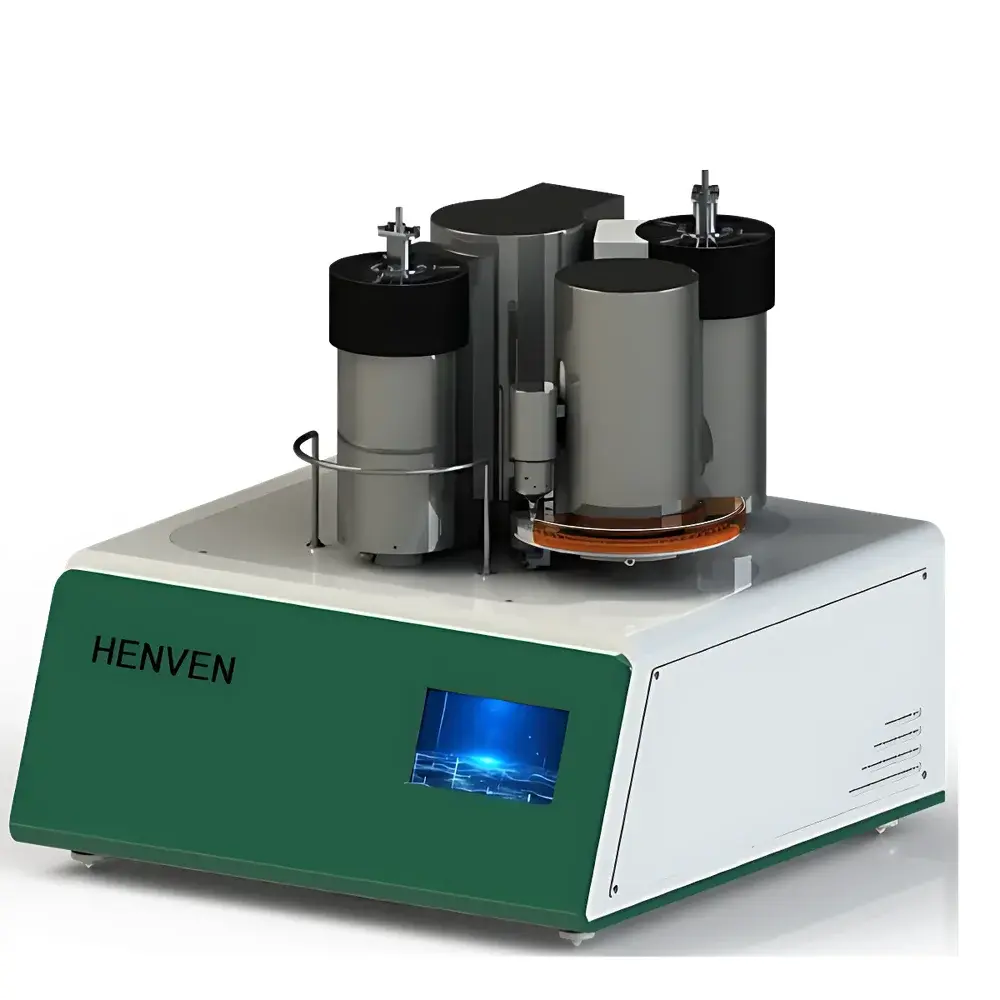
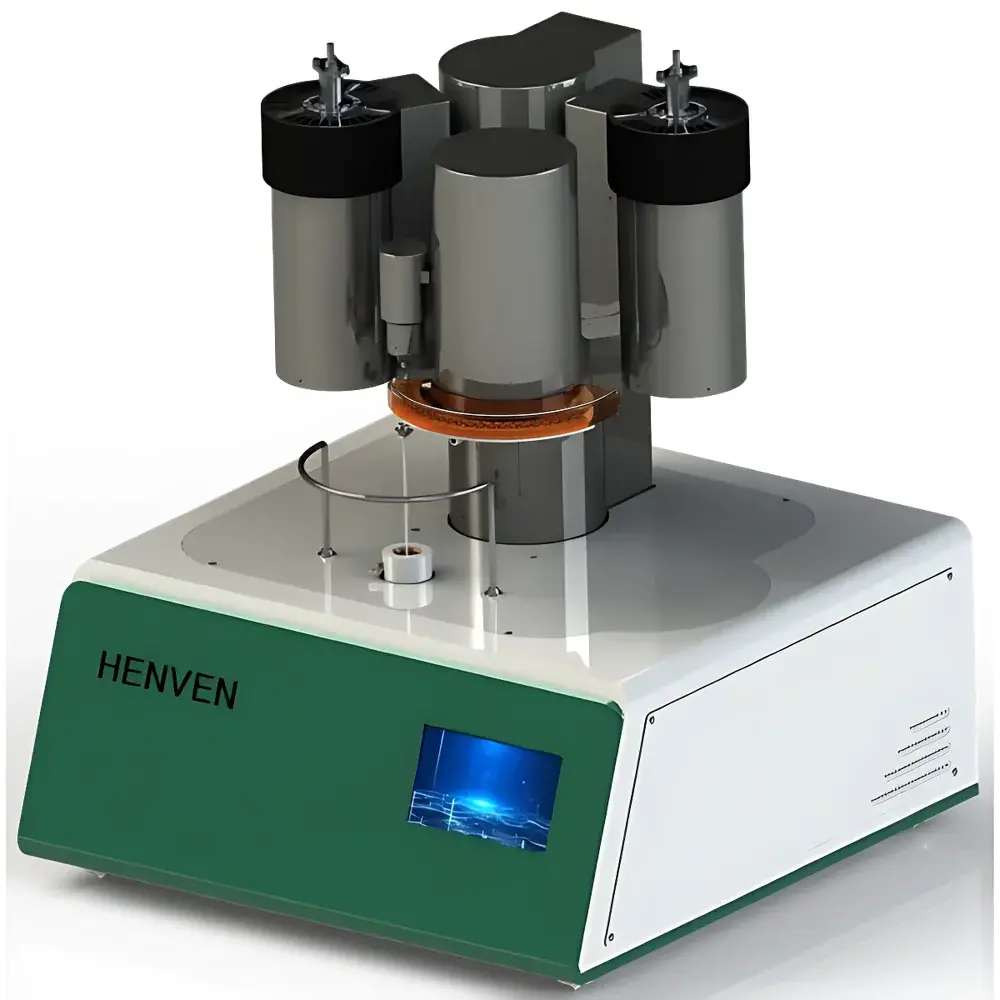
Henven HQST-1/2 Dual-Furnace Automated Sample-Loading Simultaneous Thermal Analyzer (TG-DSC)
| Brand | Henven |
|---|---|
| Origin | Beijing, China |
| Manufacturer Type | Direct Manufacturer |
| Origin Category | Domestic |
| Model | HQST-1/2 |
| Configuration | TG-DSC Coupled System |
| Temperature Range | Up to 1550 °C (High-Temperature Furnace Option) |
| Heating Rate | 0.1–100 °C/min |
| Temperature Stability | ±0.1 °C |
| Max Sample Mass | 200 mg |
| Atmosphere Control | Oxidizing, Reducing, Inert, Vacuum |
| Sample Capacity | 24-Position Automated Carousel |
| Positioning Accuracy | ≤±0.05 mm |
| Balance Type | Mechanical Zero-Position Photoelectric Microbalance |
| Mass Sensitivity | 0.1 μg |
| TG Noise Level | <0.1 μg |
| DSC Range | ±500 mW |
| DSC Sensitivity | ±0.1 μW |
| DSC Enthalpy Accuracy | ±0.1% (using In standard) |
| DTA Range | ±2000 μV |
| DTA Resolution | 0.01 μV |
| Standard Crucibles | Al₂O₃ (0.06 mL / 0.12 mL) |
| Optional Crucibles | Al, Graphite, Quartz, Pt |
| Optional Accessories | Multi-gas Mixing System, Steam Generator, UV Curing Module, Real-time Visual Monitoring Kit, FTIR/MS/GC Coupling Interface |
Overview
The Henven HQST-1/2 is a dual-furnace, automated simultaneous thermal analyzer engineered for high-precision, high-throughput thermogravimetric analysis (TGA) and differential scanning calorimetry (DSC) in a single instrument platform. It operates on the principle of concurrent mass change detection (via high-resolution photoelectric microbalance) and heat flow measurement (via symmetrical heat-flux sensor architecture), enabling true simultaneity in TG-DSC data acquisition. Designed for laboratories requiring rigorous thermal characterization under controlled atmospheres—including oxidative, reducing, inert, or vacuum conditions—the system supports temperature ranges up to 1550 °C with exceptional thermal stability (±0.1 °C) and programmable heating rates from 0.1 to 100 °C/min. Its dual-furnace architecture decouples sample heating from reference compensation, minimizing thermal lag and improving baseline reproducibility across extended runs. The instrument complies with core thermal analysis standards including ASTM E1131, ISO 11357, and USP <1163> for thermal behavior assessment in pharmaceutical and materials development workflows.
Key Features
- Dual independent furnace design with synchronized thermal control—enabling real-time compensation and enhanced signal-to-noise ratio in both TG and DSC channels.
- 24-position fully automated sample-loading carousel with sub-50 μm positioning accuracy (≤±0.05 mm), supporting unattended 24-hour operation and dynamic queue reordering during active runs.
- Mechanical zero-position photoelectric microbalance with 0.1 μg sensitivity and <0.1 μg noise floor—optimized for low-mass samples (1–200 mg) and high-fidelity decomposition kinetics.
- Modular atmosphere management: integrated mass flow controllers support multi-gas switching (N₂, Ar, O₂, H₂, CO, synthetic air), vacuum pumping (<10⁻² mbar), and optional steam or reactive gas delivery.
- Intelligent thermal calibration suite: multi-point non-linear correction using certified In, Zn, Sn, and Al standards; DSC enthalpy accuracy validated at ±0.1% (In); DTA resolution down to 0.01 μV.
- Open communication protocol (TCP/IP + RS-485) and hardware I/O ports enable integration with laboratory automation systems—including robotic arms, LIMS, and third-party analytical interfaces (FTIR, MS, GC).
Sample Compatibility & Compliance
The HQST-1/2 accommodates a broad spectrum of solid and powdered samples—from inorganic oxides and metal alloys to polymers, pharmaceuticals, catalysts, and battery electrode materials. Standard alumina crucibles (0.06 mL and 0.12 mL) ensure chemical inertness up to 1550 °C; optional Pt, quartz, graphite, and aluminum crucibles extend compatibility to corrosive, volatile, or low-temperature applications. All thermal protocols adhere to GLP-compliant data integrity requirements: full audit trail logging, electronic signatures, and 21 CFR Part 11–ready software architecture (when paired with validated control software). Instrument validation packages include IQ/OQ documentation templates aligned with ISO/IEC 17025 and ASTM E2550 for thermal stability and oxidation induction time (OIT) determination.
Software & Data Management
The native thermal analysis software provides full control over method sequencing—including isothermal holds, linear ramps, step scans, and multi-cycle thermal cycling—with real-time visualization of TG, DTG, DSC, and DTA signals. Advanced post-processing modules support kinetic modeling (e.g., Kissinger, Ozawa-Flynn-Wall, Friedman), glass transition identification (Tg via second-derivative inflection), specific heat calculation (via comparative method), and multi-sample overlay with statistical deviation mapping. Raw data export conforms to ASTM E1981 and ASTM E1641 formats (.tdms, .csv, .itx), ensuring interoperability with MATLAB, OriginLab, and Thermo-Calc. All measurement metadata—including furnace position ID, crucible type, gas composition, and calibration timestamps—is embedded in each dataset for traceability.
Applications
- Thermal stability and decomposition kinetics of advanced ceramics and refractory composites.
- Oxidation induction time (OIT) and oxidative degradation profiling of polyolefins and elastomers per ASTM D3895.
- Hydration/dehydration behavior and stoichiometric water loss quantification in pharmaceutical hydrates (ICH Q5C).
- Phase transition mapping in shape-memory alloys and ferroelectric materials (Curie temperature, martensitic transformation).
- Catalyst deactivation studies under simulated reaction atmospheres (e.g., coke formation, sintering onset).
- Multi-step thermal desorption analysis for residual solvents and volatiles in battery cathode precursors (UN 38.3 compliant screening).
FAQ
What is the maximum operating temperature for the HQST-1/2, and how is temperature uniformity maintained across the furnace zone?
The high-temperature configuration supports continuous operation up to 1550 °C. Uniformity is ensured by dual-zone resistive heating elements, PID-controlled feedback loops, and optimized ceramic insulation—achieving ±0.1 °C stability over a 10 mm axial zone.
Can the system perform quantitative evolved gas analysis (EGA) when coupled with external detectors?
Yes—the instrument features standardized gas outlet ports with heated transfer lines (up to 200 °C), pressure-regulated flow splitting, and TTL-synchronized trigger outputs compatible with FTIR, quadrupole MS, and GC-MS systems for time-resolved EGA.
Is the software compliant with FDA 21 CFR Part 11 for regulated environments?
When deployed with the optional GxP Edition software module, the system delivers role-based access control, electronic signature workflows, immutable audit trails, and full electronic record retention—validated per Annex 11 and ALCOA+ principles.
What crucible options are available for corrosive or reducing atmospheres?
Platinum crucibles (99.95% purity) are recommended for aggressive reducing conditions (e.g., H₂ at >800 °C); high-purity graphite crucibles support carbothermic reactions; fused quartz is suitable for low-temperature halogen-containing systems.
How does the dual-furnace architecture improve measurement reproducibility compared to single-furnace STA designs?
Independent thermal control of sample and reference furnaces eliminates cross-talk between heating dynamics and mass drift, reduces thermal inertia effects, and enables true baseline symmetry—critical for high-accuracy enthalpy integration and low-signal DSC events such as weak glass transitions.
Related Products



