
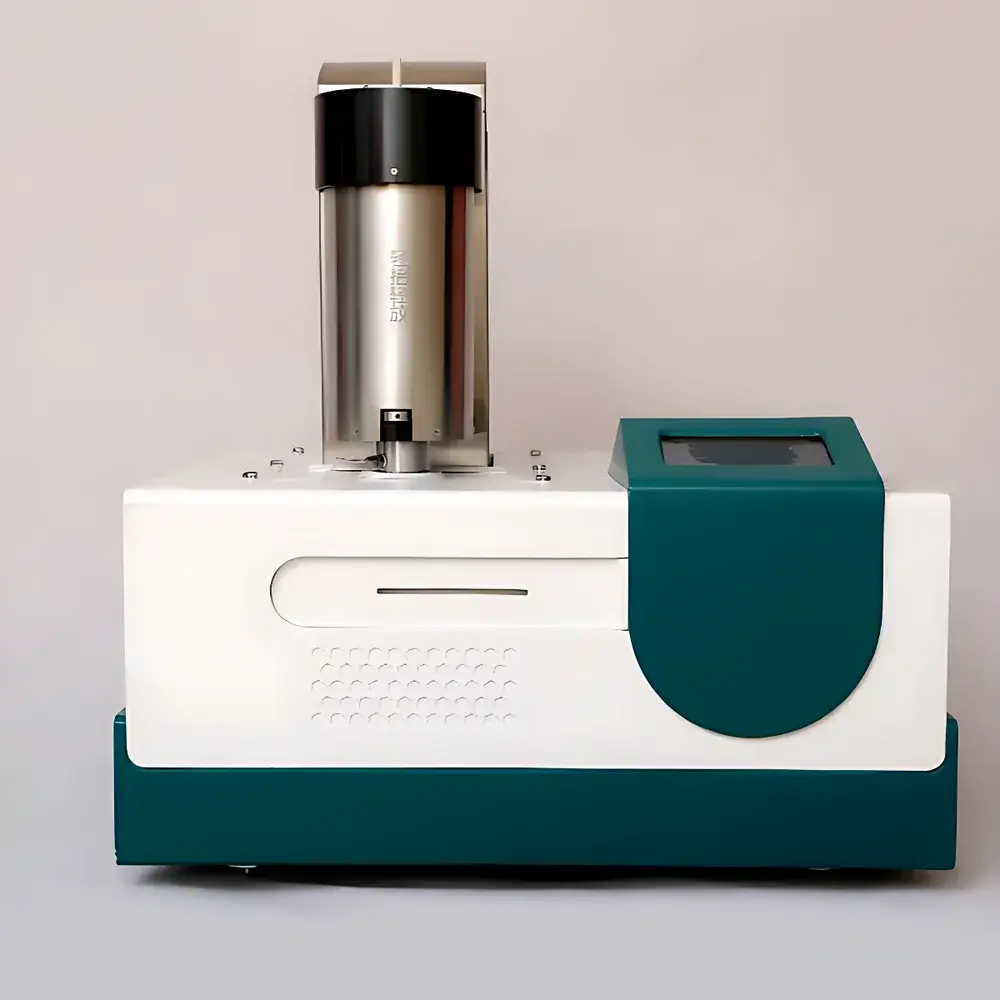
Henven HQG-4 Automated Thermogravimetric Analyzer
| Brand | Henven |
|---|---|
| Origin | Beijing, China |
| Manufacturer Type | Direct Manufacturer |
| Region of Origin | Domestic (China) |
| Model | HQG-4 |
| Operating Environment | Ambient Pressure |
| Sample Capacity | Single Sample |
| Instrument Type | General-Purpose |
| Temperature Range | Room Temperature to 1550 °C |
| Temperature Accuracy | ±0.1 °C |
| Temperature Precision | ±0.1 K |
| Dynamic Weighing Range | 0.01 mg – 5 g |
| Balance Sensitivity | 0.1 µg |
| Mass Accuracy | 0.1 µg |
| Heating/Cooling Rate | 0.1 – 100 K/min |
| Maximum Sample Mass | 5 g |
| Baseline Repeatability | 0.01 mg |
| Baseline Drift | 0.01 mg |
Overview
The Henven HQG-4 Automated Thermogravimetric Analyzer (TGA) is a precision-engineered instrument designed for quantitative measurement of mass change as a function of temperature or time under controlled thermal and atmospheric conditions. Based on the fundamental principle of thermogravimetry—where sample mass is continuously monitored during programmed heating, cooling, or isothermal holds—the HQG-4 enables rigorous characterization of thermal stability, decomposition kinetics, compositional analysis, moisture/volatile content, oxidation behavior, and reaction stoichiometry. Its operational range extends from ambient temperature up to 1550 °C, supporting high-temperature applications in metallurgy, advanced ceramics, nuclear materials, and refractory development. The system integrates a high-stability microbalance with sub-microgram resolution (0.1 µg), coupled with dual thermocouple monitoring (furnace and sample), ensuring traceable temperature calibration and reliable mass–temperature correlation across extended thermal cycles.
Key Features
- Automated, fully integrated TGA platform with motorized furnace lift mechanism for precise, repeatable sample positioning and minimized thermal lag.
- Dual independent thermocouples: one continuously monitors furnace block temperature (active or idle), while the second measures actual sample temperature in real time—enabling accurate thermal lag correction and validation of heating uniformity.
- High-fidelity microbalance with 0.1 µg sensitivity, 0.01 mg baseline repeatability, and <0.1 µg noise floor—engineered for high reproducibility in low-mass-loss regimes (e.g., dehydration, adsorption/desorption).
- Programmable heating/cooling rates from 0.1 to 100 K/min, with isothermal hold capability up to 72 hours at any temperature point within the 25–1550 °C range.
- Two-channel mass flow controller (MFC)-based atmosphere system, supporting inert (N₂, Ar), oxidizing (air, O₂), reducing (H₂, forming gas), or corrosive gas environments; optional corrosion-resistant MFCs and gas lines available upon request.
- Modular crucible compatibility—including ceramic (Φ5×4 mm to Φ18×20 mm), alumina, quartz, graphite, and platinum options—enabling tailored thermal inertia and chemical resistance for diverse sample matrices.
- Real-time LCD interface displaying furnace temperature, sample temperature, instantaneous mass, mass derivative (DTG), gas flow status, and system diagnostics.
Sample Compatibility & Compliance
The HQG-4 accommodates solid, powdered, granular, and thin-film samples ranging from 0.01 mg to 5 g, with crucible geometry optimized for thermal homogeneity and gas exchange efficiency. It supports ASTM E1131 (Standard Test Method for Compositional Analysis by Thermogravimetry), ISO 11358 (Plastics — Thermogravimetry of polymers), and USP (Residual Solvents) methodologies. Optional vacuum configuration (2.5×10⁻² Pa) enables low-pressure pyrolysis studies. For regulated environments, the system architecture supports audit-trail-enabled software (optional GLP/GMP-compliant version available), aligning with FDA 21 CFR Part 11 requirements for electronic records and signatures when paired with validated data acquisition modules.
Software & Data Management
The proprietary TGA control and analysis software provides full automation of experiment setup, real-time data visualization, and post-run processing. Standard outputs include TG (mass vs. temperature/time), DTG (first derivative), and DDTG (second derivative) curves. Advanced functions include percentage mass loss calculation, multi-step kinetic modeling (e.g., Kissinger, Ozawa-Flynn-Wall), comparative overlay of multiple runs, customizable baseline correction, and user-defined formula integration for custom parameter derivation (e.g., char yield, filler content, hydration stoichiometry). All raw data are stored in ASCII-compatible format for third-party analysis (Origin, MATLAB, Python). Screen capture at arbitrary timestamps and auto-ranging of balance signal ensure optimal signal-to-noise ratio across wide dynamic mass ranges.
Applications
- Quantification of filler, polymer, and additive content in composites and formulations.
- Thermal degradation profiling of pharmaceutical excipients and active ingredients per ICH Q1 guidelines.
- Oxidation onset temperature and kinetic analysis of metals, alloys, and coatings.
- Moisture, solvent, and volatile residue determination in catalysts, battery materials, and nanomaterials.
- Decomposition pathway mapping of carbonaceous precursors, MOFs, and biochar.
- Compatibility testing of packaging materials under accelerated aging conditions.
- Interface with GC or MS via heated transfer line (optional 200 °C constant-temperature interface) for evolved gas analysis (EGA).
FAQ
What is the maximum operating temperature of the HQG-4?
The furnace is rated for continuous operation up to 1550 °C, with certified temperature accuracy of ±0.1 °C across the full range.
Can the instrument perform isothermal holds at high temperatures?
Yes—it supports stable isothermal conditions for up to 72 hours at any temperature between room temperature and 1550 °C.
Is vacuum capability standard or optional?
Vacuum operation (down to 2.5×10⁻² Pa) requires optional vacuum pump integration and is not included in the base configuration.
Does the system support compliance with FDA 21 CFR Part 11?
A validated, audit-trail-enabled software package with electronic signature functionality is available as an optional upgrade for regulated laboratories.
How is temperature calibration performed?
Users may perform routine calibration using certified reference materials (e.g., Ni, Cu, Al₂O₃); the software includes dedicated routines for temperature and mass calibration verification.



