
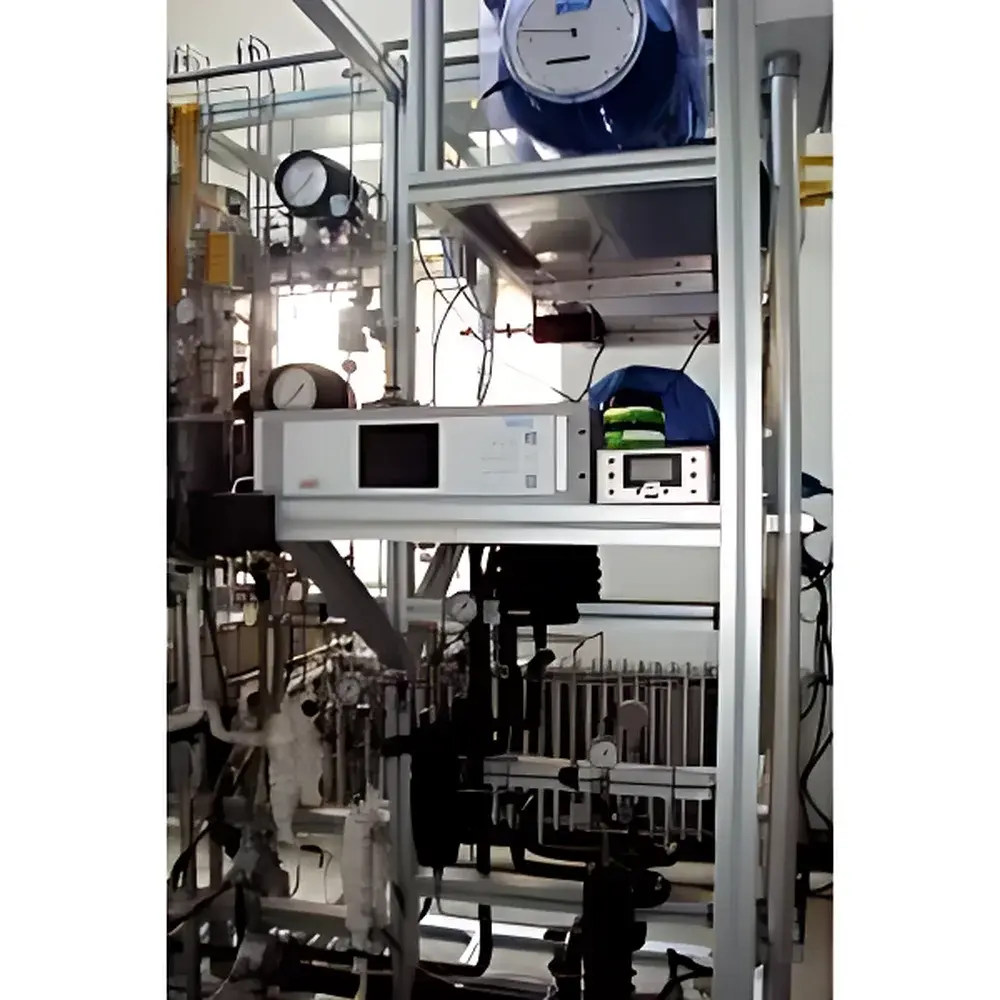
Henven HJ.10 300 mL High-Pressure Hydrogenation Reactor System
| Brand | Henven |
|---|---|
| Origin | Beijing, China |
| Manufacturer Type | Direct Manufacturer |
| Model | HJ.10 |
| Reactor Volume | 300 mL |
| Max Operating Temperature | 500 °C (Reactor), 520 °C (Gas-Liquid Mixer Outlet), 200 °C (Line Tracing) |
| Temperature Control Accuracy | ±0.1 °C |
| Linear Ramp Rate | 0.1–40 °C/min |
| Max Operating Pressure | 20 MPa |
| Gas Flow Range | 0–40 L/min |
| Light Oil Feed Rate | 0–20 mL/min |
| Heavy Oil Feed Rate | 0–50 mL/min |
Overview
The Henven HJ.10 is a fully automated, dual-reactor high-pressure hydrogenation system engineered for laboratory-scale catalytic hydrotreating, hydrocracking, and hydrogenation process development under rigorously controlled conditions. Designed specifically for liquid-phase and trickle-bed catalytic reactions involving light and heavy feedstocks, the system operates on principles of continuous-flow fixed-bed or fluidized-bed kinetics, with integrated thermal management, precise mass flow control, and real-time pressure regulation. Its core architecture supports both steady-state and dynamic transient studies—enabling researchers to investigate catalyst deactivation, reaction selectivity, heat/mass transfer limitations, and process scalability under industrially relevant conditions (up to 20 MPa and 500 °C). The system complies with ASME B31.3 process piping design guidelines for high-pressure experimental apparatus and incorporates fail-safe mechanical interlocks aligned with IEC 61511 functional safety standards for laboratory reactors.
Key Features
- Dual independent reactor configuration with segregated thermal zones—each equipped with programmable linear ramping (0.1–40 °C/min) and ultra-stable isothermal operation (±0.1 °C over >24 h).
- Integrated Renmai™ fluidized-bed control module: dynamically adjusts gas velocity, bed expansion ratio, and solids circulation rate based on real-time differential pressure, temperature gradient, and flow sensor feedback.
- Full automation stack: servo-driven high-pressure syringe pumps (light/heavy oil feeds), mass-flow-controlled H₂/N₂/Ar gas manifolds, and pneumatically actuated isolation valves with position feedback.
- Multi-point sensor network: 12-channel RTD array (ASTM E1137 Class A), 8-channel piezoresistive pressure transducers (0.05% FS accuracy), Coriolis-type liquid flow meters (±0.15% reading), and thermal mass gas flow controllers (±1% of full scale).
- Industrial-grade 15″ capacitive touchscreen HMI: intuitive ladder-logic-based sequencing interface supporting recipe storage, event logging, and alarm acknowledgment—fully compliant with ISA-88 batch control nomenclature.
- Structural integrity: AISI 316L stainless steel frame and panel construction; all wetted parts rated to ASME Section VIII Div. 1 for 25 MPa proof pressure; double-walled insulation on critical lines with trace heating (RT–200 °C).
Sample Compatibility & Compliance
The HJ.10 accommodates a broad range of feedstock viscosities (0.5–500 cP) and densities (600–1100 kg/m³), including naphtha, diesel-range fractions, bio-oils, and vacuum gas oils. Catalysts may be loaded in fixed-bed, ebullated-bed, or fluidized configurations using standardized 1/4″ or 3/8″ OD quartz or Inconel reactors. All operational protocols adhere to ASTM D2509 (hydrogenation of unsaturated compounds), ISO 17025 calibration traceability requirements, and GLP-compliant data integrity practices—including electronic signature support, audit trail generation, and secure user role management (admin/operator/observer tiers). Pressure relief systems conform to PED 2014/68/EU Annex I essential safety requirements.
Software & Data Management
Control and acquisition are managed via Henven’s proprietary ReactorOS v4.2—a deterministic real-time OS running on an embedded industrial PC. Data streams from all sensors are timestamped at 100 Hz and archived in HDF5 format with metadata embedding (unit definitions, calibration certificates, operator ID, sequence ID). Export options include CSV, MATLAB .mat, and PQDIF-compliant files for third-party kinetic modeling (e.g., Aspen Custom Modeler, gPROMS). Software modules support FDA 21 CFR Part 11 compliance: electronic signatures, change control logs, and automatic backup to network-attached storage with SHA-256 hash verification. Remote monitoring is enabled via TLS 1.3-secured OPC UA server (IEC 62541), allowing integration into centralized lab infrastructure.
Applications
- Kinetic parameter estimation for hydrodesulfurization (HDS), hydrodenitrogenation (HDN), and hydrodeoxygenation (HDO) reactions.
- Catalyst screening and lifetime assessment under cyclic pressure/temperature stress.
- Trickle-bed vs. fluidized-bed performance comparison for heavy oil upgrading.
- Process intensification studies: co-feeding of H₂ with CO₂ or NH₃ for novel hydrogenation pathways.
- Reaction calorimetry integration (optional): measurement of adiabatic temperature rise and heat of reaction via jacketed calorimetric reactor sleeves.
- Scale-up correlation: validation of dimensionless numbers (e.g., Reynolds, Capillary, and Thiele modulus) across laboratory-to-pilot transitions.
FAQ
What safety certifications does the HJ.10 hold?
The system carries CE marking per Machinery Directive 2006/42/EC and Pressure Equipment Directive 2014/68/EU; full documentation package includes EC Declaration of Conformity, risk assessment report (EN ISO 12100), and explosion protection file (ATEX Zone 2 compliance for ancillary electronics).
Can the system operate under inert atmosphere prior to H₂ introduction?
Yes—integrated purge logic enables automated N₂/Ar blanking with O₂ residual monitoring (<10 ppm) before pressurization; all gas lines feature double-block-and-bleed isolation.
Is remote diagnostics supported?
Field service engineers can initiate secure remote sessions via encrypted VNC tunnel with end-user consent; firmware updates and configuration backups are performed through signed package deployment.
What maintenance intervals are recommended?
Preventive maintenance is scheduled every 500 operational hours or annually—covering sensor recalibration, valve actuator lubrication, seal replacement, and safety valve certification per ISO 4126-1.
Does the system support custom reactor geometries?
Standard reactors are 300 mL volume with 25 mm ID; custom volumes (100–500 mL) and alternative materials (Hastelloy C-276, Inconel 625) are available as OEM options with lead-time adjustment.



