
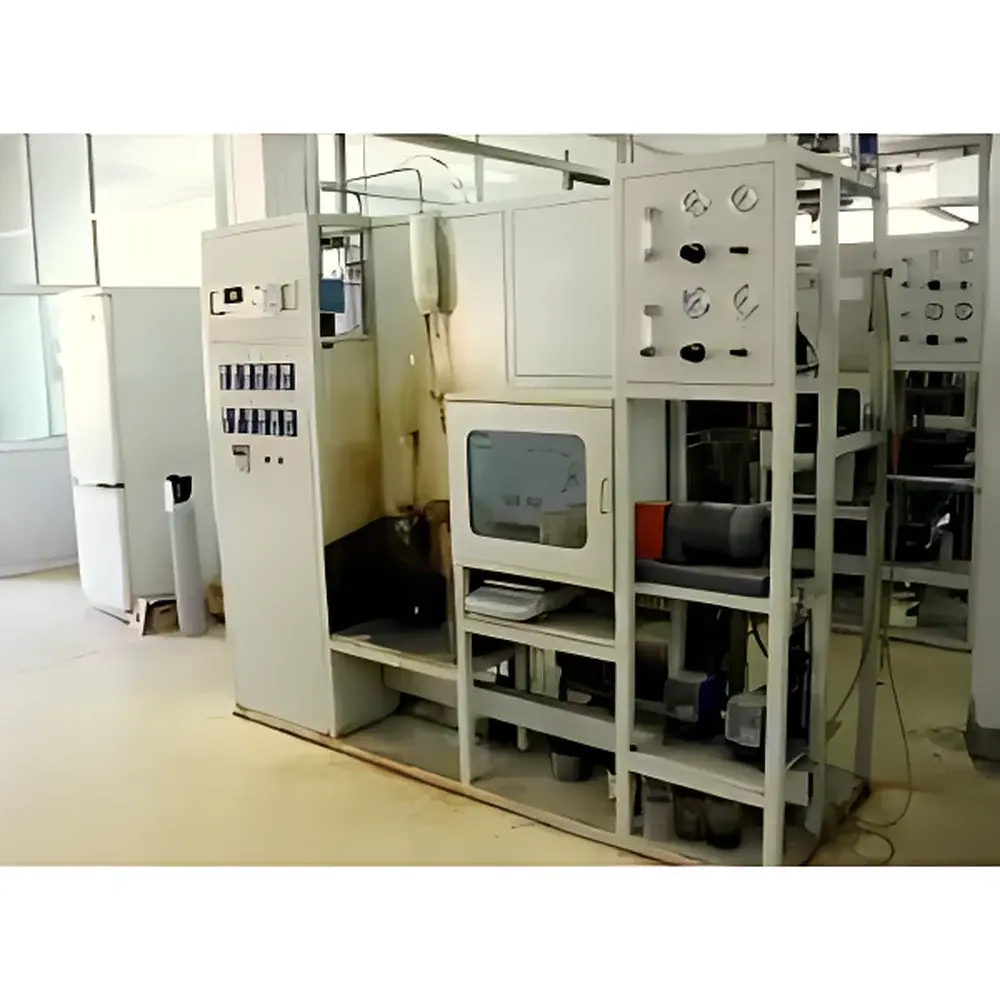
Henven HJ.6 Medium-Low Pressure Light Oil Hydrogenation Pilot Unit
| Brand | Henven |
|---|---|
| Origin | Beijing, China |
| Manufacturer Type | Direct Manufacturer |
| Model | HJ.6 |
| Reactor Configuration | Dual Parallel Fixed-Bed Reactors (One Medium-Pressure, One Low-Pressure) |
| Max Operating Temperature | 600 °C |
| Temperature Ramp Rate | 0.1–40 °C/min |
| Isothermal Stability | ±0.1 °C |
| Gas Flow Range | 0–1000 mL/min |
| Liquid Flow Range | 0–5 mL/min |
| Catalyst Bed Volume | 30 mL |
| Control Interface | Integrated Industrial Touchscreen HMI |
| Automation Level | Fully Automated with Embedded Fault Detection & Safety Interlocks |
| Structural Frame | Reinforced 316L Stainless Steel |
Overview
The Henven HJ.6 Medium-Low Pressure Light Oil Hydrogenation Pilot Unit is a dual-reactor bench-scale catalytic evaluation system engineered for rigorous kinetic and deactivation studies under controlled hydrogenation conditions. It operates on the principle of fixed-bed heterogeneous catalysis, where gaseous H₂ and liquid hydrocarbon feedstocks co-flow through catalyst beds under precisely regulated temperature, pressure, and residence time. The unit’s parallel configuration—comprising one medium-pressure reactor (up to 10 MPa) and one low-pressure reactor (up to 4 MPa)—enables direct side-by-side comparison of catalyst performance across pressure regimes without cross-contamination or sequential experimental bias. This architecture supports method development for hydrotreating processes targeting sulfur and nitrogen removal from diesel-range fractions, including coker-derived naphthas, FCC cycle oils, and cracked gasoline streams. All thermal zones employ independent PID-controlled heating jackets with segmented thermocouple feedback, ensuring spatially resolved temperature profiling and reproducible isothermal operation over extended durations.
Key Features
- Dual independent fixed-bed reactors housed in a single structural frame, each with dedicated pressure-rated vessels, safety relief valves, and back-pressure regulators compliant with ASME BPVC Section VIII Div. 1 design standards.
- Segmented linear temperature programming: users define up to 10 ramp/hold steps per zone, with ramp rates adjustable from 0.1 to 40 °C/min and sustained isothermal stability within ±0.1 °C over ≥24 h.
- High-fidelity process monitoring: integrated Pt100 RTDs (Class A, IEC 60751), piezoresistive pressure transducers (0.1% FS accuracy), and Coriolis-based liquid mass flow meters (±0.2% reading) provide real-time telemetry at all critical nodes.
- Renmai Fluidized-Bed-Inspired Control Architecture: although configured as fixed-bed reactors, the embedded control logic supports dynamic setpoint adaptation—e.g., automatic H₂ flow modulation triggered by exothermic temperature deviation exceeding user-defined thresholds.
- Fail-safe redundancy: independent hardware watchdog circuits monitor primary temperature and pressure sensors; violation of preset limits initiates immediate gas shutoff, depressurization via solenoid-actuated vent lines, and audible/visual alarm escalation.
- Industrial-grade 15.6″ capacitive touchscreen HMI with offline recipe storage, audit trail logging (ISO/IEC 17025-compliant timestamping), and configurable user access levels (operator, engineer, administrator).
Sample Compatibility & Compliance
The HJ.6 accommodates catalysts in pellet, extrudate, or granular form (mesh range: 12–40 US), with standard 30 mL loading volume per reactor—scalable to 50 mL upon request. Feedstock compatibility includes straight-run naphthas, hydrotreated distillates, and thermally unstable cracked gasoline fractions (bromine number ≤ 100 g Br₂/100 g). System materials of construction—316L stainless steel wetted parts, Hastelloy C-276 valve internals, and Kalrez® 8375 seals—ensure resistance to H₂S, NH₃, and organic acids encountered in deep HDS/HDN testing. The unit conforms to CE machinery directive 2006/42/EC, PED 2014/68/EU (for pressure equipment), and meets electromagnetic compatibility requirements per EN 61326-1. Data integrity protocols align with FDA 21 CFR Part 11 expectations for electronic records and signatures when paired with validated software configurations.
Software & Data Management
Control firmware runs on a deterministic real-time Linux kernel, enabling sub-second loop update intervals for temperature and flow regulation. Process data—including time-stamped temperature gradients, differential pressure across catalyst beds, and cumulative H₂ consumption—is logged to internal SSD storage (128 GB) with optional Ethernet/IP or Modbus TCP export to LIMS or DCS environments. Raw datasets are exported in CSV and HDF5 formats; built-in trend analysis tools support derivative calculation (dT/dt, dP/dt) and breakthrough curve fitting using Langmuir-Hinshelwood kinetic models. Audit trails record all parameter changes, user logins, alarm events, and emergency shutdown sequences with SHA-256 hashing for tamper-evident verification.
Applications
- Catalyst screening for ultra-low-sulfur diesel (ULSD) production, including NiMo/Al₂O₃ and CoMo/Al₂O₃ formulations under ASTM D2622 and ISO 8767 test conditions.
- Hydrodenitrogenation (HDN) kinetics evaluation of heavy feedstocks, with online GC-TCD/FID integration capability for NH₃ and HCN quantification.
- Thermal stability assessment of supported metal sulfides under cyclic pressure/temperature stress profiles simulating industrial start-up/shutdown scenarios.
- Reaction engineering studies involving competitive adsorption effects between sulfur-containing compounds (e.g., dibenzothiophene) and nitrogen heterocycles (e.g., quinoline) on bifunctional catalysts.
- Process validation for emerging hydrotreating technologies such as low-hydrogen-consumption staged reactors and membrane-assisted H₂ recycling loops.
FAQ
What pressure ranges does each reactor support?
The medium-pressure reactor operates up to 10 MPa (1450 psi); the low-pressure reactor is rated to 4 MPa (580 psi). Both include redundant pressure transducers and rupture discs sized per ASME PVE-1 guidelines.
Can the system be integrated with external analytical instruments?
Yes—standard 4–20 mA, RS-485 Modbus, and Ethernet/IP interfaces enable synchronization with online GC, FTIR, or sulfur chemiluminescence detectors for real-time effluent analysis.
Is catalyst reduction under H₂ possible prior to reaction testing?
Absolutely—the unit supports in-situ calcination (air/N₂) and sulfidation (H₂S/H₂) protocols with programmable ramp/hold sequences and precise stoichiometric H₂S dosing via mass flow controller.
How is temperature uniformity verified across the catalyst bed?
Each reactor features three axial thermocouple ports (inlet, center, outlet) with optional extension for radial profiling; calibration certificates traceable to NIST standards are provided with delivery.
What documentation is supplied for regulatory compliance?
Delivery includes Factory Acceptance Test (FAT) report, material certifications (EN 10204 3.1), pressure equipment CE declaration, electrical safety certificate (TÜV Rheinland), and SOP templates aligned with GLP principles.



