
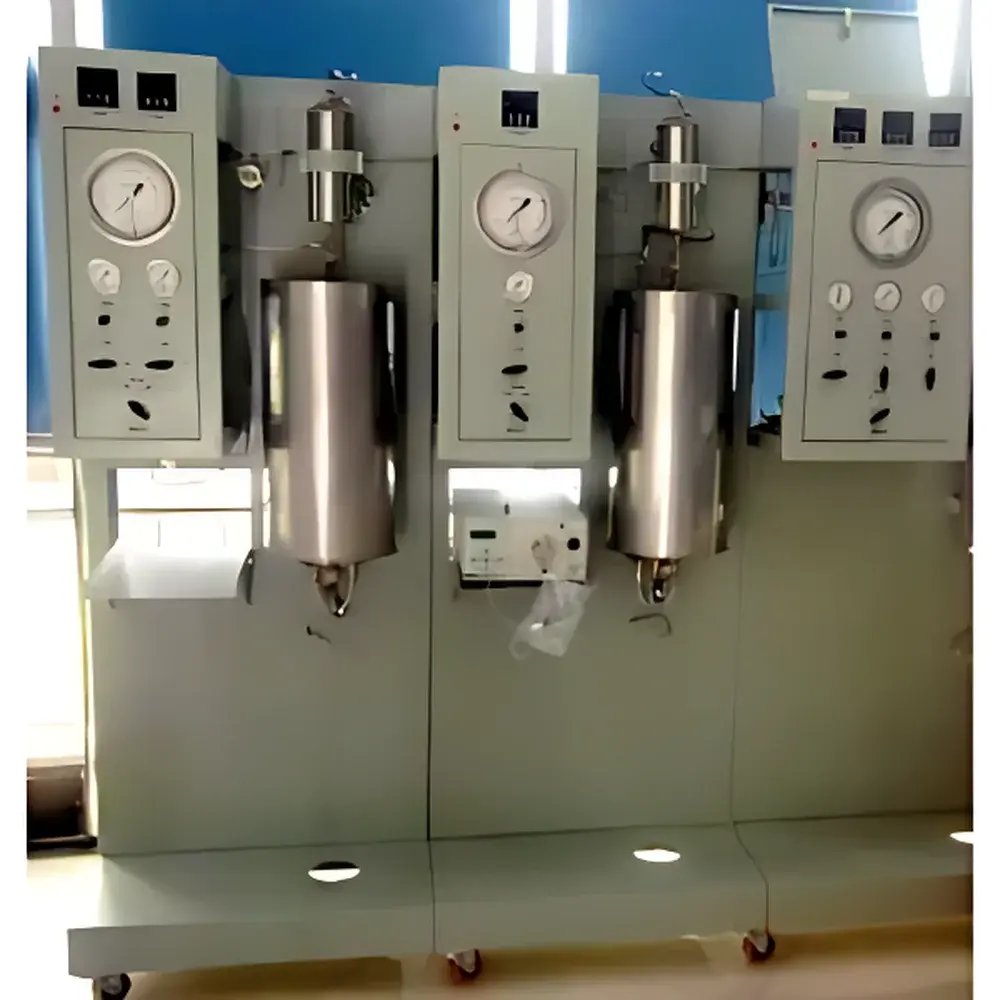
Henven HJ.4 Dual-Stream Hydrogenation Test Rig
| Brand | Henven |
|---|---|
| Origin | Beijing, China |
| Manufacturer Type | Direct Manufacturer |
| Model | HJ.4 |
| Temperature Range | Up to 500 °C |
| Temperature Ramp Rate | 0.1–40 °C/min |
| Isothermal Stability | ±0.1 °C |
| Operating Pressure | 3–10 MPa |
| Gas Flow Rate | 0–20 L/min |
| Liquid Feed Rate | 0–10 mL/min |
| Catalyst Bed Volume | 0–100 mL (customizable) |
Overview
The Henven HJ.4 Dual-Stream Hydrogenation Test Rig is a fully automated, bench-scale catalytic hydrogenation platform engineered for rigorous process development and catalyst evaluation in petroleum refining, fine chemical synthesis, and renewable fuel research. It operates on the principle of heterogeneous catalytic hydrogenation under elevated temperature and pressure, enabling precise simulation of industrial hydroprocessing conditions—including hydrotreating, hydrocracking, and hydrodeoxygenation. The system integrates two independent gas feed streams and one liquid feed channel, allowing co-feeding of H₂ with auxiliary gases (e.g., N₂, H₂S, NH₃) and controlled introduction of crude oil fractions or model compounds. Its core architecture features a vertically oriented fixed-bed or fluidized-bed reactor (configurable per user specification), designed for modular catalyst testing under representative residence time, pressure, and thermal gradient profiles.
Key Features
- Integrated dual-gas mass flow control with real-time digital feedback, supporting simultaneous H₂ and inert or reactive co-gas delivery at up to 20 L/min total volumetric flow (NTP).
- Liquid-phase feed system with high-precision syringe pump or diaphragm metering pump (0–10 mL/min), compatible with viscous feeds and thermally labile substrates.
- Advanced 7-inch industrial LCD touchscreen HMI with embedded PLC logic—enabling full parameter configuration, sequence programming, and live trend visualization without external software.
- Multi-zone reactor temperature control with segmented heating elements; supports linear ramping (0.1–40 °C/min) and long-duration isothermal operation (±0.1 °C stability over ≥24 h).
- Distributed high-accuracy sensing network: Pt100 RTDs (Class A, ±0.1 °C) at inlet, bed center, and outlet; piezoresistive pressure transducers (0.1% FS accuracy) across critical nodes; Coriolis or thermal mass flow meters for gas/liquid streams.
- Patented Renmai fluidized-bed control module—automatically modulates gas velocity, distributor plate backpressure, and bed density feedback loops based on real-time voidage estimation and differential pressure signals.
- Redundant safety architecture: independent hardware interlocks monitor upper-limit temperature (500 °C max), overpressure (10 MPa max), and coolant failure; triggers immediate valve isolation, heater shutdown, and audible/visual alarm.
Sample Compatibility & Compliance
The HJ.4 accommodates a broad range of feedstocks—including naphtha, diesel-range distillates, bio-oils, fatty acid methyl esters (FAME), and aromatic model compounds—across catalyst forms (extrudates, spheres, powders) with optional support for guard beds and pre-sulfidation modules. All wetted parts are constructed from ASTM A269 TP316L stainless steel with electropolished internal surfaces (Ra ≤ 0.4 µm) to minimize catalytic wall effects and ensure trace-metal integrity. The system complies with ASME BPVC Section VIII Div. 1 design standards for pressure equipment and meets CE Machinery Directive 2006/42/EC essential health and safety requirements. Optional IQ/OQ documentation packages align with GLP (OECD 1998) and GMP (ICH Q5D, USP ) validation frameworks.
Software & Data Management
Data acquisition is handled by an embedded real-time OS with 100 Hz sampling resolution across all analog inputs. Raw sensor data—including temperature gradients, pressure differentials, flow integrals, and actuator positions—is timestamped and stored locally on encrypted industrial-grade SSD storage (≥128 GB). Export formats include CSV, HDF5, and XML with embedded metadata (ISO/IEC 11179-compliant variable definitions). The HMI supports configurable alarm logging with audit trail (user action, timestamp, parameter change), satisfying FDA 21 CFR Part 11 requirements when paired with optional electronic signature module. Remote monitoring via Ethernet (Modbus TCP, OPC UA) enables integration into centralized LIMS or MES environments.
Applications
- Catalyst screening and lifetime assessment under simulated refinery hydrotreating conditions (e.g., sulfur/nitrogen removal from VGO).
- Kinetic modeling of hydrodeoxygenation (HDO) reactions using lignin-derived bio-oils.
- Optimization of hydrogen partial pressure effects on selectivity in asymmetric hydrogenation of α,β-unsaturated carbonyls.
- Fluidization behavior studies of NiMo/Al₂O₃ or CoMo/zeolite catalysts under varying gas velocity and temperature regimes.
- Development and validation of digital twin models for scale-up to pilot-plant reactors (e.g., matching Damköhler and Thiele modulus behavior).
FAQ
Can the HJ.4 operate in both fixed-bed and fluidized-bed modes?
Yes—the reactor vessel is mechanically and instrumentation-ready for either configuration; switching requires only minor hardware reconfiguration and HMI profile selection.
Is third-party calibration certification available for the integrated sensors?
Calibration certificates traceable to NIST standards are provided for all primary sensors (temperature, pressure, flow) upon request, with optional annual recalibration service contracts.
What level of cybersecurity is implemented for remote data access?
The embedded controller supports TLS 1.2 encryption, role-based user authentication, and configurable firewall rules; network segmentation is recommended for compliance-critical deployments.
Does the system support catalyst pre-sulfidation protocols?
Yes—integrated H₂S generation (from thiol decomposition or cylinder-fed) and programmable sulfidation ramps (e.g., 2 °C/min to 340 °C under 10% H₂S/H₂) are supported via custom sequence scripting.
Can the HJ.4 be integrated with external GC or online FTIR analyzers?
Analog/digital I/O expansion ports and Modbus RTU/TCP interfaces enable synchronized triggering and data ingestion from common analytical instruments, with sample stream routing kits available as accessories.



