
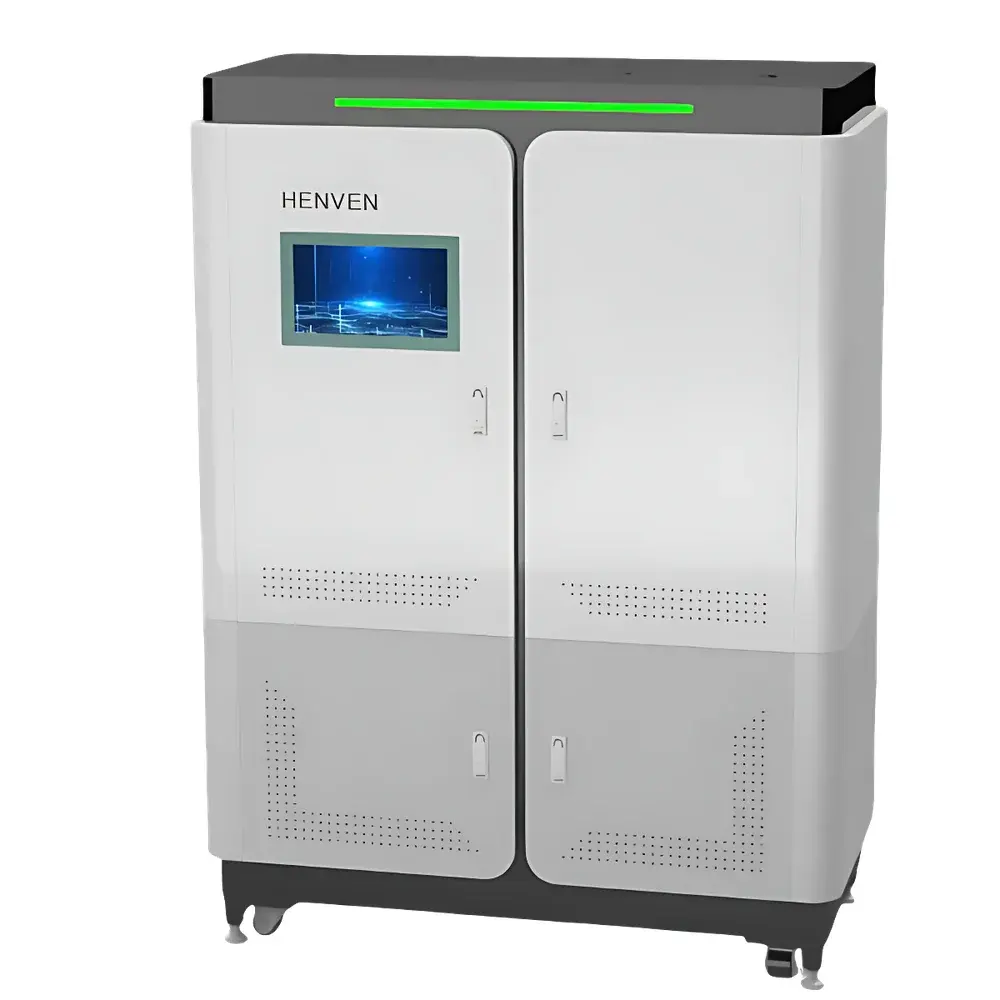
Henven HTF High-Pressure Thermogravimetric Analyzer
| Brand | Henven |
|---|---|
| Origin | Beijing, China |
| Manufacturer Type | Direct Manufacturer |
| Region of Origin | Domestic (China) |
| Model | HTF |
| Price Range | USD 70,000–110,000 |
| Sample Capacity | Single sample per run |
| Instrument Type | Dedicated TGA platform |
| Temperature Range | Ambient to 950 °C |
| Temperature Accuracy | ±0.1 °C |
| Temperature Stability | ±0.1 K |
| Dynamic Weighing Range | 1 mg–200 mg or 0–5 g (selectable) |
| Balance Sensitivity | 0.1 µg |
| Mass Accuracy | 0.1 µg |
| Heating/Cooling Rate | 0.1–30 K/min |
| Maximum Sample Mass | 5 g |
| Pressure Control Range | 0.1–5 MPa (at elevated temperature) |
| Pressure Control Precision | ±0.02 MPa |
| Steam Generation Range | 0.01–1000 mL/min (saturated water vapor, computer-controlled) |
| Atmosphere Control | Triple independent mass flow-controlled gas lines with automated switching and stabilization |
| Crucible Options | Standard ceramic crucible (Ø80 mm × H70 mm), compatible with sample masses up to 50 g |
Overview
The Henven HTF High-Pressure Thermogravimetric Analyzer is an engineered solution for quantitative thermal stability and compositional analysis under controlled pressure and reactive or inert atmospheres. Built upon a dual-compartment design integrating a high-precision microbalance and a programmable high-temperature furnace with active pressure regulation, the HTF enables real-time mass change monitoring—down to 0.1 µg resolution—while maintaining precise control over thermodynamic boundary conditions. Its core measurement principle follows ISO 11358-1 and ASTM E1131 standards for thermogravimetry, where mass loss/gain events are correlated with temperature, time, pressure, and gaseous environment to determine decomposition onset, oxidation kinetics, moisture evolution, volatilization profiles, and residual ash content. Unlike conventional ambient-pressure TGA systems, the HTF uniquely supports isobaric and isothermal pressurized experiments up to 5 MPa at temperatures up to 950 °C—making it suitable for catalytic reaction studies, coal gasification simulation, polymer pyrolysis under confinement, and geochemical mineral dehydration modeling.
Key Features
- Integrated high-stability pressure control system with digital servo-valve actuation, maintaining setpoint accuracy within ±0.02 MPa across full operating range (0.1–5 MPa)
- Motor-driven vertical furnace lift mechanism with auxiliary sample loading port, enabling fully automated insertion and positioning without manual intervention
- Triple-channel mass flow controller (MFC)-based gas delivery system supporting simultaneous or sequential introduction of N₂, O₂, Ar, CO₂, H₂, or custom mixtures; all switching, flow ramping, and dwell sequences executed via software-defined protocols
- Onboard saturated steam generator with gravimetrically calibrated liquid delivery, providing continuous, stable water vapor output from 0.01 to 1000 mL/min at ±0.01 mL/min resolution
- Auto-ranging balance electronics that dynamically adjust signal gain based on real-time mass load—ensuring optimal signal-to-noise ratio across 1 mg to 5 g sample configurations
- Ceramic crucible compatibility (standard Ø80 mm × 70 mm) validated for samples up to 50 g, with optional quartz and platinum variants available for corrosive or high-reactivity applications
- Comprehensive calibration suite supporting user-performed verification of temperature (using Ni, Cu, or Al reference standards per ISO 11357-6), mass (NIST-traceable weights), and pressure (certified dead-weight tester)
Sample Compatibility & Compliance
The HTF accommodates solid powders, granules, thin films, fibers, and pre-pressed pellets. Its modular crucible interface supports standard geometries while permitting customization for specialized reactor inserts—such as fixed-bed catalyst carriers or sealed capsule configurations. All hardware and firmware comply with CE marking requirements for electromagnetic compatibility (EMC Directive 2014/30/EU) and low-voltage safety (LVD Directive 2014/35/EU). Software operation adheres to GLP principles through audit-trail-enabled user authentication, electronic signature support, and immutable data logging. Optional 21 CFR Part 11 compliance packages include role-based access control, electronic record retention, and change history tracking for regulated QC/QA environments.
Software & Data Management
HTF-Control Suite is a Windows-native application built on Qt framework, offering deterministic real-time acquisition at 10 Hz sampling rate. It provides multi-step temperature programming (ramp-hold-ramp, step-isotherms, modulated TGA), synchronized pressure profiling, and concurrent gas switching logic. Data output conforms to ASTM E1641-compliant ASCII format with embedded metadata (instrument ID, operator, date/time, calibration status). Advanced post-processing modules include derivative thermogravimetry (DTG), peak deconvolution (Gaussian/Lorentzian fitting), kinetic modeling (Flynn-Wall-Ozawa, Kissinger-Akahira-Sunose), and comparative overlay of up to 16 curves with statistical deviation mapping. Export options include CSV, PDF reports, and direct integration with MATLAB and Python via RESTful API.
Applications
- Thermal decomposition kinetics of energetic materials under pressurized nitrogen
- Oxidation behavior of metal alloys and coatings in controlled pO₂ environments
- Moisture sorption/desorption isotherms of pharmaceutical excipients using calibrated steam injection
- Coal and biomass devolatilization modeling under simulated syngas conditions (CO/H₂/N₂ mixtures at 2–4 MPa)
- Stability assessment of MOFs and porous carbons during solvent removal under vacuum or inert backfill
- Residue quantification and ash composition analysis in lubricants and engine oils per ASTM D874
- In-situ monitoring of catalytic coke formation and regeneration cycles in fluidized-bed analogs
FAQ
What pressure ranges can the HTF maintain at 900 °C?
The HTF sustains pressures between 0.1 and 5 MPa at temperatures up to 950 °C, with active feedback control ensuring stability within ±0.02 MPa under dynamic thermal load.
Is the steam generator capable of delivering dry steam or only saturated vapor?
The integrated steam module produces saturated water vapor only; superheated steam requires external conditioning and is not supported by default configuration.
Can the HTF perform simultaneous TGA-DTA measurements?
No—the HTF is a dedicated thermogravimetric platform. Differential thermal analysis functionality is not included; however, third-party DTA sensors may be retrofitted with mechanical and electrical interface validation.
How is temperature calibration verified during routine operation?
Users perform periodic verification using certified reference materials (e.g., Ni Curie point at 354 °C, Al melting at 660.3 °C) following ISO 11357-6 procedures; calibration logs are stored with timestamped operator ID and result traceability.
What is the maximum allowable sample volume in the standard ceramic crucible?
The standard crucible (Ø80 mm × 70 mm) accommodates up to 50 g of low-density powder or 35 g of compacted solids, though optimal sensitivity is achieved within the 1–200 mg dynamic weighing range.



