
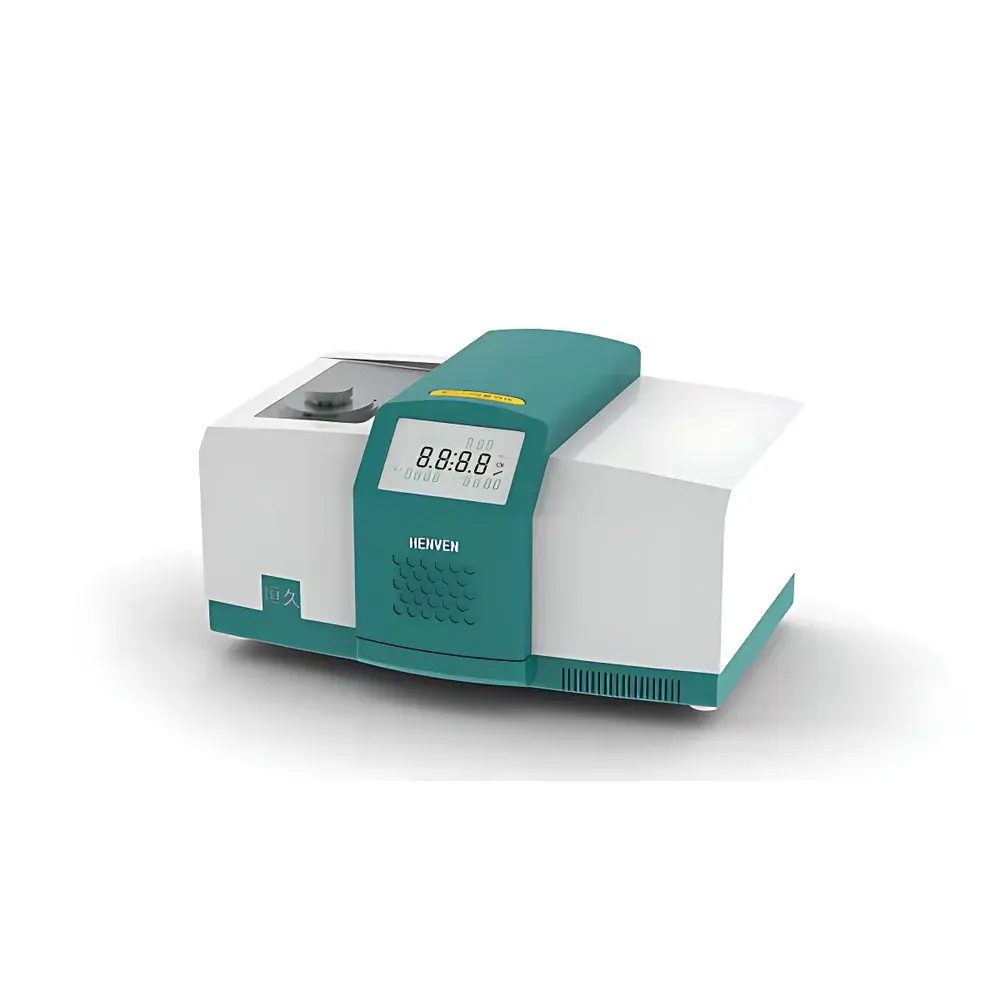
Henven HSC-3 Thermal Flow Differential Scanning Calorimeter
| Brand | Henven |
|---|---|
| Origin | Beijing, China |
| Manufacturer Type | Direct Manufacturer |
| Instrument Type | Heat-Flow DSC |
| Model | HSC-3 |
| Sample Capacity | Single |
| Temperature Range | −100 °C to 680 °C (with manual liquid nitrogen cooling) |
| Temperature Accuracy | ±0.1 °C |
| Heating/Cooling Rate | 0.1–100 °C/min |
| Temperature Precision | ±0.1 °C |
| DSC Signal Range | 0 mW to ±500 mW |
| Temperature Stability | ±0.1 °C |
| DSC Resolution | ±0.1 µW |
| Power Noise | ±0.1 µW |
| Power Accuracy | ±0.1 µW |
| Atmosphere Control | Dual-channel mass flow controlled (10–200 mL/min, auto-switchable) |
| Crucible Options | Al₂O₃, high-purity Al (standard) |
| Calibration Standards Included | In, Sn, Pb, Zn, Al |
Overview
The Henven HSC-3 is a precision-engineered thermal flow differential scanning calorimeter (DSC) designed for high-fidelity quantitative thermal analysis under programmable temperature control. Based on the heat-flow principle—where heat flux differences between sample and reference are measured as a function of temperature or time—the HSC-3 delivers exceptional reproducibility and metrological traceability in endothermic and exothermic event characterization. Its operational range spans from cryogenic conditions (−100 °C, enabled by manual liquid nitrogen introduction) to high-temperature transitions (up to 680 °C), supporting rigorous investigation of phase changes, crystallization kinetics, glass transitions, oxidative stability, and enthalpy-driven reactions across materials science, pharmaceutical development, polymer engineering, and food chemistry applications.
Key Features
- Integrated furnace-controller architecture minimizes thermal lag and signal attenuation, enhancing baseline stability and measurement fidelity.
- Dual thermocouple monitoring: one measures real-time sample temperature; the other continuously tracks furnace block temperature—enabling dynamic thermal gradient assessment independent of heating state.
- Programmable dual-gas atmosphere system with mass flow controllers (MFCs), supporting automated switching between inert (e.g., N₂, Ar) and reactive (e.g., O₂, air) environments during a single run—critical for oxidation induction time (OIT) and decomposition pathway studies.
- Modular crucible compatibility including standard Al₂O₃ and high-purity aluminum, plus optional sealed aluminum (for volatile or moisture-sensitive samples), ZrO₂ (high-temp inertness), quartz (UV transparency), graphite (reducing atmospheres), and Pt/Rh (corrosion resistance).
- Self-calibration capability using certified reference materials (In, Sn, Pb, Zn, Al) for both temperature and enthalpy axes—ensuring ongoing compliance with ISO 11357 and ASTM E794 verification protocols.
- High-resolution detection electronics with ±0.1 µW power resolution and <±0.1 µW noise floor, enabling detection of subtle thermal events such as secondary relaxations and low-enthalpy polymorphic transitions.
Sample Compatibility & Compliance
The HSC-3 accommodates solid, powder, and liquid samples in volumes up to 0.06 mL. Its broad thermal range and dual-atmosphere flexibility support testing per key international standards, including ISO 11357 (plastics), ASTM E793 (heat of fusion), ASTM D3418 (Tg determination), and USP <1151> (pharmaceutical thermal analysis). The instrument’s hardware design and software audit trail functionality align with GLP and GMP data integrity expectations. While not pre-certified for FDA 21 CFR Part 11, its timestamped, user-logged calibration records, electronic signature-ready report generation, and immutable raw data export (ASCII, CSV, .dsc) provide a foundation for regulated environment validation.
Software & Data Management
The embedded intelligent software enables fully automated method definition—including multi-segment heating/cooling/hold profiles, gas switching logic, and real-time baseline correction algorithms. Post-run processing includes automatic peak integration, Tg onset/midpoint/endpoint calculation, crystallinity estimation via enthalpy ratio, OIT derivation from isothermal oxidation curves, and melting point identification with onset/peak/offset markers. Reports are generated in customizable PDF format with embedded metadata (operator ID, calibration date, instrument serial number, environmental conditions). Raw data exports retain full temporal resolution (≥10 points/sec) and support third-party analysis in MATLAB, Origin, or Thermo Scientific™ OMNIC.
Applications
- Polymers: Crystallinity quantification, cold crystallization behavior, Tg mapping across plasticizer content gradients, degradation onset under accelerated aging protocols.
- Pharmaceuticals: Polymorph screening, hydrate/anhydrate transition enthalpies, excipient compatibility assessment, stability-indicating assay development.
- Inorganics & Ceramics: Solid-state reaction enthalpies, eutectic melting characterization, phase diagram validation, sintering onset temperature determination.
- Foods & Lipids: Solid fat content (SFC) profiling, polymorphic behavior of cocoa butter, gelatinization enthalpy of starches, oxidative shelf-life prediction.
- Batteries & Electrolytes: SEI formation enthalpy, cathode decomposition pathways, thermal runaway onset thresholds under controlled gas environments.
FAQ
What cooling method does the HSC-3 use to achieve −100 °C?
Liquid nitrogen is manually introduced into the cooling jacket; no integrated mechanical cryocooler is included.
Can the HSC-3 perform modulated DSC (MDSC)?
No—it is a conventional heat-flow DSC system and does not support sinusoidal temperature modulation or reversing/non-reversing heat flow separation.
Is remote diagnostic or firmware update supported?
Yes—via secure TCP/IP connection, authorized personnel can access instrument status, adjust PID parameters, and initiate calibration routines remotely.
Does the software comply with 21 CFR Part 11 requirements?
The base software provides audit-trail logging and electronic signature placeholders; full Part 11 compliance requires site-specific validation and supplementary access controls.
What is the minimum detectable enthalpy change?
Based on ±0.1 µW resolution and typical scan rates (10 °C/min), the practical lower limit for reliable enthalpy quantification is ~0.5 J/g for a 1 mg sample—subject to baseline flatness and noise integration window.



