
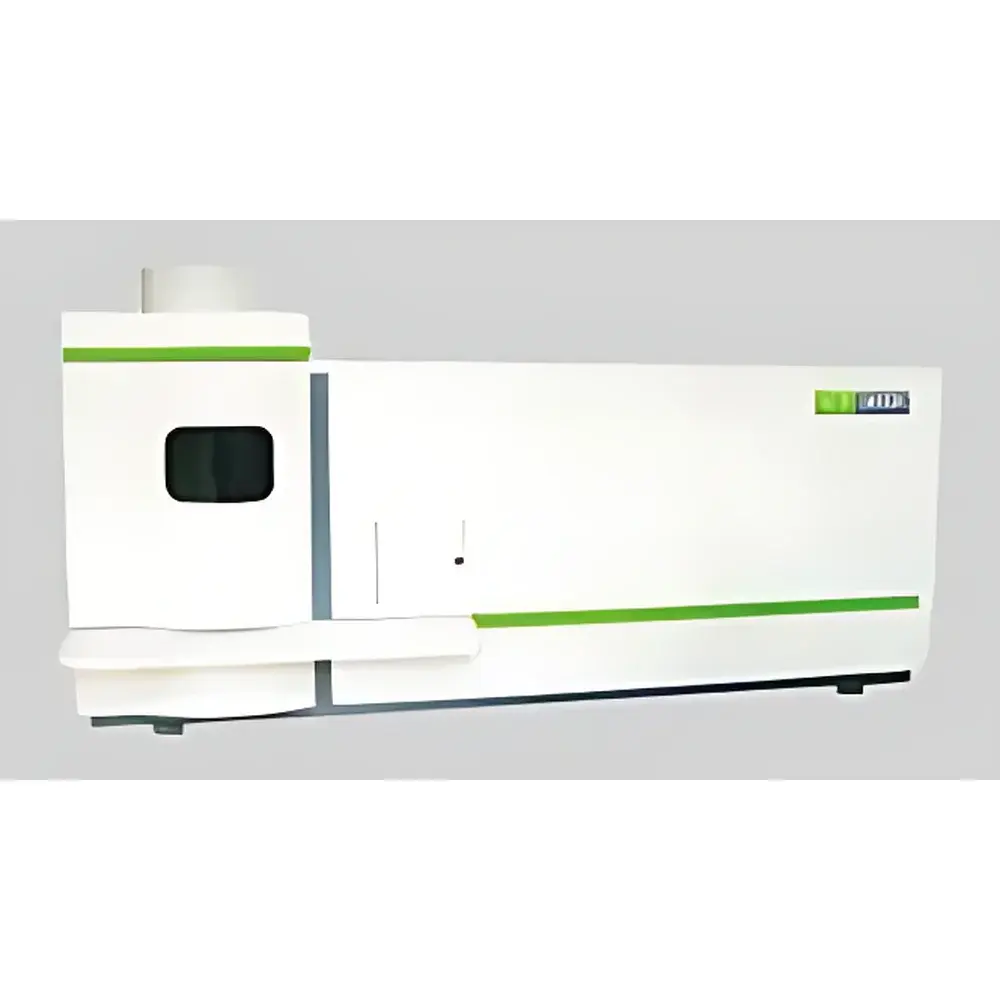
Henven ICP-AES Spectrometer
| Brand | Henven |
|---|---|
| Origin | Beijing, China |
| Manufacturer Type | Manufacturer |
| Model | ICP-AES |
| Pricing | Upon Request |
| Detection Limit | as low as 0.7 ppb (e.g., Ba, Cu) |
| Linear Dynamic Range | 6 orders of magnitude |
| Wavelength Range | 180–800 nm |
| Resolution | up to 0.002 nm |
| RF Output Stability | ≤0.2% |
| Short-term Precision (RSD) | ≤1.5% |
| Long-term Stability (RSD) | ≤2% |
| Nebulization Efficiency | 65% |
| Torch Design | Miniature concentric quartz torch (15 mm ID, 3-turn coil) |
| Nebulizer Chamber | Cyclonic or double-pass spray chamber |
| Optical System | Czerny-Turner mounting with large-area ion-etched plane holographic grating |
| Focal Length | 1000 mm |
| Temperature Control | Programmed thermostatic stabilization ±0.1°C |
Overview
The Henven ICP-AES Spectrometer is a high-performance inductively coupled plasma atomic emission spectrometer engineered for precise, multi-element quantitative and qualitative analysis across diverse sample matrices. Based on the fundamental principle of optical emission spectroscopy—where atomized and excited elements in a high-temperature argon plasma emit characteristic wavelengths—the instrument delivers robust elemental identification and quantification via high-resolution spectral dispersion and photometric detection. Designed for routine laboratory environments in QC/QA, environmental monitoring, geological surveying, metallurgical process control, and regulatory testing labs, the system integrates plasma generation, nebulization, optical spectroscopy, and intelligent software into a single compact architecture optimized for reproducibility, operational efficiency, and analytical flexibility.
Key Features
- Rapid Multi-Element Analysis: Simultaneous or sequential measurement of over 70 elements within a single run; typical throughput of 5–8 elements per minute.
- Instant Operational Readiness: Achieves stable plasma conditions in under 5 minutes—eliminating pre-purge, extended warm-up, or post-run purge delays.
- Ultra-Low Detection Limits: Sub-part-per-trillion sensitivity for key elements (e.g., Ba, Cu at 0.7 ppb), enabled by high-efficiency nebulization (65%) and optimized plasma coupling.
- Extended Linear Dynamic Range: Six-decade linear response (0.01 ppb to several % w/w) supports trace-level and major-component analysis without dilution or method switching.
- Cost-Effective Argon Utilization: Compatible with industrial-grade argon (99.95% purity); proprietary miniature concentric quartz torch reduces total argon consumption by up to 40% versus standard configurations.
- High-Resolution Optical System: Czerny-Turner monochromator with 1000 mm focal length, ion-etched plane holographic grating, and programmable thermostatic control (±0.1°C) ensures spectral stability and resolution down to 0.002 nm.
- One-Touch Plasma Ignition: Fully automated startup sequence verifies gas pressure, coolant flow, RF power status, and matching network tuning before ignition—providing real-time diagnostic feedback to the operator.
Sample Compatibility & Compliance
The Henven ICP-AES accommodates liquid samples (aqueous acids, digestates, standards) and solid samples following appropriate dissolution or fusion protocols. Supported matrices include environmental waters, geological digests (HF/HNO₃/HCLO₄), metallurgical slags, petrochemical fractions, food extracts, and clinical biofluids. The system meets core requirements for ISO/IEC 17025-accredited laboratories and supports GLP/GMP documentation workflows. While not pre-certified for FDA 21 CFR Part 11, its audit-trail-capable software architecture enables configuration for electronic signature and data integrity compliance when deployed with validated IT infrastructure. Instrument performance aligns with ASTM D1976 (water metals), ASTM E1479 (multi-element ICP-AES), and ISO 11885 (water quality — determination of selected elements by ICP-AES).
Software & Data Management
The integrated acquisition and analysis platform provides wavelength auto-selection, interference-aware line selection, co-existing element database mapping, and full-spectrum archival (180–800 nm). Users may define custom calibration curves, apply internal standard correction, perform matrix-matched or standard-addition quantitation, and generate comprehensive reports with uncertainty estimation. All spectral data—including raw intensity values, background-subtracted net intensities, and peak-fit parameters—are stored in vendor-neutral formats (e.g., ASCII, CSV) for third-party statistical or chemometric processing. Audit logs record user actions, method changes, calibration events, and instrument parameter modifications—supporting traceability and regulatory review.
Applications
- Geochemical & Mining Laboratories: Quantitative analysis of REEs, PGEs, and base metals in rock, soil, and ore samples.
- Environmental Monitoring: Regulatory compliance testing for As, Cd, Cr, Pb, Hg, and U in drinking water, wastewater, and leachates per EPA Method 200.7 and ISO 17294-2.
- Metallurgical Process Control: Rapid assay of alloy constituents (Al, Fe, Mg, Si, Zn) and impurities (Na, K, Ca) in molten metal and finished products.
- Petrochemical QA: Determination of wear metals (Cu, Fe, Al, Si) and catalyst residues (V, Ni, Na) in lubricants and crude oil fractions.
- Food & Agricultural Safety: Screening for toxic elements (As, Cd, Pb) and essential nutrients (Ca, Mg, Zn, Mn) in crops, dairy, and processed foods per EU Commission Regulation (EC) No 1881/2006.
- Clinical & Pharmaceutical Research: Elemental profiling in biological tissues, pharmaceutical excipients, and drug product containers (leachable metals per USP <232>/<233>).
FAQ
What argon purity is required for optimal operation?
Industrial-grade argon (≥99.95% purity) is fully supported; no high-purity (99.999%) argon is necessary due to optimized plasma torch geometry and RF matching design.
Can solid samples be analyzed directly?
No—solid samples require prior acid digestion (e.g., microwave-assisted HNO₃/HF/HClO₄) or alkali fusion to produce aqueous solutions compatible with pneumatic nebulization.
Is the instrument compliant with FDA 21 CFR Part 11?
The base software does not include built-in electronic signatures or role-based access control; however, it exports structured data and maintains full audit trails, enabling integration into validated Part 11-compliant LIMS or ELN systems.
How is spectral interference managed during analysis?
The software includes an interference database that recommends alternative emission lines based on co-existing elements, and supports background correction, peak deconvolution, and internal standard normalization to mitigate interferences.
What maintenance intervals are recommended for routine operation?
Nebulizer and torch inspection every 100 hours of plasma runtime; torch cleaning and alignment every 250 hours; optical grating and detector calibration annually or after major environmental shifts (e.g., lab relocation, HVAC overhaul).




