
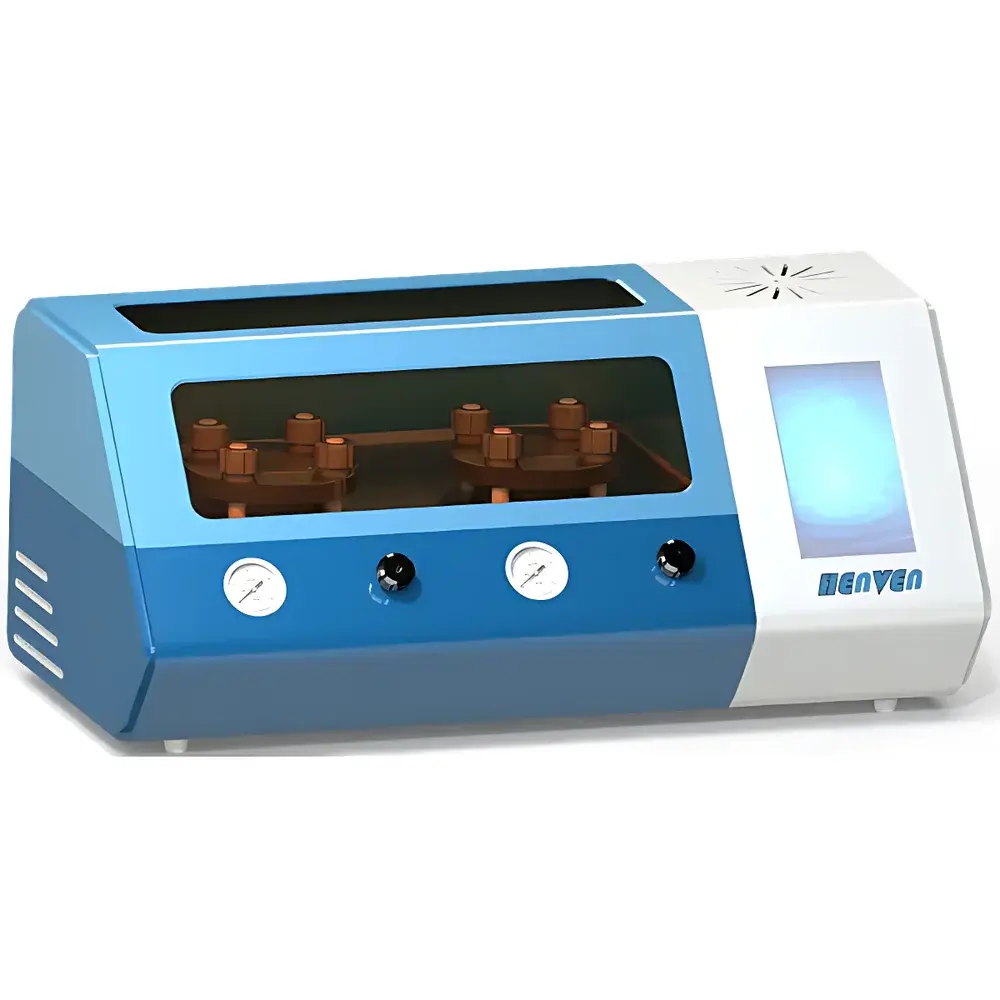
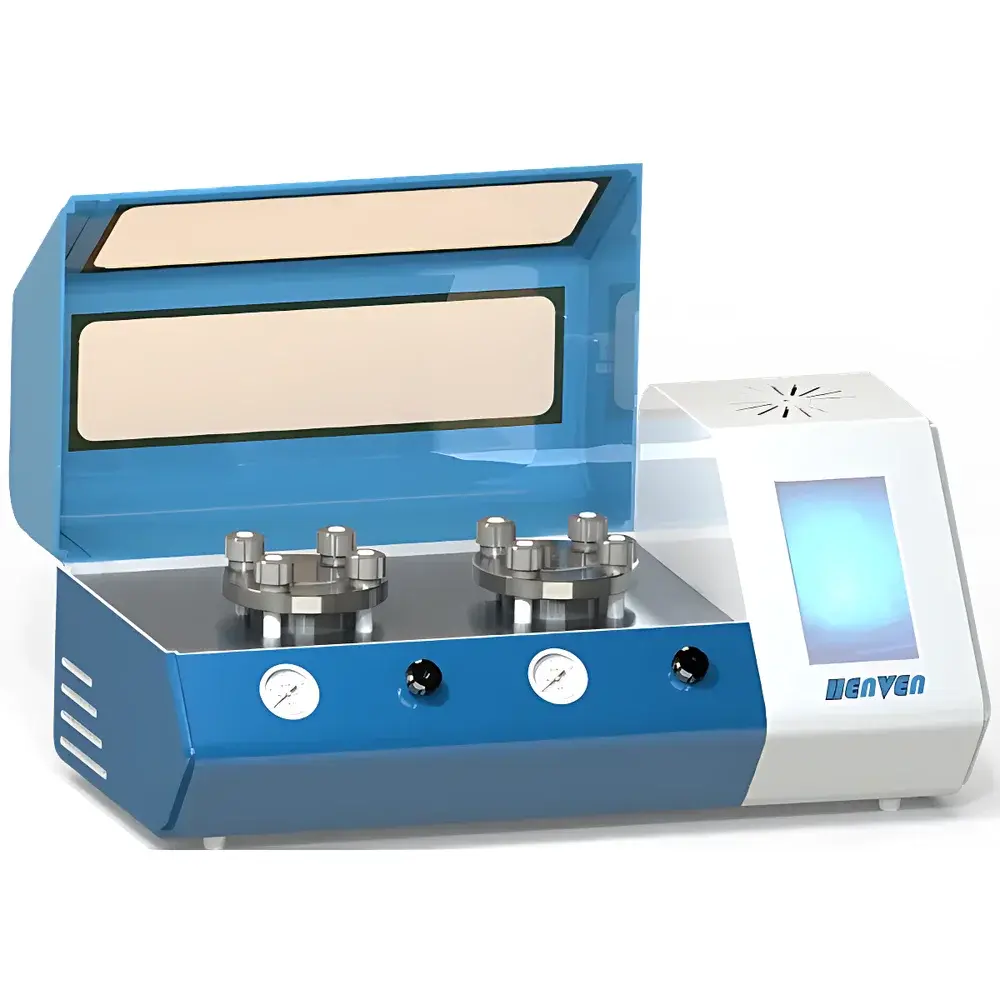
Henven HT-HP DSC High-Temperature High-Pressure Differential Scanning Calorimeter
| Brand | Henven |
|---|---|
| Origin | Beijing, China |
| Manufacturer Type | Direct Manufacturer |
| Instrument Type | DSC |
| Temperature Range | −150 to 1550 °C (with liquid nitrogen cooling) |
| Programmable Temperature Control | Heating, Isothermal Hold |
| Temperature Accuracy | ±0.1 °C |
| Heating/Cooling Rate | 0.1–50 K/min (user-definable) |
| Temperature Precision | ±0.1 °C |
| Temperature Stability | ±0.1 °C |
| Pressure Range | 0.1–10.0 MPa |
| Pressure Accuracy | ±0.002 MPa |
| Pressure Control Mode | Dynamic Pressure Regulation |
| Calorimetric Accuracy | ±1% (vs. certified metal standards) |
| Calibration Method | Multi-point Nonlinear Temperature Calibration |
| Atmosphere Options | Oxidizing, Reducing, Inert, Steam |
| Measurement Modes | Static, Dynamic, Variable Pressure & Gas Flow |
| Sensor Configurability | Interchangeable sensor modules |
| Software | Windows-based bilingual (EN/CN) control & analysis suite |
Overview
The Henven HT-HP DSC is a high-precision differential scanning calorimeter engineered for thermodynamic characterization of materials under rigorously controlled temperature and pressure conditions. It operates on the fundamental principle of heat-flux DSC, measuring the difference in heat flow between a sample and an inert reference as both are subjected to identical, programmable thermal profiles. Unlike conventional DSC systems limited to ambient or moderate pressure, this instrument integrates a hermetically sealed, pressure-rated furnace chamber capable of sustaining up to 10.0 MPa while maintaining thermal stability across an unprecedented range of −150 °C to 1550 °C—enabled by integrated liquid nitrogen cryogenic cooling and radiation-based high-temperature heating. Its dual-regime thermal architecture decouples low-temperature refrigeration from high-temperature resistive/radiative heating, minimizing cross-coupling interference and ensuring uniform temperature distribution across the sample zone during rapid ramping or extended isothermal holds.
Key Features
- Interchangeable sensor modules optimized for specific thermal regimes (cryogenic, mid-range, ultra-high-temperature), each calibrated for signal linearity and noise suppression under corresponding thermal-electric boundary conditions;
- Thermally stabilized furnace assembly featuring directional airflow channels and high-density isothermal blocks to suppress convective turbulence and reduce thermal drift caused by internal air currents;
- Multi-parameter adaptive compensation algorithm that dynamically corrects for baseline drift during variable heating rates, gas flow modulation, and pressure transitions—ensuring consistent sensitivity across operational modes;
- Electrothermal decoupling design mitigating thermoelectric voltage artifacts induced by cryogenic cooling, achieved through strategic sensor material selection and orthogonal alignment of thermal gradient vectors relative to electrical leads;
- Hybrid temperature regulation system combining low-thermal-mass radiant heating elements with multi-resistance cryofluid manifolds, enabling precise, independent control of heating and cooling dynamics without mutual thermal perturbation;
- Gas-flow-optimized sample chamber with laminar-flow inlet geometry and static-position anchoring to eliminate sample displacement under pressurized or reactive atmospheres (e.g., H₂, O₂, steam);
- Dynamic pressure regulation subsystem with real-time feedback loop, supporting both stepwise and ramped pressure profiles synchronized with thermal programs;
- Multi-point nonlinear temperature calibration traceable to NIST-traceable metal standards (In, Sn, Zn, Ag, Au), validated across the full operating range.
Sample Compatibility & Compliance
The HT-HP DSC accommodates solid, powdered, and encapsulated samples (including hermetically sealed crucibles rated for ≥12 MPa). It supports testing in oxidizing (air, O₂), reducing (H₂, CO), inert (Ar, N₂), and humidified (steam-saturated) atmospheres—enabling studies of oxidation kinetics, hydrogen embrittlement, hydrothermal stability, and catalytic decomposition pathways. The system complies with core requirements of ASTM E794 (melting point), ASTM E1269 (heat capacity), ISO 11357 (polymer thermal analysis), and USP for pharmaceutical thermal profiling. Its pressure-rated construction meets ASME BPVC Section VIII Div. 1 mechanical integrity criteria. Full audit trail logging, user-access controls, and electronic signature support align with FDA 21 CFR Part 11 and GLP/GMP documentation standards when configured with validated software modules.
Software & Data Management
The bundled Windows-native software provides synchronized control of temperature, pressure, gas flow rate, and atmosphere composition. Real-time visualization includes dual-axis plots (heat flow vs. time/temperature), derivative thermograms (dH/dT), and pressure-compensated enthalpy integrals. All raw data files are saved in vendor-neutral HDF5 format with embedded metadata (instrument ID, calibration timestamp, operator ID, method version). Batch processing supports automated peak identification, baseline subtraction, and kinetic modeling (Ozawa-Flynn-Wall, Kissinger). Export options include CSV, PDF reports, and direct integration with LIMS via OPC UA or REST API. Software validation packages—including IQ/OQ documentation templates and performance verification protocols—are available upon request for regulated environments.
Applications
- High-temperature phase transition analysis of refractory alloys, ceramics, and nuclear fuel simulants under simulated reactor pressure;
- Thermal stability assessment of energetic materials (propellants, explosives) under controlled oxygen partial pressures;
- Polymorph screening and crystallization kinetics of active pharmaceutical ingredients (APIs) under hydrated or pressurized conditions;
- Decomposition thermodynamics of metal-organic frameworks (MOFs) and battery cathode materials in CO₂ or O₂ atmospheres;
- Reaction enthalpy quantification for catalytic hydrogenation, Fischer–Tropsch synthesis, and steam reforming processes;
- Low-temperature glass transition and cold-crystallization behavior of amorphous polymers using liquid nitrogen cooling;
- Calorimetric validation of thermodynamic databases (e.g., CALPHAD) for multicomponent metallurgical systems.
FAQ
What pressure media are compatible with the HT-HP DSC?
Nitrogen, argon, helium, oxygen, hydrogen, carbon dioxide, and saturated water vapor are supported. Custom gas mixtures require prior validation of seal compatibility and pressure safety interlocks.
Can the system perform simultaneous TGA-DSC measurements?
No—it is a dedicated DSC platform. However, its pressure-tight sample chamber and thermal stability allow seamless integration with external mass spectrometry or FTIR gas analyzers via heated transfer lines.
Is liquid nitrogen consumption monitored automatically?
Yes—the integrated level sensor triggers audible/visual alerts and can pause runs when LN₂ falls below user-defined thresholds; optional auto-refill interface is available.
How is temperature uniformity verified across the 1550 °C range?
Uniformity is characterized using multi-point thermocouple mapping per IEC 60584-2, with ≤±0.3 °C deviation across the 5 mm sample zone at all setpoints above 1000 °C.
Does the software support custom method scripting?
Yes—Python-based method automation is supported via COM interface, enabling conditional branching, external device triggering, and iterative optimization loops.



